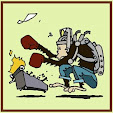
Happy Star Force Day everybody! Look - I'm your Father!
So here's something I made earlier. Nope, it's not a kit, and I just used our own bits and pieces and a photo reference. As far as I can tell there are bits of Batmobile here, some Millennillimum Falcon Microfighter bits and a Lego Friends windscreen and no small number of hours. Probably at least three evenings' worth in front of the TV right there.
So in making my own I saved myself, let's see... Oh. "Retired Product". Heh. Not in this house, George.
Happy Star Warps Day, to every man and child everywhere!
Who doesn't love the magic of Star Warps? I'll tell you who - the hissing, wheezing groan gives him away: it's the Lord of the Shift himself... Dark Vapor!
"Search for your heart - it's the only way to be sure..."
Thanks to Al I recently got to see Batman v Superman: Dawn of Justice. Thanks, Al!
Wow. Complicated movie.
I'll try to be brief, as lots of words have already been expended on this film. It seems that even for a perceived failure, BvS has generated a LOT of discussion, and of course to call an $870M grossing movie a failure is to overlook a lot of first week interest in DC Warner's expanding Justice League franchise. As I say, it's complicated.
The movie itself to me immediately comes across in one word: existential. Even in its dream-fed Bruce Wayne-centric opening the film employs real world referencing, to sometimes uncomfortable levels - a climactic re-enactment from immediate predecessor Man of Steel recalls instead a plane cannoning into a skyscraper. The terrorists are cleaved from real world examples like Boko Haram; no criminal comes unarmed, most carry an automatic weapon, and they don't politely line up to be taken down in turn in hand-to-hnd combat by an outnumbered hero.
Not even in Christopher Nolan's trilogy was the Dark Knight this dark, this brutal, and at times in this very unheroic superhero world you wonder if there's a point to it all.
The answer is yes, and it's not initially from Batman himself, but it is about him and his alter ego. Ben Affleck's Batman is as far from the Caped Crusader as you could have, and yet the Bruce Wayne-to-Batman story here, reiterated once more, is core to the movie. Wayne narrates the film's opening, and the first line of dialogue is (crucially) his mother's name, the very word that will towards the film's end become the lynchpin of Bruce's understanding of his believed enemy, a man he is unable to categorise as anything but an alien until the realisation that they both had a mother, a family, and are capable of calling this planet their home.
Superman meanwhile struggles under his burden, and his doubt and ability
to be led is open to exploitation by madmen and cruel geniuses with
father complexes. Were I a Superman fan (as my good friend Al is), this would upset me the most -
and yet this is a movie where even in death Superman triumphs. He never
loses his imperative, the trailers (which tell many lies about the
movie) do not show that he approaches Batman addressing him by his real name, appealing
for understanding.
To me, Batman v Superman is about the plotting of Bruce Wayne's recovery from his lowest state as an angry, hard-drinking loner with deadly vigilantism as his escape - a monster glowering under the disapproval of a cynical Alfred, to being the hero he once was, needing the help of others to achieve this. The film's message in one line could be: Superman saves Batman's soul, echoed in Bruce's last lines: "I failed him in life; I won't fail him in death", and crucially his resolve that "Men are still good ... we can do better. We will. We have to."
I didn't enjoy this movie. I saw it under a strict timeframe and was itching to leave the theatre before it ended. It was noisy, depressing in places and often without mercy. And yet, given space and time, and on a second viewing even the theatrical version (I've not yet seen the Ultimate Edition) falls more into place. There's a lot of work in this picture from direction and cinematography (Zack Snyder is one of the best visual directors working in superhero cinema today) to score and casting. The criticisms of storytelling and pacing are fair, but the film is sumptuous.
Many of the themes from Man of Steel are continued here, and developed. One of the curious dichotomies of the Superman story is his Semitic origins (an intestellar Moses, the creation of two Jewish boys from New York) with a Christian iconography, and even in death and repose Krypton's last son is depicted with the same visual language of Michelangelo's Pieta among crooked crosses of twisted reinforcing steel. This is specifically Superman as God/god, while the earthly Luthor and Wayne are the John Gaults from a director whose next movie outside of Justice League set may well be The Fountainhead.
Ultimately Batman versus Superman has to be seen as a building block in the DC cinematic world. Contrary to expectations, it's not a Superman movie - although Superman will undoubtedly return, and one of the consequences of BvS' reception will surely point to a revision of this version of the Man of Steel. It has to happen. In the mean-time we have another Batman for our age, also reinvented and repurposed, and like it or not, another step in the road to DC's heroic vision.
I have a guilty secret. I think my favourite season might be
Autumn. This, I suspect, would not go down well chez Simian, as my wife
is an avowed lover of the summer and dislikes winter with a pathological
enthusiasm. Similarly Jet Jr will happily
bask in the sun on our back deck when the weathers good.
Winter's fine by me - I have a July birthday and for me the season
is all about hearty meals, open fires, grey outdoors and indoor
comfort; a modern sentiment based on primal needs. But Autumn - ahh, now
that's different because it's al about the anticipation
of winter, and like spring it's a miraculous season being a
transitional one. Our alleged control over daylight hours slips and the
mornings and evenings draw in, shadows grow long and lean as the sun
sits low on the horizon, and sunlight acquires a watery
aspect, as though filtered through smoky glass. Sure, the washing takes
longer to dry on the clothes line, but this year has enjoyed a
prolonged Indian summer - a period of clement, even quite hot weather
that is long-staying but not quite endless, broken
by hints of cooler days to come. I've given this time of the year
'Sortumn' - sort of summer, sort of Autumn.
The other great thing about this time of the year is the discovery
that like Halloween we've actually got the good deal with regards to
Easter in the Southern Hemisphere. If you ignore the near-certainty of
crap weather over the long weekend and of course
the northern Spring associations of new chicks and rabbit eggs and what
have you, there's really no better time of the year to enjoy a good
buttery spicy hot crossed bun than Autumn.
Autumn gets a bad rap. It's a season of promise for the prepared,
the self-sufficient, a tap on the shoulder for DIY and outdoor house
maintenance. In the weeks to come the lead mountain within the
Monkeyhouse will be eyed up for winter modelling and
painting, and a new indoor ascent will be planned up its precipitous
slopes. Outside the town belt is turning a golden amber, and branches
are fingering their way into the fading light. Sure, there's a bit of
work to tame the garden and patch up some weatherboards
before winter arrives - but who wants to think that far ahead? Autumn's
here to be enjoyed!
For a number of years I carried the memory of a show I watched as a
young Simian after school. One was about three boys who went bush in
the English countryside and had a distinctive piping theme tune. The
other was a words and pictures tale of some little folk who went
looking for one of their number called Cloudberry. Both eluded me
for ages until I recently did the sensible thing and turned to Google. As
it turned out, both series - respectively Brendan Chase and Baldmoney, Sneezewort, Dodder and Cloudberry were connected through their author/illustrator Denys Watkins-Pitchford, who wrote under the nom de plume 'B.B' (after the air rifle pellet and not an abbreviation of Bilbo Baggins.) No wonder I'd had difficult searching them out.
B.B. seems to have belonged to a specific generation of British writers
who, affected by the changing landscape of post Industrial Revolution
England turned their concern for the disappearing landscape into
children's writing. If it's possible to draw a line from Tolkien to
Richard Adams then that same line must pass through BB, whose stories
are imbued with woodlands nostalgia.
In The Little Grey Men (1942) and its sequel Down the Bright Stream (1948) B.B. uses his
gnome protagonists as vessels of concern as in both stories they
traverse the waterways and woodlands of a changing countryside in search
of their brother and, later, a new home (the second tale has some
kinship with Adams' Watership Down) these gnomes - Dodder, Baldmoney, Sneezewort and Cloudberry are the last of their kind, dwellers in a world
of talking animals and where man is at best a blundering fool, at worst a
monster. It's written well in a naive style akin to Tolkien's Hobbit,
but with some of the attendant sexism and xenophobia of the age.
Nevertheless, for the most part the gnomes are well characterised, with Dodder in particular developing between the books in an arc worthy of a
Baggins.
I found the books affecting - not quite as epic in scope or dour as Watership Down, but very charming and highly readable.
Watkins-Pitchford effectively captures a world in macrocosm, with a
population and sense of community, but devoid of politics or human
concerns. Don't be fooled though - there's a darkness in these books
including treachery, cruelty and murder. Cast members die in natural and
unnatural ways, and though the face of God isn't present in B.B.'s
woodland, the great god Pan is, in a striking and surreal chapter which precipitates
some remarkable character turns among the gnomes. Similarly in Bright Stream
the growing sinister truth about one of their number leads to a genuinely tense
chapter of skullduggery and truly natural justice. All the while Watkins-Pitchford's distinctive writing elegises the loss of the gnomes world, a
quiet voice in the wilderness. And his illustrations are gorgeous.
The takeaway for me, as mentioned in my earlier post, is in the nature of the gnomes themselves. Here B.B imbues them as spokemen of a vanishing natural world, dodging beasts and men, habitat destruction, and even after the fires and noises of the Blitz are heard but not entirely fathomed by them on their last great journey, ultimately abandoning England for a home of older myth and safer refuge. There's much in keeping with the Seventies version of Huygen's text - and in fact, given that B.B's works concern themselves chiefly with the last gnomes of England, they needn't be mutually exclusive. I believe there's a place for this version of the Gnome in a modern RPG - and in fact, there already is, in the independent RPG Tales from the Wood, and it's in my next post that I'll turn to this.
In the mean-time, I made some notes based on the gnomes and their world for anyone interested below:
Hey - look! I found another vehicle to complement this one!
A recent school fair (pro tip: always go to the posh school fairs. Their toy areas have LEGO!) I picked up this poor beauty. Who is she - this poor creature who once saw better days in a blister box with a company of silver plastic future cop guys ? Yes, this is the K-2002 Flight Hunter from Matchbox's Adventure 2000 die cast set. I never had this one. My friend Derek did, but even in this state I wasn't going to let him be the only person I know who owned one.
Oof, but whoever her previous owner was, it was not a little old lady who only took her to church on Sundays (as much as I'd like to see that.) Here's what it should look like: All gull-wing doors, laser turret and snap-out red wings - y'know, for flight!
Well, the doors open here, but they don't close flush. There's chrome effect off the shiny bits, but that's to be expected. And there are no- repeat NO wings. Not one. They've been pulled out of this thing. I don't even know where the button goes that makes them emerge. Hang on - no, it's the hole behind the cockpit. That makes sense.
Still, she's intact, and the windscreen glass is in great nick. Most of what's there is still there - it just looks lived in. Turning it over though - yikes, those axles! What was her payload?!
Oh, you poor baby. Why did I pick you up? Because I wanted to rescue you! And maybe... just maybe I think I can fix you. So onto the project pile you go!
Recently I've been thinking about Gnomes. I confess, I've been feeling a little guilty about them.
For a number of years I've thought on and off about the place of these little guys in the various editions of Dungeons and Dragons, and why in its Basic form they never distiguished themselves enough to be Player Characters. Sure, they're there among the Monsters in Mentzer's red box, and in the Moldvay Expert Set a floorplan of a Gnome lair appears, but by and large I suspect that early players just treated them as I and my friends did when we played - easy Experience Points. Kill them all!!! After I stopped playing of course the Companion module Earthshaker! came out, and then the supplement Top Ballista!, but these were, to my mind, mid-edition AD&D Gnomes retro-fitted in.
In D&D's Basic rules, Gnomes are NPC characters at best. They have an entry among the other 'Monsters' in the red box DM's Guide - and that's pretty much it. Cross over to the various versions of AD&D however, and it's a different story. For whatever reason the Gnome was abandoned in the Moldvaying and Mentzerising of the core game (fellow casualty races of course include the Half-Orc and Half-Elf), the race gets something of an on-going revision within the various iterations of the 'Advanced' game. First edition casts them as Halfling-sized Dwarf variants with similar attributes and an enmity with Kobolds (this is the version translated over to Moldvay/Mentzer); and as the game gets older the Gnome derives its own variants - Rock, Deep, Forest, and so forth. Originally given the option of an Illusionist specialty, Gnomes are later cast as Bards (another unloved and un-developed character class) and by 4th and 5th edition Gnomes really come into their own as tinkerers and tricksters - crazy inventors with a love of mischief.
I can't say I'm mad about the idea of Gnomes being cast so much along personality, particularly a personality almost purpose-built to irritate the hell out of fellow players or unbalance your campaign world with quasi high-tech. Indeed, I've heard of some groups who mutually have decided to just not include Gnomes for that reason.
Back in Basic-land I guess for purists the temptation in bringing the Gnome in as a Player Character is to adopt the D&D version - but even that has its critics. The popular argument goes: why use a Gnome when you could use a Dwarf? They generally live in the same areas, have similar cultures and a weakness of underground treasures. Or why not just use a Halfling, if you're after a diminutive Thief? There is of course the Illusionist class type to be imported - but a combination of magic and fighting ability in Basic is the domain of Elves; and a potentially weak fighter with a less-offensive array of spells may not have much going for it for players. So what then?
I believe the problem with the shifting niche of Gnomes is that they apparently lack a clear literary or mythological archetype. Gnomes in culture go only as far back as Paracelsus and the 16th century, and have no mythological or folklore precedent, which may be why they are often switched for Dwarfs (or dwarfs) in stories. The original Gnome is a theoretical earth elemental, but with more description becomes... a Dwarf with the registration number filed off. But what about in literature?
Ask anyone who lived through the Seventies about books with Gnomes in them and they may well recall Will Huygen's Gnomes(1974), the twentieth-century imprimatur that put the Gnome - pointed hat, jolly face, fulsome beard, well and truly in the public consciousness. If your common or garden Gnome wasn't already, well, a garden gnome, then this book would do little to change that.
But there is another literary precedent to the Gnome, and one that pre-dates Huygen's field guide by nearly three decades. 'B.B.''s The Little Grey Men and its sequel Down the Bright Stream* posits the adventures of the last four Gnomes in Britain, and places the race firmly in the woods as one of Pan's people (don't laugh). For all of that, however, 'B.B.' and Huygen seem to have seized on the Gnome in a smiliar fashion - they are guardians of the earth, forest-dwellers, and immensely practical, without recourse to tinkering with large-scale machinery (there are exceptions, but they are clearly not the rule).
The up-shot of this is that I think I've found a decent niche for the Gnome in a Basic D&D setting, and one which is rigid enough to avoid the overlap with the game's two other dimunitive PC races. Having read both Huygen's book and B.B.'s two novels, I considered the woodland guardian element of these texts and thought that with a brace of Druid spells one could effectively accommodate the race without too much hard work. That did do for my other idea of swapping Magic User spell sets for Elves with Druid spells, though. And in the end, I didn't want to do that. So my Gnomes are not especially magical - just like the literary ones, but they retain their woodland expertise, loyalties and preternatural identity. Rather than making them Druids I seem to be casting the Gnome as a Race-As-Class Ranger. And I think I'm pretty happy with that!
[Insert obligatory video. NO, no that one**]
[* Blogger's note: 'B.B' was the nom de plume of D. J
Watkins-Pitchford, who also provided the wonderful illustrations -
painting, etchings and line art, in both volumes. The name was
apparently taken from the ball-bearing gun pellet and wasn't, as my
thirteen-year-old self assumed, a cash-in on the name Bilbo Baggins]
[**
This song's nomination is more apposite than you may think, as Syd
Barrett was a huge fan of the books and the writer, a quote from the
first book was read at Barrett's funeral]