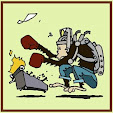
Winter has arrived, and with it 2015 is halfway through. Funny old year. Some triumphs, some upsets; by early next week I may well be on the hunt for a new job, my present one quickly running out, but with this turn of fortunes perhaps an opportunity for some reinvention. A change would be nice.
Outside the workplace there's been some quiet shifting of priorities for me: I'm gradually coming around to the quite-settled realisation that I'm robably no longer a fan of Doctor Who. The old series has been in my life for over thirty years,and it's the old series I still love, but the new stuff? Ehhh. Really like Capaldi, Jenna Coleman's good, too. But the rest just doesn't grab me, and that's okay.
Besides, there's still heaps of stuff to get excited about: two of my favourite bands have put out albums this year, and two more are expected to before the year's over. Four albums is nearly three more than I usually buy in twelve months! TV's been pretty decent, and there are some witty, fun, informative and just really interesting podcasts out there forthe listening. Before I got into a regular cycle of CV updating and cover letter writing I was working on a Mirkwood-themed model (yeah - remember those guys?) and I'm thinking of returning to study. Haven't done that for a few years, but I do remember I got a lot better at it the older I got.
So perhaps the second half of the year will be a busy one, and hopefully a productive one. I'll keep the blog up, anyway.
Showing posts with label Bit of a Blur. Show all posts
Showing posts with label Bit of a Blur. Show all posts
Wednesday, June 3, 2015

Friday, April 24, 2015
Blurred Lines
Today my chum Tim and I are going to brave Wellington's Very Big ANZAC Parade and venture out to one of Wellington's last remaining inner-city music shops to buy The Magic Whip, Blur's surprising new album (as in: "surprise! A new album!") I've juggled the idea for a few years as to how to approach Blur's discography, and as I've not long finished Manic Street Preachers', and the memory of the marathon that was Iron Maiden's discography is still fresh. Blur's set of seven studio albums to date is by comparison much more manageable, but for some reason I find the idea of sallying forth and covering another band - this band in particular, just a bit too hard. I've been a Blur fan for twenty years now (bloody hell. Seriously - Bloody Hell!), have read countless magazine articles, a Britpop biography and the bassist's autobiography, watched a few docos and their own very very good film story - and still I feel like I don't know them very well.
So the following is a potted mixed-up history of me and Blur via the means of a countdown of their albums according to me. If you've read this far, thangyewverymuch and enjoy:
 The Great Escape (1995) Post-Parklife and the beginning of the comedown troika that reinvents the band and almost destroys it. Damon Albarn reduces his beloved Britain to shallow caricatures with caustic songs like 'Entertain Me', 'Stereotypes' and 'Mr Robinson's Quango'. There's so much more like that, but best to dwell on the successes: 'The Universal' and 'Yuko and Hiro' save this, really. Otherwise it's a spiteful, joyless stomping on Nineties Britain with no alternative offered. And then Oasis won the Britpop war to nobody's surprise.
 Leisure (1991) The debut album, unsurprisingly pulling in a lot of directions, many of them baggy and not a little saggy. Very few bands indeed arrive fully-formed, and while this is fun, this is also Blur the followers and not the leaders.
The singles 'There's No Other Way' and 'She's So High' are harmless and non-threatening in such a way that it's interesting to note how much an impression non-single track 'Sing' made, earning it a key place in the Trainspotting album years later.
Leisure (1991) The debut album, unsurprisingly pulling in a lot of directions, many of them baggy and not a little saggy. Very few bands indeed arrive fully-formed, and while this is fun, this is also Blur the followers and not the leaders.
The singles 'There's No Other Way' and 'She's So High' are harmless and non-threatening in such a way that it's interesting to note how much an impression non-single track 'Sing' made, earning it a key place in the Trainspotting album years later.
 Think Tank – complicated and sad. If 13 is the break up album over Justine Frischmann, then Think Tank details the entropic effects of Graham Coxon's departure. There are some really good songs on this: 'Out of Time', 'Sad Song', 'Gene by Gene' and the sorrowful 'Battery in Your Leg', but Think Tank, being one foot in Albarn's politics and World Music dabblings, and one foot in Blur's heritage (including - inevitably- Gorillaz) is a discomforting body of work, and perhaps all the more interesting for it.
 Blur (1997) - the rescue attempt. If I'm honest, I find Think Tank gets more of an outing on my stereo, but this nudges it because there’s more Coxon here. Also, 'Beetlebum', one of their best songs (particularly the instrumental coda) 'On Your Own', and 'Song 2' - the little song that broke the US when the band had long-ceased trying.

13 (1999) – The millennium approaches, the band is hardly speaking, things fall apart, and William Orbit is around (with Stephen Street again) to literally pick up the pieces aided and abetted by ProTools. The result is never boring - from a spiritual 'Tender' opening, to some fuzzy, wiggish Bowie mugging ('Bugman') then to the some very trippy head music ('Battle', 'Caramel') the should-have-been-a-single culminating in a weary, weepy 'No Distance left to Run'. I love the flavours of 13, but it's not the sound of a band at its peak or in the midst of joy.
 Modern Life is Rubbish (1993) – near-perfect,with the band firing on all cylinders distilling Kinks, Who, Small Faces and coming up with the true beginnings of their most recognisable sound, and kicking off their 'Life' trilogy. There's some great experimentation here: 'Oily Water' almost matches the live version from the Hyde Park reunion.
although the oom-pah shouting in 'Sunday Sunday' gets a bit much, and possibly the album is one song too long.
That said, it's indispensible.
Modern Life is Rubbish (1993) – near-perfect,with the band firing on all cylinders distilling Kinks, Who, Small Faces and coming up with the true beginnings of their most recognisable sound, and kicking off their 'Life' trilogy. There's some great experimentation here: 'Oily Water' almost matches the live version from the Hyde Park reunion.
although the oom-pah shouting in 'Sunday Sunday' gets a bit much, and possibly the album is one song too long.
That said, it's indispensible.
 Parklife
(1994) – Where pretty much everything falls into place. The battle of Britpop doesn’t exist, and the zeitgeist is wholly grappled and pinned down. From the bouncing, bassy sun-drenched onlooking of 'Girls and Boys' to the wonderful shipping forecast lyrical closer, it’s an album that can be listened to end to end, and is still the band’s grandest sweep of British life in the mid-Nineties. For me it was a slow grower, and the first and still the most significant album of theirs I bought. The Clash may have formed my in-head soundtrack to a 2000 landing in London, but it was 'This is a Low' which fed the return home, and a flight over the northern coastlines of the British Isles.
Parklife
(1994) – Where pretty much everything falls into place. The battle of Britpop doesn’t exist, and the zeitgeist is wholly grappled and pinned down. From the bouncing, bassy sun-drenched onlooking of 'Girls and Boys' to the wonderful shipping forecast lyrical closer, it’s an album that can be listened to end to end, and is still the band’s grandest sweep of British life in the mid-Nineties. For me it was a slow grower, and the first and still the most significant album of theirs I bought. The Clash may have formed my in-head soundtrack to a 2000 landing in London, but it was 'This is a Low' which fed the return home, and a flight over the northern coastlines of the British Isles.
And so to The Magic Whip? We'll see...
So the following is a potted mixed-up history of me and Blur via the means of a countdown of their albums according to me. If you've read this far, thangyewverymuch and enjoy:
The Great Escape (1995) Post-Parklife and the beginning of the comedown troika that reinvents the band and almost destroys it. Damon Albarn reduces his beloved Britain to shallow caricatures with caustic songs like 'Entertain Me', 'Stereotypes' and 'Mr Robinson's Quango'. There's so much more like that, but best to dwell on the successes: 'The Universal' and 'Yuko and Hiro' save this, really. Otherwise it's a spiteful, joyless stomping on Nineties Britain with no alternative offered. And then Oasis won the Britpop war to nobody's surprise. Leisure (1991) The debut album, unsurprisingly pulling in a lot of directions, many of them baggy and not a little saggy. Very few bands indeed arrive fully-formed, and while this is fun, this is also Blur the followers and not the leaders.
The singles 'There's No Other Way' and 'She's So High' are harmless and non-threatening in such a way that it's interesting to note how much an impression non-single track 'Sing' made, earning it a key place in the Trainspotting album years later. Think Tank – complicated and sad. If 13 is the break up album over Justine Frischmann, then Think Tank details the entropic effects of Graham Coxon's departure. There are some really good songs on this: 'Out of Time', 'Sad Song', 'Gene by Gene' and the sorrowful 'Battery in Your Leg', but Think Tank, being one foot in Albarn's politics and World Music dabblings, and one foot in Blur's heritage (including - inevitably- Gorillaz) is a discomforting body of work, and perhaps all the more interesting for it.
Blur (1997) - the rescue attempt. If I'm honest, I find Think Tank gets more of an outing on my stereo, but this nudges it because there’s more Coxon here. Also, 'Beetlebum', one of their best songs (particularly the instrumental coda) 'On Your Own', and 'Song 2' - the little song that broke the US when the band had long-ceased trying.
13 (1999) – The millennium approaches, the band is hardly speaking, things fall apart, and William Orbit is around (with Stephen Street again) to literally pick up the pieces aided and abetted by ProTools. The result is never boring - from a spiritual 'Tender' opening, to some fuzzy, wiggish Bowie mugging ('Bugman') then to the some very trippy head music ('Battle', 'Caramel') the should-have-been-a-single culminating in a weary, weepy 'No Distance left to Run'. I love the flavours of 13, but it's not the sound of a band at its peak or in the midst of joy.
Modern Life is Rubbish (1993) – near-perfect,with the band firing on all cylinders distilling Kinks, Who, Small Faces and coming up with the true beginnings of their most recognisable sound, and kicking off their 'Life' trilogy. There's some great experimentation here: 'Oily Water' almost matches the live version from the Hyde Park reunion.
although the oom-pah shouting in 'Sunday Sunday' gets a bit much, and possibly the album is one song too long.
That said, it's indispensible. Parklife
(1994) – Where pretty much everything falls into place. The battle of Britpop doesn’t exist, and the zeitgeist is wholly grappled and pinned down. From the bouncing, bassy sun-drenched onlooking of 'Girls and Boys' to the wonderful shipping forecast lyrical closer, it’s an album that can be listened to end to end, and is still the band’s grandest sweep of British life in the mid-Nineties. For me it was a slow grower, and the first and still the most significant album of theirs I bought. The Clash may have formed my in-head soundtrack to a 2000 landing in London, but it was 'This is a Low' which fed the return home, and a flight over the northern coastlines of the British Isles. And so to The Magic Whip? We'll see...
Friday, February 20, 2015
Whip It Good!
So, Blur are putting out a new album? Blur are touring? Blur are back together again?
I can’t keep up. Earlier this morning I was reading
about Bruce Dickinson’s rather alarming cancer scare (and a speedy
recovery to you, sir!), but this is a bit of a curve ball. However, it’s
all true – Blur’s eighth studio album The Magic
Whip comes out in April, and I’m getting rather stupidly excited at the
news.

It’s the first full album from the band in twelve years (their
last being Think Tank), and the first full album from the band in full
including guitarist Graham Coxon in sixteen
years (his last with Blur being 13.) I’ve been a big fan over the
years, and have followed them post-band really as far as Gorillaz… I
have one of Coxon’s albums, which has been played a little… but I
appreciate the band the most as one unit, really. The important
thing is that Blur now are something of a re-set, no longer the US-shy
Britpop combo but older, more world-weary, well-seasoned travellers with
a few more musical influences up their sleeve. The last album came out
after Damon Albarn’s Mali Music collaborations,
and The Magic Whip was recorded on tour in Hong Kong: I wonder what
that will bring?
So now I/we wait. The first single ‘Go Out’ is
already streaming on the Web. It’s definitely Blur – there are Albarn’s
sleepwalker vocals over the top of Coxon’s Fripp-ish stabs, with James
and Rowntree providing the chugging rhythm at
the back of the room; I’m pretty happy. It’s a bit skewed, but has a
nice lop-sided refrain that stayed with me over this afternoon, similar
to how my ears and brain first received the equally weird but
ultimately-loved 'Beetlebum' eighteen years ago (yes, really).
The album’s been described by Damon Albarn as reminiscent of Bowie’s
Berlin set… I’m suspicious about that. Albarn and Coxon have shown in
the past they’re not averse to mining Bowie’s back catalogue for ideas –
some very obviously ('M.O.R'/'Boys Keep Swinging',
'Bugman'/'Suffragette City' – I could add Elastica’s 'Line Up'/'It’s No Game',
but least said about Albarn’s ex and her influences the better); I’ve
heard this sort of comparison before, and the result is usually bad
pastiche or something quite off the mark. We’ll
see.
Mind you, the last album I bought that summoned the ghost of Hansa Studios was… well lookee – Manic Street Preachers’ Futurology! Now there’s a hint if ever I had one.
Mind you, the last album I bought that summoned the ghost of Hansa Studios was… well lookee – Manic Street Preachers’ Futurology! Now there’s a hint if ever I had one.
Tuesday, November 11, 2014
Intoning Verisimilitude to the Autocratic Hierarchy
No, I don't know what the point of Russell Brand is, a clever and charismatic man with a (largely) strong message and a (personally) irritating public image; but I do know a couple of things: firstly, that in order to truly make its mark speaking truth to power demands the register of the everyday citizen, and secondly, this is still very funny.
Wednesday, January 22, 2014
On a Stroppy Little Island of Mixed-up People
 Today marks the 7th anniversary of the release of The Good, the Bad & The Queen, the album product of the formally-unnamed, collaboration between Damon Albarn, Paul Simonon, Simon Tong and Tony Allen. It remains a pretty much loved album in my small, Daddish collection.
Appropriately for a winter release, GBQ (as I shall abbreviate it henceforth) doesn’t get a lot of playtime in sunnier months, but yesterday was a very soggy day for summer, and it seemed to fit. In fact, my earliest memory after buying this was listening to it on the car stereo during a drive home, stuck in traffic with what looked like half of Wellington’s annual rainfall hammering down around me. GBQ is a rain-lashed album, with imagery of dark, thunderous clouds and an impending deluge – a post-millennial throwback to the rising oceans of Simonon’s famous former act’s London Calling. There’s London on the album, too, of course – throughout the album, in fact. This is Damon Albarn in his late solo phase cast as a fretful sleeper anchored in England’s sinking and drinking capital, singing songs about global warming, the Iraq invasion and the spiritual gloom of his homeland. It’s not all storm clouds, but the Apocalypse can’t be far away: bunting hangs awaiting the return of soldiers posted abroad, ambulance sirens chorus in the distance, a whale is stranded up the Thames, and the ravens of the Tower take flight. GBQ shares its producer Danger Mouse with Gorillaz’ equally doomsday Demon Days, but the result here is less global, more local. This is an album which flirts as much with other works as it does with English ritual and lore – there are echoes of Dirty Old Town in the lyrics, late in the play Simonsn’s bass threatens to deliver an updated version of Guns of Brixton (something the bassist reportedly did accidentally during a live performance), and comparisons and contrasts are inevitable with the Village Green Preservation Society sound of peak era Blur. Yet the arch, playful Parklife this is not, but it’s as perfect a counterpart to Blur’s London album as its follow-up, the fraught and boorish The Great Escape wasn’t.
Thursday, August 4, 2011
The Doctor is in
Among a few entertaining coincidences in my reading and listening of late is the appearance of a figure from English history whom I intend to read a little more about, er, at some point soon.
 Dr John Dee was royal astrologer to Elizabeth I, and her sister Mary before his skill and persuasion found better favour with the Virgin Queen. Dee seems to have been cut from similar cloth to the genii of his era and the later Renaissance; he was a scholar, cartographer, Hermeticist, military strategist, an astronomer and a mathematician. By forecasting the potential death of Mary he courted his own demise, yet in setting an auspicious date for Elizabeth’s coronation almost certainly retained his station as one of her most trusted advisors. His feats were humanist, yet remarkable – he owned the largest library in England and conceived the idea of a national library in the interest of the preservation of knowledge (Mary wasn’t keen), and for Elizabeth he presented the notion (and thus coined the epithet) of a British Empire. By predicting the approaching tempests off the Dover coast he encouraged his Queen to spare her navy the perilous and precipitous defence against the approaching Spanish Armada, and instead they watched nature perform the task from the safety of land. Alongside the Queen’s ‘spymaster’ Sir Francis Walshingham he pioneered the use of espionage and was literally through his own codename the original “007.”
As befalls one who straddles history and mysticism, Dee finds his way into the canon of Iron Maiden songs, with The Alchemist from The Final Frontier:
Dee’s pursuit of mysticism and the occult is presumably what endears him to Maiden, and has helped to ensure the longevity of his name today. He has been described variously as the inspiration for Marlowe’s Doctor Faustus and Shakespeare’s Prospero; Alan Moore surely also had him in mind in his conception of the latter character for the closing of The League of Extraordinary Gentlemen: The Black Dossier, yet it’s curious too that this somewhat late pursuit of his life turns him into an utterly human figure as well. Taking up with mystic John Kelly, an aging Dee and his young wife travelled Europe with Kelly in their pursuit of the supernatural. Communing with angels, Kelly claimed that he had instructions from the diving agents to share a bed with Dee’s wife; Dee reluctantly submitted, and returned to England alone, never seeing Kelly again.
This year’s Manchester Festival of the Arts saw the debut of Damon Albarn’s Dr Dee: An English Opera, from which the following song Apple Carts is taken. Albarn originally was to have worked on the opera with Alan Moore, but the would-be modern polymath and postmodern magician parted company early on, the cause apparently being frustration on Moore’s part rather than the intervention of alleged angels. I love the song; it’s so much that Maiden’s galloping biography simultaneously isn’t, humanist and spiritual, it suggests a twofold narrative, of Dee ordering a new Empire built on the mystical landmarks of England’s past (Silbury Hill), and later returning to “the kingdom of the broken heart”, much beaten and seeking solace beneath its stones, the same man who returned from Europe to a ravaged and looted library and ended his days in poverty, the new monarch James I being the antithesis of his aunt in a morbid distrust of the supernatural.
It’s Dee’s fate to have become one of popular literature’s playthings, portrayed as a spy, a wizard, a necromantic villain or a mystical guru. This side of the story interests me less than his falling in and out with Kelly, of whom the jury is itself still undecided – was it carnal interests that led him to turn Dee into a cuckold, or was his growing fame as an alchemist leading him to some drastic action to divorce himself of a man on the wane? It might depend on what book I eventually read…
 Dr John Dee was royal astrologer to Elizabeth I, and her sister Mary before his skill and persuasion found better favour with the Virgin Queen. Dee seems to have been cut from similar cloth to the genii of his era and the later Renaissance; he was a scholar, cartographer, Hermeticist, military strategist, an astronomer and a mathematician. By forecasting the potential death of Mary he courted his own demise, yet in setting an auspicious date for Elizabeth’s coronation almost certainly retained his station as one of her most trusted advisors. His feats were humanist, yet remarkable – he owned the largest library in England and conceived the idea of a national library in the interest of the preservation of knowledge (Mary wasn’t keen), and for Elizabeth he presented the notion (and thus coined the epithet) of a British Empire. By predicting the approaching tempests off the Dover coast he encouraged his Queen to spare her navy the perilous and precipitous defence against the approaching Spanish Armada, and instead they watched nature perform the task from the safety of land. Alongside the Queen’s ‘spymaster’ Sir Francis Walshingham he pioneered the use of espionage and was literally through his own codename the original “007.”
As befalls one who straddles history and mysticism, Dee finds his way into the canon of Iron Maiden songs, with The Alchemist from The Final Frontier:
Dee’s pursuit of mysticism and the occult is presumably what endears him to Maiden, and has helped to ensure the longevity of his name today. He has been described variously as the inspiration for Marlowe’s Doctor Faustus and Shakespeare’s Prospero; Alan Moore surely also had him in mind in his conception of the latter character for the closing of The League of Extraordinary Gentlemen: The Black Dossier, yet it’s curious too that this somewhat late pursuit of his life turns him into an utterly human figure as well. Taking up with mystic John Kelly, an aging Dee and his young wife travelled Europe with Kelly in their pursuit of the supernatural. Communing with angels, Kelly claimed that he had instructions from the diving agents to share a bed with Dee’s wife; Dee reluctantly submitted, and returned to England alone, never seeing Kelly again.
This year’s Manchester Festival of the Arts saw the debut of Damon Albarn’s Dr Dee: An English Opera, from which the following song Apple Carts is taken. Albarn originally was to have worked on the opera with Alan Moore, but the would-be modern polymath and postmodern magician parted company early on, the cause apparently being frustration on Moore’s part rather than the intervention of alleged angels. I love the song; it’s so much that Maiden’s galloping biography simultaneously isn’t, humanist and spiritual, it suggests a twofold narrative, of Dee ordering a new Empire built on the mystical landmarks of England’s past (Silbury Hill), and later returning to “the kingdom of the broken heart”, much beaten and seeking solace beneath its stones, the same man who returned from Europe to a ravaged and looted library and ended his days in poverty, the new monarch James I being the antithesis of his aunt in a morbid distrust of the supernatural.
It’s Dee’s fate to have become one of popular literature’s playthings, portrayed as a spy, a wizard, a necromantic villain or a mystical guru. This side of the story interests me less than his falling in and out with Kelly, of whom the jury is itself still undecided – was it carnal interests that led him to turn Dee into a cuckold, or was his growing fame as an alchemist leading him to some drastic action to divorce himself of a man on the wane? It might depend on what book I eventually read…
Subscribe to:
Posts (Atom)