If you were a passing linguist and wanted snapshot of the mood of the Western world as the year turns fitfully over in its sleep, then the annual Word of the Year from various publications and institutions can be somewhat useful. Recent years certainly tell a particular story, which you'll pardon me for cherry picking as I lead my horse to the crux of the matter. 2023 was a particularly fruitful year, providing us with 'AI' (Collins English Dictionary), 'generative AI' (Macquarie Dictionary), 'ChatGPT' (The Economist), 'hallucination' (Cambridge English Dictionary) and the prosaic 'enshittification' (American Dialect Society). A year later that last word returned for a victory lap (alongside brat, rawdog, brain rot and manifest), while for 2025? 'slop' (Merriam-Webster and The Economist), 'AI slop' (Macquarie) and 'rage bait' (Oxford).
You get the idea.
AI is not everyone's amber-hued, six-fingered cup of tea, but it's here to stay, probably, and may one day prove its cost in a positive way for all humanity. At least for all the... enshittification of the visual and musical arts, we can be grateful that a good use of upscaling brings us a lovely restoration of Bjork dismantling a Sony Trinitron TV. You can stop it at the 3:34 mark if you like, but stay up 'til then at least for a Christmas-adjacent exploration of miniature transistor cities, even smaller screens, all sorts of 'situations' and Danish TV manuals. It's charming and brilliant, and reminds me of why my friends and I fell in love with the singer from the Sugarcubes over 35 years ago:
I might return to Bjork some other time, but in the meanwhile, let's give her the floor a little longer with the tale of the Icelandic Yule Cat, all the way back in the year of my friends' and my first contact:
Jólaköttur the Yule Cat is a giant beastie who eats those who do not receive new clothes for Christmas - so for their sake, be generous to those in need this winter. There are some things that AI slop really won't fix, and this is one.
So merry Yuletide, one and all. Dress warm if you can (unless it's midsummer, obv), stay safe, and don't listen to poets.
It's All Hallow's Eve, 2025, and time for more members of the local Lantern Corps to give us a grin!
This year's models have no real Jet Jr input - a fact he discovered late into play we he entered the kitchen as I was finishing off the second pumpkin asking which one was 'his'. "Neither" I replied. "Ohh - so is it this one?" he indicated the old school looking one. "No, that's your cousin's" And indeed it is, my first commissioned lantern, based it turns out on Eerie from a few years back, but with some slight modification (he's had his eyes done) Given the choice of grim or ginning, sawtooth or peggy tooth, Jr's cousin went for the more traditional, and so here is un-named Birthday Pumpkin for tomorrow night's party:
Of course, I did have to do one for myself, and so Gulper here is the result, going for cartoonish and a little bit Jamie Hewlett, a little bit Mike Mignola. Also pretty okay.
Not much more to note as I'm really getting the hang of doing these things quickly and safely (but boy do we have a lot of pumpkin pulp to use now). I did this watching Larry Blamire's very silly Dark and Stormy Night, and then listening to bit of Paul McGann reading the novelisation of the Doctor Who TV Movie which, fact fans, had its encore showing on Halloween night 1996 here in NZ. That's nearly thirty years ago now - blimey!
Welcome back to my nightmare. On the second night of October Mrs Simian and I ventured into the murky depths of some of our free Aussie streamers available through our public library. Beamafilm and Kanopy can be accessed for a limited number of views per month as 'tickets', and offer an interesting range of documentaries, TV series, movies and short form progamming. As you'd expect, there's a heavy Australian bias (as there is in another free channel, Brollie), but that inevitably also means some NZ content gets thrown in, because... our sunburned cousins do me like that.
So tonight's viewing was a documentary, The Darkside. Gorillamydreams is a bigly fan of supernatural reality slop like Finding Bigfoot (they haven't), Expedition X (not ex-enough, frankly), and Scared Stupid. I may have made one of those up. The Darkside is a bit less tongue in cheek, and purports to retell real-life eerie stories with the help of Australian actors (Deborah Mailman, Claudia Karvan, Bryan Brown, Jack Charles, among others) usually straight to camera with some landscapiness thrown in, and sometimes with their own craft helping to interpret things.
The Darkside (Warwick Thornton, 2013)
The tales in The Darkside are very much Australian stories, with a strong sense of location and history, and told largely from a First Nations perspective, as you would expect from Thornton's body of work (Samson & Delilah being the one I am most familiar with). The stories drift in and out, not linking with one another, nor presenting a throughline, but lingering in places wit some arresting images - a painting of a girl which turns into a landscape, and then back to a girl, stretches of slow camera tracks through dim museum corridors, mist coming in with the tide, and the unflinching stare of the narrators as they tell their stories straight down the barrel.
So onto the Halloweenometer: I can barely rate this one. We didn't finish it, although I may return. It's eerie, and unsettling in places - but it's not what I'm after for a Halloween watch, and I imagine that Halloween traffic is not what this movie is looking for. The most affecting story - and our checking out point was among those corridors of the Australian National Archive, and the stories of remains of indigenous peoples, inspected, prodded, measured, tested and examined and othered by a white scientists and physicians, reducing them to museum exhibits and dusty remains in indexed boxes. Genuinely unnerving, confronting and grim. Stories deserving to be told and remembered, but not in this context.
Another year, another pumpkin to sacrifice to the dark lord. Well, not really. 2024 is turning out to be another Austerity Pumpkin year, and so Jet Junior, rapidly outliving his moniker, designed this latest face. JJ has ever been the fan of the 'happy pumpkin' rather than his Dad's sinister variety, and so here's Hob-Nob. Recipe "smiling, two square teeth, eyes like half-moons." Simplicity and positivity. Nice.
Due to an accidental setting Hob-Nob has a bit of a JJ Abrams lens flare to his grin, which is not too bad, either. And like all gourd boys he's not averse to checking his reflection before going out of an evening. I have to admit, he scrubs up well.
Soundtrack to this carving session (another robust crown pumpkin - ooh, my wrist!) was the splendid Every Sc-Fi Film Ever podcast, looking into my favourite era of SF movies, the 50s and Howard Hawk's The Thing From Another World. As usual, it was the hollowing out which was tough, the face was done in record time. Atta boy!
It's the most WOUNDERFUL time of the year - Halloween again! And this year the Simian Samhain has taken place a little more quietly, but with the usual guests in tow...
Jet Junior is now into his teens, and so the allure of Halloween is a changing thing. No more trick or treating for him, instead the decision tree that is creating the Perfect Halloween Playlist. His tastes are changing - perhaps next year it'll be a proper teenage Halloween Party for him? Who knows? But in the mean-time, father and son have shared yet another Halloween tradition: the designing and carving of the yearly Jack O' Lanterns...
Last year's seeds didn't take in time for April/May, so instead we used the tried and tested garden centre vines on the home pumpkin ladder. I thought we had one good looking fruit survive the season, but when I went to pull out the exhausted vine, another almost perfectly-formed fruit appeared, peeking out from behind some protective lavender. Given the number of ants in the garden it's a Halloween miracle that they made it, made it through the winter in the garage, and through to their de-BOO.
Introducing Scary and Eerie, designed by me and Jet Jr:
EVIL- er, I mean Eagle-eyed readers may notice a cold sweat on old Scary. That's because he was first to be carved and spent the night in the cooler (well, the fridge). He's got a candle to keep him warm now, though. They even had some neighbourhood kids visiting and pointing out their toothy maws. Smiles all-round. Job done.
A Northern Hemisphere winter is the popular version in fantasy RPGs and the 'traditional' setting for Christmas. It is a time of snow, darkness and shelter for remote human populations against the figurative and literal wolves of the leanest season. The harvest may be in, and an opportunity for feasting available to mark midwinter's passing, but in all it is a harsh season, and an isolated homestead might appreciate help - any help, from friendly beings.
In Scandinavian folklore this is the Nisse or Tomte, a small humanoid creature who lives alongside countryfolk, helping (usually) invisibly as a quiet labourer, mender, and guardian of the homestead. They are, in that regard, akin to Brownies or Leprechauns, or perhaps the fairy tale elves from The Elves and the Cobbler; to be respected and occasionally appeased (but not flattered) lest that helping hand turn into a harmful one.
The equation is obviously closer to those aforementioned domestic helpers, but interestingly, by description the Tomte is very close to the Gnome: tall, pointed hat, long beard, very small, and seemingly able to either disappear or blend into the background at will. A useful natural talent to have - perhaps mechanically close to a Thief's Hide in Shadows skill. Might be useful to appropriate . The Tomte also gives the Gnome that essential niche of straddling the worlds of nature and civilisation: domestic without being domesticated, civilised without being a part of human civilisation.
In the Christmas lore of Scandinavia, the Tomte has been enhanced as a representative of midwinter or, in particular, Christmas. In its male appearance (and they are very usually male) it resembles Santa Claus, and is credited with gift giving, charity and the goodwill of strangers for the harshest season. As capricious as the Tomte or Nisse may be, this can embody much of the civil nature of the Gnome, giving the Gnome an additional 'hook' in his RPG identity - and a sense of time and location in a fantasy human world.
Dungeons and Dragons changed their Gnome several times over until we got the version we have today, leagues from where the creature began, as Paracelsus' embodiment of the element of Earth. It's notable that it wasn't just the adventure profession that changed or 'evolved' over its history - they also changed appearance and motivation.
"Gnomes are excellent metalsmiths and miners. They love gold and gems and have been known to make bad decisions just to obtain them [...] Gnomes like most dwarves, but war with goblins and kobolds who steal their precious gold." Dungeons & Dragons Mentzer edition, Dungeon Master's Guide.
The traditional Gnome has stuck to the same template for over a hundred years. Everyone can describe a Gnome, probably without too much effort: short, hat, beard, nose, maybe a belly, maybe stone, maybe the woods, maybe the mines. The Dwarf association in Gnomes is strong and must be acknowledged, because their evolutions are shared. The rare appearance of the Gnome in its own right takes some time to assert the figure beyond a blending of the stock little person type (Paracelsus borrows from the 'pygmies' of the Iliad, which is transferred into English literature through Pope's The Rape of the Lock, which sets them up in a war with the more elfin Sylphs.) Thus Gnomes become earth-tied through the alchemical version by Paracelsus, then become embittered in Pope's parody.
Gnomes appear as a treasure hoarder and equally capricious in the collected tales of the Brothers Grimm (The Gnome) by which time their function as an antagonist is wrapped up with the equally greedy and subterranean Dwarf and Goblin. The Grimms of course also collected Snow White, whose absorption into popular culture through Disney and later (but unconnectedly) Tolkien not only redeemed the Dwarf, but made them accessible as humourous and sympathetic characters. The Gnome of course found some salvation as a garden totem - and perhaps it's the link with the green, growing world of nature which preserved the Gnome for more recent writers.
Further reading:
Folklore Thursday: 'On Gnomes: From Alchemical Theory to a Fairy Tale Staple [https://folklorethursday.com/folktales/on-gnomes-from-alchemical-theory-to-a-fairy-tale-staple/]
THE SEMIOSPHERES OF
PREJUDICE IN THE FANTASTIC
ARTS
THE INHERITED RACISM OF IRREALIA
AND THEIR TRANSLATION
MIKA LOPONEN (2019, University of Helsinki. Dissertation, Department of Modern languages [https://tuhat.helsinki.fi/ws/portalfiles/portal/124871175/PhD_Dissertation_Mika_Loponen_e_text_version_1.65.pdf]
I find myself returning to the books of B.B and Wil Huygen for my Gnome treatises because they (largely) agree with each other, and both stick to a pretty reliable and recognisable depiction of the overland version - the one I prefer.
D&D of course had a booted foot in both camps, where early Gnomes could be the 'woodland' variety (see above) or a subterranean version, at the time hewing less to the very deep underground Svirfneblin (which translates to 'svirf' (unknown?) and 'neblin', connected etymologically to the Old Norse 'nifl', meaning mist or fog. No gnomes is Norse mythology - just elves, trolls and dwarfs). The subterranean Gnomes were miners, ever seeking precious gemstones and valuable metals. B.B's Forest of Boland gnomes are also miners - but for practical metals, using them for constructions like their railroad. The Gygaxian Gnome on the other hand is mostly a creature of the underground, seeking treasures and trophies of their craft. In a way, this makes them more natural dungeon crawlers than a protector of the woodland, and the 80s introduction (by Gygax again) of the Deep Gnome simply drives them further underground - to the extent where Wizards of the Coast recently addressed what they perceived to be negative racial stereotypes tied to the dark-skinned Underdark peoples including the Drow, the Svirfneblin, and the more common Orc, among others.
There's no obvious evidence that the Gnome changed over thirty years beyond the early style because of a perceived racial association, but the aforementioned 'look' of the Gnome and the linking with underground treasures is where the D&D Gnome begins, and both definitively disappear in favour of the version you can see today. Could there be a connection?
The early D&D Gnome stuck doggedly to form, thanks in part to the roster of artists who drew them, and in part with the insistence of of the then contemporary 'look' of the Gnome, most frequently seen in the Huygen books. That said, Huygen's book doesn't really go to town with big noses, and certainly not with LONG noses. Their ears are human-like and round, not pointed. Their beards are full and their hats are large, pointed and usually red - just like a garden gnome statute, of course.
The garden gnome has no less a complicated history, going back at least as far as Anatolia (now modern Turkey) and travelling through Europe to Germany and of course the United Kingdom by the Nineteenth Century. The cap is Phrygian in shape and likely origin, the beard perhaps as old. The nose and ears? A rounded button and large Enid-Blytonesque ears with no points. Curious.
Fairy creatures have long been drawn or portrayed with exaggerated features, and Gnomes and Dwarfs haven't been immune. Pixie or Elfin ears are usually pointed, Dwarfs often have large noses - but not necessarily long ones, or hooked ones. Only when we look past the Disney 'Snow White' Dwarfs with their friendly bulbous hooters does the profile change.
So where did Gygax, Sutherland and others get their Gnome characteristics - pointedly the pointed ones, from?
The woods are big, but there are also beaches, hills, moors, lakes and rivers, meadows and fells.
Wil Huygen and B.B. had Gnomes be the soul of the forest - companion to the animals there and guardians of the intelligent life there, but I think the more compelling aspect of this is just how close to nature the Gnomes of their books are. Like their Dwarfen counterparts, in the mixed folklore of Gnomes, they are tied to the earth, and representative of it, but the folklore doesn't give them much more than that. Like their mining cousin, the 'traditional' gnome is a little person with magical aspects, and maybe some wisdom to share or protect (or which more on another day, readers.) By contrast, B.B's/Huygen's Gnomes reside and represent the natural world. They place them specifically in an environment where they are collectors and scavengers, and use tools made from the world around them. They hunt (carefully), craft, burrow and build. Certainly, in B.B's later gnome stories there's machinery and more of the fairy town storytelling of Enid Blyton than in the more mystical early stories, but those first two books really set the model. The natural world immediately forms the identity of the Gnome PC.
In the RPG world this presents something of a challenge, but it also presents opportunities. The degree to which Gnomes are in tune with the environment in which they live sets their abilities and world view, which is as useful as whether any other PC is from an urban, rural, common or regal class. It's instantly character-building and relatable, and equips the Gnome character with a lot of potential.
Take the Gnome out of that world and you present a challenge. re they as familiar with the wider world? Once underground in a dungeon does the lack of wind in the trees, the language of the brook weaken them? Maybe. It's up to the player. But what a start!
Another Guy Fawkes Night has passed, and tomorrow I'll be off to work in the morning, kicking spent fireworks on the street as I walk to the bus.
Guy Fawkes Night is our national guity secret. We have no claim to it, and little good ever came of it, save the delights of children in wicked firelight and bangs and cracks loud enough to wake the Devil.
Trooping the Guys, Oamaru, November 1936. Photo courtesy: Sir George Grey Special Collections, Auckland Libraries, AWNS-19361118-49-4
As a child, particularly in the Seventies, I loved Bonfire Night and the excitement of fireworks, took part in enjoying the casual availability of firecrackers and rockets once pocket money became a factor and have plenty of good memories from years of marking the event: genuine actual rural community bonfire nights in Morven, an hour up the road from our home town where real Guys were wheeled around before their ritual immolation for various charitable ventures. I remember Tom Thumbs, Po-Has, Golden Rain (stop sniggering back there) and Roman Candles (but not Doublehappies), and my Dad nearly burning a hole through his new wooden fence with a shonkily-nailed Catherine Wheel, and I remember school friends who'd work their way through toy plastic soldiers and a pack of smaller crackers, doing what schoolboys have done to toy soldiers since time immeasurable. My memories aren't unusual, and do count for something, but I'm happy to have them in the past when the present means that public displays (especially in the bigger cities) are much more spectacular, better run, safer and free, and I haven't bought a firework (sparklers included) in nigh over twenty years.
But the whole thing is an absurdity placed where it is, and when it is to this day: during Daylight Saving at a seasonally dry time of the year in a past colony when even Australia don't observe the festival. It's a throwback.
You know where I'm going with this. Every bloody year, newspaper editorials about grass fires, damage to property, cruelty to pets, and worse in the past (skyrocket fights between the towers of Otago University's Unicol hall, for example)Yes, I think, as I mentioned earlier, we need to move fireworks to another time of the year in the Southern Hemisphere. Remove the barbaric Jesuit Plotter observance - it is literally meaningless in New Zealand, serving only as an excuse for jokers to bring out the perennial gag concerning Fawkes being "the only person to enter Parliament with honourable intentions" (ho ho), move any actual fireworks to a winter month like, say, July, and stop the public sale of fireworks altogether.
of course, this is exacly what the Wellington City Council did this year, observing matariki as a true winter festival of light, and while the night was cold, the publc still came, braving a waterfront chill to be assured of a good show (slightly delayed due to an errant whale in the harbour, of course) at a child-friendly time.
Fireworks AND Parliament. Matariki 2018
So there - proof of concept, and we'd have the unending thanks of emergency services, the SPCA and parents of very young children the country over.
Our neighbourhood was quieter than your actual grave this year, in fact. No visitors, no roaming trick or treaters, child-sized or teen and gangly. A sorry state of affairs, but the diametric opposite of newer suburbs like Churton Park where, allegedly, a greater proportion of Asian families have readily taken up the Americanism of the 'holiday' and gone all-in. Maybe. We might have to get in the car next year and see for ourselves.
That didn't stop a little bit of home craft for another year, though, and this year, as in 2017, Jet Junior got into the pumpkin-carving lark by designing his own pumpkin's face - all deliberately mismatched eyes and lopsided toothy-peg mouth. He's a natural! For myself I did two: one small butternut variety (like Junior's) for a workplace table display as we had a themed office lunch, and a bigger one for home - both a little more traditional, with triangled eyes and sawtooth grins.
Ladies and gentlemen, presenting the Jack Pack of 2018...
Learnings for this season: Butternut pumpkins are pretty easy to carve with a sharp knife and an ice cream scoop, and ideal size for a kid's lantern. Their smaller interior, however, means the lid inside is more likely to dry out and get scorched by the candle inside. My tip: consider making a tight hole in the base to fit a tealight candle almost flush with the 'floor' of the fruit, or even safer, opt for battery-powered mock tealight LEDs. Cooler, less hazardous, and aside from the no-flickering aspect, every bit as good as a naked flame.
Jack-o-Lanterns also like being turned into magic lanterns!
1. Pumpkins are fruit, notanically. They grow on a vine and develop from flowers.
2. Early European Jack O Lanterns weren't pumpkins, but were more likely carved turnips. Even in the US into the Twentieth Century your actual Halloween produce could be a squash, a turnip or swede, a cucumber or a potato. I wish we'd carved the weekend swede we had last Saturday because it was late season and inedible.
3a. I reckon kumara might be a go-er. A nice gold variety, obviously. (Sorry, a kumara fact crept in there)
3b. Back on topic: The first Dungeons & Dragons 'Bugbear' creature to appear
in the game's 'white book' edition was a bear-like creature with a large
pumpkin for a head, due to the artist taking Gary Gygax's description a
litte too literally. Figurs have been made pf this vriant, and some
still play Bugbears in this form. The creature was lifted out into Runequest as the 'Jack-o-Bear.' (note to self: must use these some time)
4. New Zealand's common variety pumpkins are usually more closely related to squash, which is why some American pumpkin reipes don't work quite so well with our varieties. But thought my spicy pumpkin muffins kicked arse, thanks to Alison Holst's recipe.
6. I first developed an interest in drawing pumpkin-headed people during my band days when illustrating posters for my and other bands. An example was done of course this time a couple of years back Here's the first one I did, the spelling mistake was at the insistence of the band (I checked):
7. And here's something I put out the front door this evening, our own Jack O lantern / Hinkypunk / Punkie / Spunkie what have you. It worked a treat and survived the ocasional maraduing tweens who turned up to graze over our sweet offerings, taking the larger bars, picking and choosing between the sweets... honestly, if they hadn't been the remainder of last year's bucket, the Chistmas pile, and sundry birthday party goody bags one could be offended!
In all, a pretty good Halloween, despite some less prominent decorations and the slightly under-par Jet Jr. Pop culture followers might wish to note that by and large vistors were in back as assorted zmbies, ghouls and ghosts, including one young lass in candy skull make up (bravo!, one Hawkeye (who drew his arrow at me and nearly copped a door in his face) and a Harley Quinn (who'd have been offered an extra pick from the candy bowl out of brand loyalty were it not for the fact that she'd already helped herself hugely.) Next year I might even dress up myself!
Now, long-time readers and short-time archives browsers will recall from a year or so back that I am a long-time Halloween fan, and am quite happy to celebrate it, even out of season as we do in New Zealand. Tonight the Simian household will see in the Spookiest Night of the Year with a brace of in lawses and young cousins. Jet Jr is a bit poorly today, so it might be a stripped down affair, but the moment has been prepared for: the decorations have been dragged out from the garage, Mrs Simian has made some white chocolate cupcakes with chocolate spider toppings, and I've been busy with a pumpkin...
This is (I think) the first pumpkin I've carved in Wellington, and it's the best one I've done yet! The local pumpkin of this season is the crown pumpkin, a fine and fleshy variety which is not really ideal for carving. The flesh is a beautiful orange, and very thick as well as dense - excellent for soups and roasting, but in need of some prep for baking and the like. For the necessary deal of hollowing out the fruit, I hit on an absolute gift of a suggestion online: an ice cream scoop! This weekend Jet Jr and I selected an ideal pumpkin from a local market, and yesterday I got to work, reducing some five centimetres of flesh to about half that amount. The face design is courtesy of Jet Jr, who picked out his favourite sets of eyes, mouth, teeth and nose from sketches I'd prepared, and the knife work - well, it had to be me, was duly carried out. Too risky and hard otherwise.
Elsewhere Halloween continues to insert itself into the local commercial calendar. All manner of tat can be bought for the day from your neighbourhood Warehouse or Two Dollar Shop, and the usual received wisdom is being reported and broadcast relating to the day's purported origins. Now, in my first Halloween posting I was still a wholesale subscriber to the belief that Halloween is a Celtic hangover and descendent of Samhain (this idea is still the majority view, appearing as recently on Radio NZ yesterday morning and presented by a professor of cultural stiudies from AUT) however over the past couple of years my opinion has changed, thanks to the reputable Jim Moon's research in his Hypnogoria podcast. We may never truly know whether Halloween is an Irish Celtic harvest festival marking the thin veil lying between the worlds of the living and the dead, sustained in the US from potato famine refugees and exported back to us... but Jim doesn't believe it, and his case for the negative is an exhaustive and compelling one. I'm now led to believe that Halloween isn't especially Celtic, not particularly Irish, definitely not an American invention, and pretty much nothing to get all worked up over.
I've a mind to see if I can grown some more suitable, red-orange pumpkins to carve next May for a seasonal Halloween (when they'll also be in season.) As for today's pumpkin,he's going to be lit up tonight for the evening, and has already made a rather nice dozen spicy muffins to give out.
For a number of years I carried the memory of a show I watched as a
young Simian after school. One was about three boys who went bush in
the English countryside and had a distinctive piping theme tune. The
other was a words and pictures tale of some little folk who went
looking for one of their number called Cloudberry. Both eluded me
for ages until I recently did the sensible thing and turned to Google. As
it turned out, both series - respectively Brendan Chase and Baldmoney, Sneezewort, Dodder and Cloudberry were connected through their author/illustrator Denys Watkins-Pitchford, who wrote under the nom de plume 'B.B' (after the air rifle pellet and not an abbreviation of Bilbo Baggins.) No wonder I'd had difficult searching them out.
B.B. seems to have belonged to a specific generation of British writers
who, affected by the changing landscape of post Industrial Revolution
England turned their concern for the disappearing landscape into
children's writing. If it's possible to draw a line from Tolkien to
Richard Adams then that same line must pass through BB, whose stories
are imbued with woodlands nostalgia.
In The Little Grey Men (1942) and its sequel Down the Bright Stream (1948) B.B. uses his
gnome protagonists as vessels of concern as in both stories they
traverse the waterways and woodlands of a changing countryside in search
of their brother and, later, a new home (the second tale has some
kinship with Adams' Watership Down) these gnomes - Dodder, Baldmoney, Sneezewort and Cloudberry are the last of their kind, dwellers in a world
of talking animals and where man is at best a blundering fool, at worst a
monster. It's written well in a naive style akin to Tolkien's Hobbit,
but with some of the attendant sexism and xenophobia of the age.
Nevertheless, for the most part the gnomes are well characterised, with Dodder in particular developing between the books in an arc worthy of a
Baggins.
I found the books affecting - not quite as epic in scope or dour as Watership Down, but very charming and highly readable.
Watkins-Pitchford effectively captures a world in macrocosm, with a
population and sense of community, but devoid of politics or human
concerns. Don't be fooled though - there's a darkness in these books
including treachery, cruelty and murder. Cast members die in natural and
unnatural ways, and though the face of God isn't present in B.B.'s
woodland, the great god Pan is, in a striking and surreal chapter which precipitates
some remarkable character turns among the gnomes. Similarly in Bright Stream
the growing sinister truth about one of their number leads to a genuinely tense
chapter of skullduggery and truly natural justice. All the while Watkins-Pitchford's distinctive writing elegises the loss of the gnomes world, a
quiet voice in the wilderness. And his illustrations are gorgeous.
The takeaway for me, as mentioned in my earlier post, is in the nature of the gnomes themselves. Here B.B imbues them as spokemen of a vanishing natural world, dodging beasts and men, habitat destruction, and even after the fires and noises of the Blitz are heard but not entirely fathomed by them on their last great journey, ultimately abandoning England for a home of older myth and safer refuge. There's much in keeping with the Seventies version of Huygen's text - and in fact, given that B.B's works concern themselves chiefly with the last gnomes of England, they needn't be mutually exclusive. I believe there's a place for this version of the Gnome in a modern RPG - and in fact, there already is, in the independent RPG Tales from the Wood, and it's in my next post that I'll turn to this.
In the mean-time, I made some notes based on the gnomes and their world for anyone interested below:
Recently I've been thinking about Gnomes. I confess, I've been feeling a little guilty about them.
For a number of years I've thought on and off about the place of these little guys in the various editions of Dungeons and Dragons, and why in its Basic form they never distiguished themselves enough to be Player Characters. Sure, they're there among the Monsters in Mentzer's red box, and in the Moldvay Expert Set a floorplan of a Gnome lair appears, but by and large I suspect that early players just treated them as I and my friends did when we played - easy Experience Points. Kill them all!!! After I stopped playing of course the Companion module Earthshaker! came out, and then the supplement Top Ballista!, but these were, to my mind, mid-edition AD&D Gnomes retro-fitted in.
In D&D's Basic rules, Gnomes are NPC characters at best. They have an entry among the other 'Monsters' in the red box DM's Guide - and that's pretty much it. Cross over to the various versions of AD&D however, and it's a different story. For whatever reason the Gnome was abandoned in the Moldvaying and Mentzerising of the core game (fellow casualty races of course include the Half-Orc and Half-Elf), the race gets something of an on-going revision within the various iterations of the 'Advanced' game. First edition casts them as Halfling-sized Dwarf variants with similar attributes and an enmity with Kobolds (this is the version translated over to Moldvay/Mentzer); and as the game gets older the Gnome derives its own variants - Rock, Deep, Forest, and so forth. Originally given the option of an Illusionist specialty, Gnomes are later cast as Bards (another unloved and un-developed character class) and by 4th and 5th edition Gnomes really come into their own as tinkerers and tricksters - crazy inventors with a love of mischief.
I can't say I'm mad about the idea of Gnomes being cast so much along personality, particularly a personality almost purpose-built to irritate the hell out of fellow players or unbalance your campaign world with quasi high-tech. Indeed, I've heard of some groups who mutually have decided to just not include Gnomes for that reason.
Back in Basic-land I guess for purists the temptation in bringing the Gnome in as a Player Character is to adopt the D&D version - but even that has its critics. The popular argument goes: why use a Gnome when you could use a Dwarf? They generally live in the same areas, have similar cultures and a weakness of underground treasures. Or why not just use a Halfling, if you're after a diminutive Thief? There is of course the Illusionist class type to be imported - but a combination of magic and fighting ability in Basic is the domain of Elves; and a potentially weak fighter with a less-offensive array of spells may not have much going for it for players. So what then?
I believe the problem with the shifting niche of Gnomes is that they apparently lack a clear literary or mythological archetype. Gnomes in culture go only as far back as Paracelsus and the 16th century, and have no mythological or folklore precedent, which may be why they are often switched for Dwarfs (or dwarfs) in stories. The original Gnome is a theoretical earth elemental, but with more description becomes... a Dwarf with the registration number filed off. But what about in literature?
Ask anyone who lived through the Seventies about books with Gnomes in them and they may well recall Will Huygen's Gnomes(1974), the twentieth-century imprimatur that put the Gnome - pointed hat, jolly face, fulsome beard, well and truly in the public consciousness. If your common or garden Gnome wasn't already, well, a garden gnome, then this book would do little to change that.
But there is another literary precedent to the Gnome, and one that pre-dates Huygen's field guide by nearly three decades. 'B.B.''s The Little Grey Men and its sequel Down the Bright Stream* posits the adventures of the last four Gnomes in Britain, and places the race firmly in the woods as one of Pan's people (don't laugh). For all of that, however, 'B.B.' and Huygen seem to have seized on the Gnome in a smiliar fashion - they are guardians of the earth, forest-dwellers, and immensely practical, without recourse to tinkering with large-scale machinery (there are exceptions, but they are clearly not the rule).
The up-shot of this is that I think I've found a decent niche for the Gnome in a Basic D&D setting, and one which is rigid enough to avoid the overlap with the game's two other dimunitive PC races. Having read both Huygen's book and B.B.'s two novels, I considered the woodland guardian element of these texts and thought that with a brace of Druid spells one could effectively accommodate the race without too much hard work. That did do for my other idea of swapping Magic User spell sets for Elves with Druid spells, though. And in the end, I didn't want to do that. So my Gnomes are not especially magical - just like the literary ones, but they retain their woodland expertise, loyalties and preternatural identity. Rather than making them Druids I seem to be casting the Gnome as a Race-As-Class Ranger. And I think I'm pretty happy with that!
[Insert obligatory video. NO, no that one**]
[* Blogger's note: 'B.B' was the nom de plume of D. J
Watkins-Pitchford, who also provided the wonderful illustrations -
painting, etchings and line art, in both volumes. The name was
apparently taken from the ball-bearing gun pellet and wasn't, as my
thirteen-year-old self assumed, a cash-in on the name Bilbo Baggins]
[**
This song's nomination is more apposite than you may think, as Syd
Barrett was a huge fan of the books and the writer, a quote from the
first book was read at Barrett's funeral]
It's Halloween in the Monkeyhouse, and as a family we'e surrendered to its American Victorian trappings and just gone with it. I can pimp up a doorway with fake spiderweb like the best of 'em, and having family around with kids of Jet Jr's age gave us an opportunity to use his birthday party decorations from an abandoned attempt last year. So, on that note of ghoulies and ghosties and long-legged beasties, here's a book review.
Like a lot of followers of Hypnogoria I am of course in great envy of Mr Jim Moon's Great Library of Dreams, and as a sometime librarian I would have to admit that I too would love to have my own collection of ephemera and weird literature. I don't, however, hence the intact marriage among other things like being able to move around inside the Monkeyhouse. I do own this, though, and it forms part of my very very small gentleman's collection of dark folklorey literature.
Time Life's mid-1980s Enchanted World series was a surprisingly vast and thorough collection of around twenty volumes about myth, folklore, superstition, legends and such. While I cut my teeth on Usborne's triple threat of its Mysterious World books, as a child and teen I never found anything to equal it in content and look, until I canched upon this volume in the Dunedin Public Library. Oh my youth, my young adulthood - the notion that I'd spentd up to three hours perusing the folklore section of a public library for Dungeons and Dragons ideas seems at once both quaint and alarming, but reader, I did. My Uni days were very dry days in roleplaying (for which I am actually quite grateful), but discovering this text, literally set alongside great works by Katherine M Briggs and Jorge Luis Borges, rekindled my interest in simple storytelling and creepy social psychology, untrapped from the stats and To Hit charts of the D&D manuals.
Nadilla, Persian vampire or ghoul?
Night Creatures, like other titles in The Enchanted World, is a long-form work, separated into chapters, but otherwise moving fluidly between imaginative storytelling (Beowulf, the Croglin Vampire et al) and scholarly interpretation. It's a surprisingly mature read, and contains some of the most atmospehric and in places downright grim illustrations I've ever seen in such a text - which, to be honest, is part of its apeal. It takes things seriously; its universal trinity of vampires, werecreatures and hags are all depicted as murky, shadowy and bestial shapes, among its roster of artists (including Tolkien great John Howe) one Marshall Arisman, who uses a kinetic Francis Bacon-like brush in his pieces, adding to the overall memorable effect. This book stuck in my head for years, and whenn it recently appeared in a local secondhand book shop, I snapped it up on the spot.
Not seen: Annis' collection of child pelts. Yikes.
This work actually did what I hoped it would back in the day, rebooting my interest in traditional ghost stories and weird tales, and introducing me to previously-unheard of horros, like Black Annis, Rawhead and Bloodybones and their kin. It strove to be fairly international, in its coverage, although understandably sticks close to Europe, by way of Japan and Persia; plus it's a damned-fine looking book. I've been tempted to pick up other volumes in the series, but for the moment this is the daddy, and occupies pride of place in the upper shelves of the Simian Collection
Now, of late things have been quiet on Jetsam, and somewhat reactive rather than proactive. I'm hoping to address this soon by posting some creative endeavours, but in the mean-time, some more reaction in the cheapest way - a combination post! Yes, my apologies. It's nearly bed time.
That's pretty cool. Lord knows, the original movie had enough sequel hooks in it, and if I might take a moment to be a leeetle unkind, this is a movie project that may benefit from having some of its old cast unavailable for bookings. Okay, that is unkind - I loved Bernard Bresslaw and Morgan Sheppard, and it looks like Ray Charleston is back as a very Old Crow, but Voltan must be recast with Jack Palance out of the frame and, well, I wish them all the best. As readers will know, I rather took a shine to this little piece of cinematic miscalculation, and after some very disappointing fantasy movie spectacles, perhaps small-scale fantasy might be the way forward for a while?
And while we're riding through the glen, today's news is of another long-rumoured, long-attempted follow up to an even more beloved Eighties slice of fantasyfolklore. Robin of Sherwood is getting an audio sequel! Based on a script by RoS' late, great creator Richard Carpenter, Knights of the Apocalypse has a title that promises something as big and tumultuous as the original series' The Swords of Wayland. Even better, it's in good hands, courtesy of Bafflegab (who produce the wonderful Scarifiers series), script editor John Dorney (who has produced some top-notch stories for Big Finish's Doctor Who line) and a lot of the original cast. Okay, no Michael Praed, but Jason Connery, Nickolas Grace AND Ray Winstone, plus Judi Trott and Paul Rose! I'm in. Sign me up.
What a year to be alive. Cue Hawk-inspired rock song!
[NB: This post was being written on Christmas Eve proper, before a two-hour power cut cancelled proceedings and sent the Simian family instead to a candle-lit evening in front of an open fire. There's an irony in here, somewhere]
Santa's pants - or maybe just two red towels? Wellington, December 23rd 2013
It's Christmas Eve here in Wellington - happy festive season, wherever you are.
Sort of early apologies to my northern hemisphere readers who may be at this moment either waking up to the Eve, or even attempting to make their way to work (shudder)before a brief midwinter holiday, and then another one for New year's. Weird - how do you people do it?
Down here of course it's the middle of summer - although with today's weather you'd be surprised to hear that. Christmas in the middle of summer brings its own dilemmas for this simple Simian. Somewhere between curmudgeonly tut-tutting at the proliferation of cheap imported winter-themed tat, fake snow shopping displays and culinary stodge, and half-embarrassingly giving in to the whole upside-down tradition. The sad fact is, Christian observations aside, we're caught once again (as with Halloween) in the wrong hemisphere to be celebrating a mid-seasonal feast (hence the stodge) to keep the past literal wolf from the door. Down here, laden down with the obligatory ham, turkey, force meat and fruity pudding we'd be wolf-dinner rather too easily in the heat.
Really, it's a ridiculous premise, the tradition of fortifying oneself against the hardship of a long winter in the middle of summer with orchards and fields groaning with produce. Mind you, with cherries currently at over $11 a kilo... but I digress.
Next Christmas, after grumbling about this to anyone who can't get out of earshot, I'm actually going to do something about it at the Simian abode. The Christmas pine can be replaced by a Pohutukawa, the holly and berries can feel the steel cap of my monkey boot and be exchanged for brilliant red and orange karaka berries (that puts paid to the 'pukeko up a ponga tree' nonsense as well - with karaka come the kereru or wood pigeon - even mid-winter a much more appetising bird), and latter-day cuckoo of Santa's retinue Rudolph the Red-nosed earworm Reindeer can give up his 'Sant-Nav' duties for local upstart Stickybeak the Kiwi. There - job done, and we can give a boost to our own endangered species of mistletoe too, while we're at it.
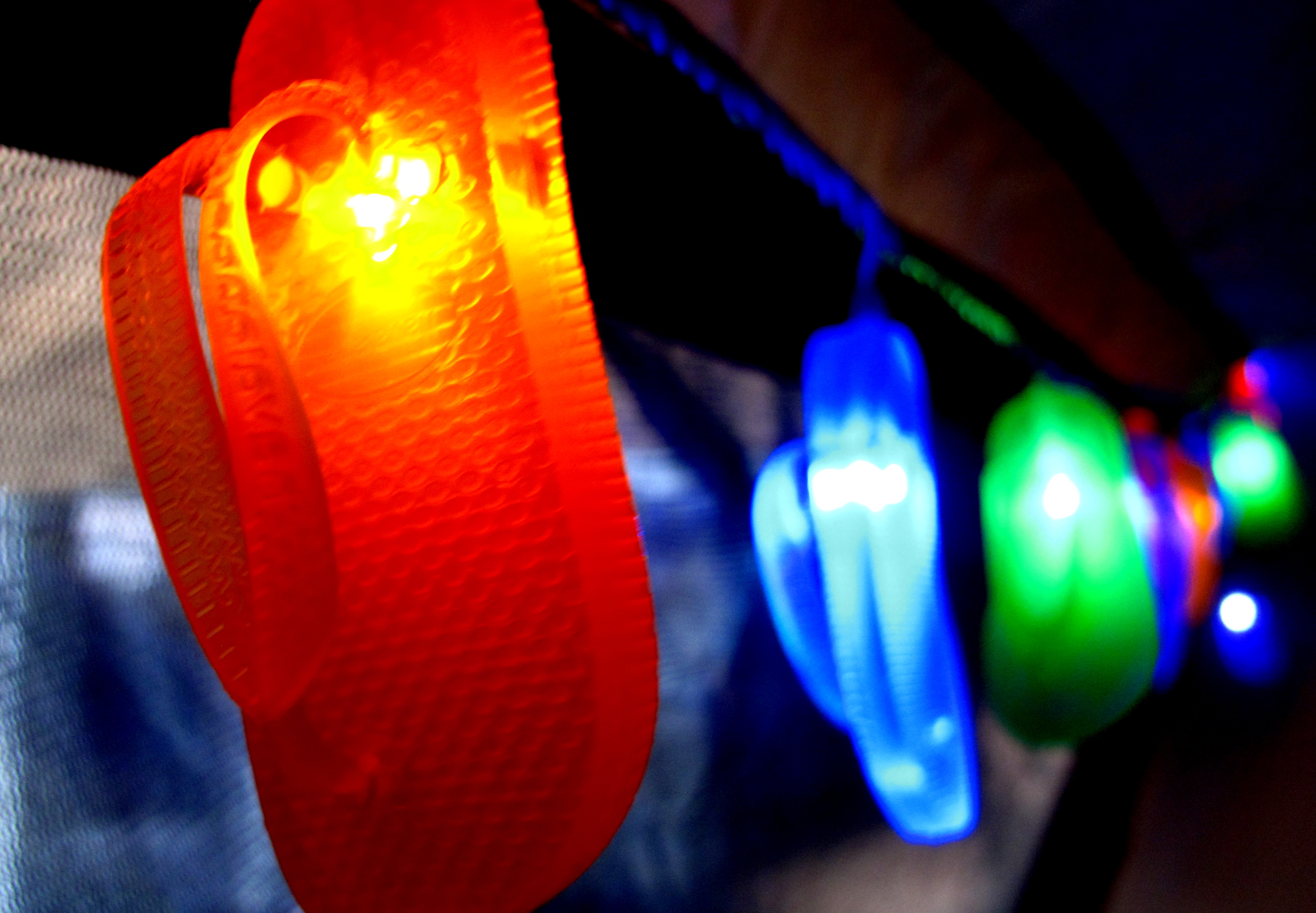
So, you see, this isn't just jingoism - it's a plea for regional diversity and putting a bit of local context into a seasonal observation that's laughably beyond irony wearing its wool-lined Santa hat in the sweltering afternoon sun. It's right and good that there are versions already about - Christmas cards can be found locally and easily with sun-kissed beaches, board-shorted Santas and pohutukawa in flower jostling alongside snowmen and red-breasted robins, and local versions aren't hard to find, really - as strings of brilliant colourful jandal tree-lights indicate. Enough of this seasonal denial, I say - let's band with our Trans-Tasman cousins and claim a proper summer Christmas with no denial!
[NB: This blog does agree with local mid-winter Christmas parties too, because they are aces]
here is th capital it's been trousering down with rain today, with the CBD's north-south streets like Featherston and Taranaki producing the dreaded spring and autumnal 'wind tunnels', ergo... sideways rain by the skip load. Not great for running off to work in, or waiting for a bus home, but not too shabby for dissuading those pesky Trick or Treaters!
Anyway, in honour of Featherston Street and Halloween, here's a nifty, shifty combination of the two. Pleasant dreams, Mr Meromo!
And, with October drawing to a close, that also wraps up Doodle a Day; a pleasure and a challenge, but something of a relief now it's over. Thanks to everyone who's followed, chanced upon this thread (you know who you are and I know what you were drawn to!) and especially those who've commented on and off to blog - I might yet revisit this in time, though probably not this year!