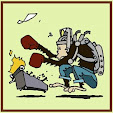
“It's a dangerous business, Frodo, going out your door. You step onto the road, and if you don't keep your feet, there's no knowing where you might be swept off to.” - Bilbo Baggins
So far I've described a Gnome at home in the woods; tied to nature, attuned to the rhythm of the living world, breathing to the wind in the treetops. A Gnome in his or her element is exactly where they should be - but it's no epic story in the making. If a Gnome is so ideally posited as a loner, or part of a small community of fosters, what on earth would inspire one to go adventuring?
Fortunately we have a literary precedent, in the form of Cloudberry, a Gnome at the heart of B.B's The Little Grey Men. Unlike his brothers Dodder, Sneezewort and Baldmoney, Cloudberry is, as his name suggests, something of a spiritual wanderer and is gripped with wanderlust. Of his own volition, and against the counsel of his brothers, he leaves Folly Brook and goes off 'up river', adventuring with a flock of high flying geese ('heaven Hounds') to distant lands. Like Bilbo and Frodo in the quote above, he returns to his brothers, never the same again.
Despite this cautionary example (Cloudberry is at the last a dangerous dreamer, and at worst... much worse), we can at least say we have one - and it's useful in noting the 'change' that occurs in Cloudberry afterwards. he is ever restless, unable to think or talk of anything else but his travels, and schemes to find a way to rejoin them. A player character Gnome needn't be so pathologically obsessed, but the curiosity is a handy hook. Everything else is detail, although my preference, if it hasn't been obvious already, is to start out keeping things simple. A beginner Gnome adventurer ought to have their own hand-crafted tools and weapons, and little armour, perhaps collecting the more usual trappings along the way. The life of a wandering Gnome among fellow drifters of other races need have little more, but change is inevitable. If you seek to play a Gnome adventurer, expect change.
Given that they don't have a true fairytale background, Gnomes were something of a blank slate for a long time before they were incorporated into the RPG world. The Will Huygen/BB/David Gnomes are reasonably down to Earth, with little in the way of powerful magic to them - if anything, the tease of fairy dust was on them, as many diminutive characters had.
In Dungeons and Dragons of course, their magical abilities come as PC Classes for AD&D, and in the form of Illusionists a Magic User variant. It seems kind of fitting, doffing the pointed cap towards glamour-based fairy magic, but without the obvious heavy weaponry that Human or Elven PCs could muster. Gnome magic in D&D is subtle, tricksy, maybe even cerebral?
That's fine, but I could never really get with the idea that this was a distinctly Gnomish trait. It's maybe a fairy trait - but Gnomes aren't fairies. They're also not Dwarves, so anything they can have that distinguishes them from their more earthy 'cousins' is good. When I developed an idea of what I wanted Gnomes to be for my games, Illusions went, and the fairy aspect soon followed. In the end, the solution was in those old books after all. But that's a story for another day, folks...
For a number of years I carried the memory of a show I watched as a
young Simian after school. One was about three boys who went bush in
the English countryside and had a distinctive piping theme tune. The
other was a words and pictures tale of some little folk who went
looking for one of their number called Cloudberry. Both eluded me
for ages until I recently did the sensible thing and turned to Google. As
it turned out, both series - respectively Brendan Chase and Baldmoney, Sneezewort, Dodder and Cloudberry were connected through their author/illustrator Denys Watkins-Pitchford, who wrote under the nom de plume 'B.B' (after the air rifle pellet and not an abbreviation of Bilbo Baggins.) No wonder I'd had difficult searching them out.
B.B. seems to have belonged to a specific generation of British writers
who, affected by the changing landscape of post Industrial Revolution
England turned their concern for the disappearing landscape into
children's writing. If it's possible to draw a line from Tolkien to
Richard Adams then that same line must pass through BB, whose stories
are imbued with woodlands nostalgia.
In The Little Grey Men (1942) and its sequel Down the Bright Stream (1948) B.B. uses his
gnome protagonists as vessels of concern as in both stories they
traverse the waterways and woodlands of a changing countryside in search
of their brother and, later, a new home (the second tale has some
kinship with Adams' Watership Down) these gnomes - Dodder, Baldmoney, Sneezewort and Cloudberry are the last of their kind, dwellers in a world
of talking animals and where man is at best a blundering fool, at worst a
monster. It's written well in a naive style akin to Tolkien's Hobbit,
but with some of the attendant sexism and xenophobia of the age.
Nevertheless, for the most part the gnomes are well characterised, with Dodder in particular developing between the books in an arc worthy of a
Baggins.
I found the books affecting - not quite as epic in scope or dour as Watership Down, but very charming and highly readable.
Watkins-Pitchford effectively captures a world in macrocosm, with a
population and sense of community, but devoid of politics or human
concerns. Don't be fooled though - there's a darkness in these books
including treachery, cruelty and murder. Cast members die in natural and
unnatural ways, and though the face of God isn't present in B.B.'s
woodland, the great god Pan is, in a striking and surreal chapter which precipitates
some remarkable character turns among the gnomes. Similarly in Bright Stream
the growing sinister truth about one of their number leads to a genuinely tense
chapter of skullduggery and truly natural justice. All the while Watkins-Pitchford's distinctive writing elegises the loss of the gnomes world, a
quiet voice in the wilderness. And his illustrations are gorgeous.
The takeaway for me, as mentioned in my earlier post, is in the nature of the gnomes themselves. Here B.B imbues them as spokemen of a vanishing natural world, dodging beasts and men, habitat destruction, and even after the fires and noises of the Blitz are heard but not entirely fathomed by them on their last great journey, ultimately abandoning England for a home of older myth and safer refuge. There's much in keeping with the Seventies version of Huygen's text - and in fact, given that B.B's works concern themselves chiefly with the last gnomes of England, they needn't be mutually exclusive. I believe there's a place for this version of the Gnome in a modern RPG - and in fact, there already is, in the independent RPG Tales from the Wood, and it's in my next post that I'll turn to this.
In the mean-time, I made some notes based on the gnomes and their world for anyone interested below:
Recently I've been thinking about Gnomes. I confess, I've been feeling a little guilty about them.
For a number of years I've thought on and off about the place of these little guys in the various editions of Dungeons and Dragons, and why in its Basic form they never distiguished themselves enough to be Player Characters. Sure, they're there among the Monsters in Mentzer's red box, and in the Moldvay Expert Set a floorplan of a Gnome lair appears, but by and large I suspect that early players just treated them as I and my friends did when we played - easy Experience Points. Kill them all!!! After I stopped playing of course the Companion module Earthshaker! came out, and then the supplement Top Ballista!, but these were, to my mind, mid-edition AD&D Gnomes retro-fitted in.
In D&D's Basic rules, Gnomes are NPC characters at best. They have an entry among the other 'Monsters' in the red box DM's Guide - and that's pretty much it. Cross over to the various versions of AD&D however, and it's a different story. For whatever reason the Gnome was abandoned in the Moldvaying and Mentzerising of the core game (fellow casualty races of course include the Half-Orc and Half-Elf), the race gets something of an on-going revision within the various iterations of the 'Advanced' game. First edition casts them as Halfling-sized Dwarf variants with similar attributes and an enmity with Kobolds (this is the version translated over to Moldvay/Mentzer); and as the game gets older the Gnome derives its own variants - Rock, Deep, Forest, and so forth. Originally given the option of an Illusionist specialty, Gnomes are later cast as Bards (another unloved and un-developed character class) and by 4th and 5th edition Gnomes really come into their own as tinkerers and tricksters - crazy inventors with a love of mischief.
I can't say I'm mad about the idea of Gnomes being cast so much along personality, particularly a personality almost purpose-built to irritate the hell out of fellow players or unbalance your campaign world with quasi high-tech. Indeed, I've heard of some groups who mutually have decided to just not include Gnomes for that reason.
Back in Basic-land I guess for purists the temptation in bringing the Gnome in as a Player Character is to adopt the D&D version - but even that has its critics. The popular argument goes: why use a Gnome when you could use a Dwarf? They generally live in the same areas, have similar cultures and a weakness of underground treasures. Or why not just use a Halfling, if you're after a diminutive Thief? There is of course the Illusionist class type to be imported - but a combination of magic and fighting ability in Basic is the domain of Elves; and a potentially weak fighter with a less-offensive array of spells may not have much going for it for players. So what then?
I believe the problem with the shifting niche of Gnomes is that they apparently lack a clear literary or mythological archetype. Gnomes in culture go only as far back as Paracelsus and the 16th century, and have no mythological or folklore precedent, which may be why they are often switched for Dwarfs (or dwarfs) in stories. The original Gnome is a theoretical earth elemental, but with more description becomes... a Dwarf with the registration number filed off. But what about in literature?
Ask anyone who lived through the Seventies about books with Gnomes in them and they may well recall Will Huygen's Gnomes(1974), the twentieth-century imprimatur that put the Gnome - pointed hat, jolly face, fulsome beard, well and truly in the public consciousness. If your common or garden Gnome wasn't already, well, a garden gnome, then this book would do little to change that.
But there is another literary precedent to the Gnome, and one that pre-dates Huygen's field guide by nearly three decades. 'B.B.''s The Little Grey Men and its sequel Down the Bright Stream* posits the adventures of the last four Gnomes in Britain, and places the race firmly in the woods as one of Pan's people (don't laugh). For all of that, however, 'B.B.' and Huygen seem to have seized on the Gnome in a smiliar fashion - they are guardians of the earth, forest-dwellers, and immensely practical, without recourse to tinkering with large-scale machinery (there are exceptions, but they are clearly not the rule).
The up-shot of this is that I think I've found a decent niche for the Gnome in a Basic D&D setting, and one which is rigid enough to avoid the overlap with the game's two other dimunitive PC races. Having read both Huygen's book and B.B.'s two novels, I considered the woodland guardian element of these texts and thought that with a brace of Druid spells one could effectively accommodate the race without too much hard work. That did do for my other idea of swapping Magic User spell sets for Elves with Druid spells, though. And in the end, I didn't want to do that. So my Gnomes are not especially magical - just like the literary ones, but they retain their woodland expertise, loyalties and preternatural identity. Rather than making them Druids I seem to be casting the Gnome as a Race-As-Class Ranger. And I think I'm pretty happy with that!
[Insert obligatory video. NO, no that one**]
[* Blogger's note: 'B.B' was the nom de plume of D. J
Watkins-Pitchford, who also provided the wonderful illustrations -
painting, etchings and line art, in both volumes. The name was
apparently taken from the ball-bearing gun pellet and wasn't, as my
thirteen-year-old self assumed, a cash-in on the name Bilbo Baggins]
[**
This song's nomination is more apposite than you may think, as Syd
Barrett was a huge fan of the books and the writer, a quote from the
first book was read at Barrett's funeral]