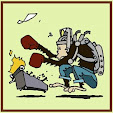
A Northern Hemisphere winter is the popular version in fantasy RPGs and the 'traditional' setting for Christmas. It is a time of snow, darkness and shelter for remote human populations against the figurative and literal wolves of the leanest season. The harvest may be in, and an opportunity for feasting available to mark midwinter's passing, but in all it is a harsh season, and an isolated homestead might appreciate help - any help, from friendly beings.
In Scandinavian folklore this is the Nisse or Tomte, a small humanoid creature who lives alongside countryfolk, helping (usually) invisibly as a quiet labourer, mender, and guardian of the homestead. They are, in that regard, akin to Brownies or Leprechauns, or perhaps the fairy tale elves from The Elves and the Cobbler; to be respected and occasionally appeased (but not flattered) lest that helping hand turn into a harmful one.
The equation is obviously closer to those aforementioned domestic helpers, but interestingly, by description the Tomte is very close to the Gnome: tall, pointed hat, long beard, very small, and seemingly able to either disappear or blend into the background at will. A useful natural talent to have - perhaps mechanically close to a Thief's Hide in Shadows skill. Might be useful to appropriate . The Tomte also gives the Gnome that essential niche of straddling the worlds of nature and civilisation: domestic without being domesticated, civilised without being a part of human civilisation.
In the Christmas lore of Scandinavia, the Tomte has been enhanced as a representative of midwinter or, in particular, Christmas. In its male appearance (and they are very usually male) it resembles Santa Claus, and is credited with gift giving, charity and the goodwill of strangers for the harshest season. As capricious as the Tomte or Nisse may be, this can embody much of the civil nature of the Gnome, giving the Gnome an additional 'hook' in his RPG identity - and a sense of time and location in a fantasy human world.
Gentle reader, I have a rather full dance card for the next week with Real Life(tm) and Other Projects(r) hanging around, so there may be Gnomes posted with not many comments accompanying. Oh, there's plenty more to write, but not the time to put it onscreen just yet. bear with, and I'll be back in a bit with more Gnowledge
Dungeons and Dragons changed their Gnome several times over until we got the version we have today, leagues from where the creature began, as Paracelsus' embodiment of the element of Earth. It's notable that it wasn't just the adventure profession that changed or 'evolved' over its history - they also changed appearance and motivation.
"Gnomes are excellent metalsmiths and miners. They love gold and gems and have been known to make bad decisions just to obtain them [...] Gnomes like most dwarves, but war with goblins and kobolds who steal their precious gold." Dungeons & Dragons Mentzer edition, Dungeon Master's Guide.
The traditional Gnome has stuck to the same template for over a hundred years. Everyone can describe a Gnome, probably without too much effort: short, hat, beard, nose, maybe a belly, maybe stone, maybe the woods, maybe the mines. The Dwarf association in Gnomes is strong and must be acknowledged, because their evolutions are shared. The rare appearance of the Gnome in its own right takes some time to assert the figure beyond a blending of the stock little person type (Paracelsus borrows from the 'pygmies' of the Iliad, which is transferred into English literature through Pope's The Rape of the Lock, which sets them up in a war with the more elfin Sylphs.) Thus Gnomes become earth-tied through the alchemical version by Paracelsus, then become embittered in Pope's parody.
Gnomes appear as a treasure hoarder and equally capricious in the collected tales of the Brothers Grimm (The Gnome) by which time their function as an antagonist is wrapped up with the equally greedy and subterranean Dwarf and Goblin. The Grimms of course also collected Snow White, whose absorption into popular culture through Disney and later (but unconnectedly) Tolkien not only redeemed the Dwarf, but made them accessible as humourous and sympathetic characters. The Gnome of course found some salvation as a garden totem - and perhaps it's the link with the green, growing world of nature which preserved the Gnome for more recent writers.
Further reading:
Folklore Thursday: 'On Gnomes: From Alchemical Theory to a Fairy Tale Staple [https://folklorethursday.com/folktales/on-gnomes-from-alchemical-theory-to-a-fairy-tale-staple/]
THE SEMIOSPHERES OF
PREJUDICE IN THE FANTASTIC
ARTS
THE INHERITED RACISM OF IRREALIA
AND THEIR TRANSLATION
MIKA LOPONEN (2019, University of Helsinki. Dissertation, Department of Modern languages [https://tuhat.helsinki.fi/ws/portalfiles/portal/124871175/PhD_Dissertation_Mika_Loponen_e_text_version_1.65.pdf]
I find myself returning to the books of B.B and Wil Huygen for my Gnome treatises because they (largely) agree with each other, and both stick to a pretty reliable and recognisable depiction of the overland version - the one I prefer.
D&D of course had a booted foot in both camps, where early Gnomes could be the 'woodland' variety (see above) or a subterranean version, at the time hewing less to the very deep underground Svirfneblin (which translates to 'svirf' (unknown?) and 'neblin', connected etymologically to the Old Norse 'nifl', meaning mist or fog. No gnomes is Norse mythology - just elves, trolls and dwarfs). The subterranean Gnomes were miners, ever seeking precious gemstones and valuable metals. B.B's Forest of Boland gnomes are also miners - but for practical metals, using them for constructions like their railroad. The Gygaxian Gnome on the other hand is mostly a creature of the underground, seeking treasures and trophies of their craft. In a way, this makes them more natural dungeon crawlers than a protector of the woodland, and the 80s introduction (by Gygax again) of the Deep Gnome simply drives them further underground - to the extent where Wizards of the Coast recently addressed what they perceived to be negative racial stereotypes tied to the dark-skinned Underdark peoples including the Drow, the Svirfneblin, and the more common Orc, among others.
There's no obvious evidence that the Gnome changed over thirty years beyond the early style because of a perceived racial association, but the aforementioned 'look' of the Gnome and the linking with underground treasures is where the D&D Gnome begins, and both definitively disappear in favour of the version you can see today. Could there be a connection?
The early D&D Gnome stuck doggedly to form, thanks in part to the roster of artists who drew them, and in part with the insistence of of the then contemporary 'look' of the Gnome, most frequently seen in the Huygen books. That said, Huygen's book doesn't really go to town with big noses, and certainly not with LONG noses. Their ears are human-like and round, not pointed. Their beards are full and their hats are large, pointed and usually red - just like a garden gnome statute, of course.
The garden gnome has no less a complicated history, going back at least as far as Anatolia (now modern Turkey) and travelling through Europe to Germany and of course the United Kingdom by the Nineteenth Century. The cap is Phrygian in shape and likely origin, the beard perhaps as old. The nose and ears? A rounded button and large Enid-Blytonesque ears with no points. Curious.
Fairy creatures have long been drawn or portrayed with exaggerated features, and Gnomes and Dwarfs haven't been immune. Pixie or Elfin ears are usually pointed, Dwarfs often have large noses - but not necessarily long ones, or hooked ones. Only when we look past the Disney 'Snow White' Dwarfs with their friendly bulbous hooters does the profile change.
So where did Gygax, Sutherland and others get their Gnome characteristics - pointedly the pointed ones, from?
If I had trouble establishing for myself the 'perfect' Gnome, then at least it was my own battle and it only lasted around fifteen years. TSR (and I suppose Wizards of the Coast/Hasbro after them) took something closer to a generation. In fairness, it wasn't a well-defined race to begin with, and it wasn't a playable race until AD&D; a lot of things were in play, and in the ensuing years and later editions of the game a good many things would be revised. The Gnome would be one of them.
It seems likely that Gary Gygax's original model for the fighter Gnome of D&D/AD&D is Hugi the Gnome in Poul Anderson's Three Hearts and Three Lions. Hugi is woods-homed, a doughty fighter and something of a braggart, but otherwise not much different from a fantasy Dwarf. In AD&D some magic is added in the form of Illusionist spells, and this class preference persists in succeeding editions, past the introduction of the 'Deep Gnome' or Svirfneblin in the 1e Unearthed Arcana and its assumption as a playable class for 2e. The Dragonlance novels and AD&D setting then incorporated that world's Tinker Gnome as a character type, and subsequent editions married the fey magic element with an artificer's skill (though often with hazardous results). Meanwhile, in Basic D&D Gnomes have burst with reinvention as an NPC race in exclamation-mark-bearing madcap flying city adventure supplements (Top Ballista!) and mecha modules (Earthshaker!). The woodland Gnome of old has by now disappeared, as has its appearance, replaced in the wider game by a slimmer, more fey figure with wild hair, less facial hair and elfin eyes. It's a divisive reinvention, to say the least, but the whimsical Steampunk Gnome type endures in World of Warcraft. By D&D's 5e the favoured class of the Gnome has become Bard.
So much for the in-game Gnome, in the history of the Gnome in popular culture, the character has also undergone an evolution...
Believe it or do not, but the road to the Redcastle Gnome took a great many twists and turns before I found the ingredient I was looking for in the books of B.B.
I honestly don't even remember first setting out on it - though it would have been at least fifteen years ago. I rolled a Gnome character (Wrangfauld Orpin, a Thief/Illusionist, if memory serves) who never got used in my heady AD&D days, and even started on a large-scale adventure storyline that would eventually be resurrected around 2005 to become the Dwarven minecrawl Barbigazl.
The Gnomes that featured in Barbigazl were where I thought I would take the class if a regular gaming group had spun off: a largely subterranean culture with woodland roots who were devoted to exploration. Their paragons were the Delvers, who dared to go farther and deeper than those before them in search of the secrets of the earth. They would be spellcasters, after a fashion, with their requisite staff/rod analogue being a highly practical and desirable crozier or 'crook'. I allowed them options for invention and professions as 'tinkerers', themselves drawn to creating the most miraculous and fanciful of machines to serve Gnomekind. They would trade with Dwarves, war with kobolds, and build great and unfathomable subterranean cities incorporating fungi, giant arthropods and diminutive architecture.
It doesn't look too bad on paper, but it was probably too complicated, relied on too much buy-in to meet the rather necessary worldbuilding... and unless there were whole campaigns built around this sort of thing, who could be bothered? So it was abandoned.
Nearly ten years later I read the little grey men books, and my mind was re-sparked, and everything seemed to fall into place - a new race-as-class option for Basic D&D games (the Gnome as Druid) emerged, and there was enough cultural integrity to ensure that this player character option was recognisable, believable, and relatable. And if in the Barbigazl days I was at risk of reinventing the Deep Gnome or Tinker Gnome, I was later at risk of just reinventing the Forest Gnome, then whatever. The Druid spells papered over the gaps the ratification exposed.
Could I have made a similar problem for the Gnome in declaring them a woodland creature as the original game had in having them encroach across the Dwarf template? Maybe. But in my Redcastle world, that's a largely empty ecological niche, Elves being more widespread than just the green bits on the map, and most definitely not flower-wearing earth warriors. Instead, I move the Elves out of the forest; up mountains, in elaborately-excavated hill fortresses and under the sea. The woods no longer ring with their noble song, and have become more wild, dangerous and full of ancient mystery.
And there, in the tangled roots and fallen trunks of ancient trees, under the bends of whispering brooks and between to fissures of weathered cliffs, the Gnomes live, and watch the outside world.
It may seem counterintuitive to think of a Gnome worshipping a deity - at least as much as those other early demi-humans. Back in D&D's early days it was assumed clerics - that practical way to restore hit points and get rid of undead, were particular to all races, but only the human (or half-orc in AD&D) peoples would allow their clergy to also kit up and go a-dungeon-crawling.
In the case of Gnomes in early D&D the lines were drawn even thicker. Gnomes, it could be inferred, were not spiritual, they were magical; creatures adept in illusion and sleight of hand, it jibed with the theory, aligning with other diminutive tricksters of the fairy world. Who cares if the ability to cast great illusions seemed strange in a dark old mine? Their sworn enemies, the kobolds, were also underground dwellers and tricksy. Otherwise, it went some way to justifying the Illusionist class spell list if it could be used in more than one player character type. Woodland Gnomes weren't much different, and unless you are prepared to go back to the Brothers Grimm (it's complicated) , they're not especially magical.
Unless...
Unless the woodland Gnome were taken to specialise in woodland magic, and employ natural components in their spells, supplicating to gods personifying wild nature. This is what B.B offers in The Little Grey Men, with the older Dodder praying and ultimately summoning Pan, whose presence is felt throughout the rest of their story. I like the aspect of Pan: in line with the gods, actually a god, but not entirely godly, being very earthly, somewhat feral and (maybe) a bit horny as well. Of the Roman gods he's the most animalistic, and that works, too. I'm not saying Gnomes should worship Pan, but other gods are available: Silvanus, Gaia, Abnoba, Cernunnos, Phaunus, Leshy - and so on.
Woodland magic, the worship of nature deities satisfies the Druid role in AD&D, and so my ideal race-as-class Gnome PC is just that: a Druid.
Having covered Gnomes from a floral aspect for a couple of episodes now, it's time to turn to fauna - the beasts of the Gnomes' world.
I'm going to assume an archetypal D&D fantasy woodland and its animals - that is to say, Northern Hemisphere, European, and temperate, with defined seasons. The variety of animals (excluding invertebrates) run the range of fish, reptiles and amphibians, birds (waterfowl, passerine and non-passerine, raptors) and mammals. In the works of B.B and Wil Huygen the largest animals are generally badgers, foxes, domesticated dogs and polecats, but a fantasy woodland might also incorporate bears, boars, wildcats and wolves. Below that size are the other common woodland creatures: otters, squirrels, moles, bats, mice, rats, voles, rabbits, hedgehogs, weasels and stoats. The Cook Expert D&D Set of course includes giant ferrets as guard animals for a sample Gnome lair - but the aforementioned works, strictly sticking to their favoured Gnome dimensions (roughly a handspan), has no need of them.
Size notwithstanding, it's the relationship which counts. Gnomes are the guardians of the woodland, friend to most animals, and sometimes fellow residents (B.B's little grey men share a tree with a couple of owls, Hugyen's foster infant mammals). Reptiles are at best tolerated - in Down the Bright Stream an adder is as capricious and sinister as the serpent of Eden, and fish are equally food and predator, depending on their size (minnow and a pike, respectively.) The underlying philosophy is that the Gnomes share their woodland home with animals. They rarely eat flesh, save for fish (it's okay, they don't have any feelings), and steal bird eggs, but don't seem to hunt fowl or rabbits. This extends to their craft - of which more in another post.
Above: Gnome with Squirrel, after B.B
Gnomes share a language with the animals, being able to converse with (seemingly) all mammals, most birds, and the aforementioned adder, and they rely on the strength, skills (burrowing by moles, hunting by otters, flight by the owls) and knowledge of these creatures. In exchange they ply their crafts, invention and dexterity to help their animal friends. In short, Gnomes are a woodland creature among others - notably in the Tales from the Wood RPG inspired by Watership Down and the books of BB, Gnomes are simply another player type alongside the rabbits, badgers, squirrels and other creatures.
To the adventuring Gnome such relationships and skills are significant. The ability to naturally Speak With Animals (certain kinds) and rely on them for intelligence and local lore could be very handy. the ability to summon those creatures at a time of peril could be a life saver.
Best left there for now. Suffice it to say the animal/Gnome relationship is essential to the character class and not to be sniffed at. There's more to add, but there we drift into the mystical. And that's best for another post...
There is a lot of codification in the names of fantasy characters. George Martin employed consonant shifts and an almost phonetic approach in adapting common names for his characters in his Song of Ice and Fire novels ('Eddard', 'Podrick', 'Sersei'). Tolkien took hi from Old Norse and Anglo Saxon histories, depending on the culture of his people - and when it came to Hobbits, he mixed the old with the contemporary, adding evocative descriptors and alliteration to give them their own distinctive sounds: Bilbo, Frodo, Samwise, Odo, Bungo, Meriadoc, Gerontius, Belladonna.
The last name - that of Bilbo's ill-fated mother, is of course a botanical name, and it's the names of wild flowers that B.B. uses for his little grey men: Dodder is a vine-like weed, Baldmoney an aromatic mountain plant, Cloudberry a raspberry-like fruit, and Sneezewort a hardy wildflower. Some of these are edible, some have medicinal properties, others known for their toughness or resilience, and yet others for their beauty.
I like the convention of botanical names for Gnomes. They divorce themselves from the human and cleave instead to the natural world. There are dozens of names for some plants, and hundreds of varieties; some names are almost lost , or so regional as to be obscure, and if Gnomes are not numerous, in a fantasy setting they needn't have linear surnames to distinguish themselves - in fact, I'd recommend against the convention. But to make it slightly codified, I've taken to using tree or weed names for males, and floral or herbal names for females. It'll do for now.
Above: Houndstongue and Primula.
Recommended sourcebook: Culpeper's Complete Herbal (1653), via Project Gutenberg
“It's a dangerous business, Frodo, going out your door. You step onto the road, and if you don't keep your feet, there's no knowing where you might be swept off to.” - Bilbo Baggins
So far I've described a Gnome at home in the woods; tied to nature, attuned to the rhythm of the living world, breathing to the wind in the treetops. A Gnome in his or her element is exactly where they should be - but it's no epic story in the making. If a Gnome is so ideally posited as a loner, or part of a small community of fosters, what on earth would inspire one to go adventuring?
Fortunately we have a literary precedent, in the form of Cloudberry, a Gnome at the heart of B.B's The Little Grey Men. Unlike his brothers Dodder, Sneezewort and Baldmoney, Cloudberry is, as his name suggests, something of a spiritual wanderer and is gripped with wanderlust. Of his own volition, and against the counsel of his brothers, he leaves Folly Brook and goes off 'up river', adventuring with a flock of high flying geese ('heaven Hounds') to distant lands. Like Bilbo and Frodo in the quote above, he returns to his brothers, never the same again.
Despite this cautionary example (Cloudberry is at the last a dangerous dreamer, and at worst... much worse), we can at least say we have one - and it's useful in noting the 'change' that occurs in Cloudberry afterwards. he is ever restless, unable to think or talk of anything else but his travels, and schemes to find a way to rejoin them. A player character Gnome needn't be so pathologically obsessed, but the curiosity is a handy hook. Everything else is detail, although my preference, if it hasn't been obvious already, is to start out keeping things simple. A beginner Gnome adventurer ought to have their own hand-crafted tools and weapons, and little armour, perhaps collecting the more usual trappings along the way. The life of a wandering Gnome among fellow drifters of other races need have little more, but change is inevitable. If you seek to play a Gnome adventurer, expect change.
The default 'Monster' setting for any character race in D&D is the Fighter. It's reductionist, and we know that there's so much more to many of these peoples, but there it is. Look in the Monster Manual, or the Monsters pages of the Basic set (Moldvay or Mentzer) and they're there among the similarly fighter-ised Halflings and Elves (who do at least get a spell in). In part this is simple game mechanics - a template to base your encounter off. But unlike the pop culture histories of Dwarves and Elves, Halflings and Gnomes don't carry the same martial weight.
And so, setting Halflings aside, we must ask: what is a Gnome Fighter? Are Gnomes warriors - i.e., do they go to war?
The woods are big, but there are also beaches, hills, moors, lakes and rivers, meadows and fells.
Wil Huygen and B.B. had Gnomes be the soul of the forest - companion to the animals there and guardians of the intelligent life there, but I think the more compelling aspect of this is just how close to nature the Gnomes of their books are. Like their Dwarfen counterparts, in the mixed folklore of Gnomes, they are tied to the earth, and representative of it, but the folklore doesn't give them much more than that. Like their mining cousin, the 'traditional' gnome is a little person with magical aspects, and maybe some wisdom to share or protect (or which more on another day, readers.) By contrast, B.B's/Huygen's Gnomes reside and represent the natural world. They place them specifically in an environment where they are collectors and scavengers, and use tools made from the world around them. They hunt (carefully), craft, burrow and build. Certainly, in B.B's later gnome stories there's machinery and more of the fairy town storytelling of Enid Blyton than in the more mystical early stories, but those first two books really set the model. The natural world immediately forms the identity of the Gnome PC.
In the RPG world this presents something of a challenge, but it also presents opportunities. The degree to which Gnomes are in tune with the environment in which they live sets their abilities and world view, which is as useful as whether any other PC is from an urban, rural, common or regal class. It's instantly character-building and relatable, and equips the Gnome character with a lot of potential.
Take the Gnome out of that world and you present a challenge. re they as familiar with the wider world? Once underground in a dungeon does the lack of wind in the trees, the language of the brook weaken them? Maybe. It's up to the player. But what a start!
Given that they don't have a true fairytale background, Gnomes were something of a blank slate for a long time before they were incorporated into the RPG world. The Will Huygen/BB/David Gnomes are reasonably down to Earth, with little in the way of powerful magic to them - if anything, the tease of fairy dust was on them, as many diminutive characters had.
In Dungeons and Dragons of course, their magical abilities come as PC Classes for AD&D, and in the form of Illusionists a Magic User variant. It seems kind of fitting, doffing the pointed cap towards glamour-based fairy magic, but without the obvious heavy weaponry that Human or Elven PCs could muster. Gnome magic in D&D is subtle, tricksy, maybe even cerebral?
That's fine, but I could never really get with the idea that this was a distinctly Gnomish trait. It's maybe a fairy trait - but Gnomes aren't fairies. They're also not Dwarves, so anything they can have that distinguishes them from their more earthy 'cousins' is good. When I developed an idea of what I wanted Gnomes to be for my games, Illusions went, and the fairy aspect soon followed. In the end, the solution was in those old books after all. But that's a story for another day, folks...
The 'classic' Gnome is a model of sexual dimorphism. Males are bearded, weathered and portly, females are braided, voluptuous, and look like they've strayed from Oktoberfest, losing their steins somewhere along the way.
There's nothing wrong with this, but it does to my mind tend towards the same pigeonholing that the more recent insane Rube Goldberg Gnome did -it pushes a character, a stereotype into a demi-human character class. Each demi-human class has that issue in D&D and AD&D - heck, Gygax had cross-referenced tables to further establish their traits and preferences; but it does rub against the more open-ended aspects of the game.
Anyway, this month is about Gnomes, not the Gygaxian world, so here's one of my female Gnomes:
My female Gnomes have more variety in body shape and attire. There's room for the 'hausfrau' model, but also for the wise-old-woman-of-the-woods, the ingenue, the virago, the 'gypsy' dancer, the defender of the hearth. Variety is good. Other than that, the standards still apply (no beards, though) - ears, nose, pointed hat.
So why have I been banging on about Gnomes for so long?
I had the mistaken belief that they were an untapped resource! I was wrong. If anything, Gnomes have been tapped out many times. They're been in the D&D system, sidelined, made central, excised, reinstated and reinvented, and now seemingly are a step down from the whimsy machines of previous recent editions... I dunno. I'm a purist. But I like the Gnomes in my head (a sentence I never thought I'd write, folks), and these are they: diminutive woodland humanoids, wary of the ways of the larger world, but fueled with invention and curiosity.
But I also need to acknowledge those who came before me in drawing the classic D&D Gnome, and for me that's David C Sutherland in the 1e AD&D Manuals. I assumed they were Gnomes, of course - they might well have been Dwarves. But they had big noses, which is an important signifier (even if it may have been one of the characteristics that got them canned in the later years) After your David the Gnomes, Sutherland's version of what I fancy may have been a grudging inclusion of the race in Gygax's blueprint, gives them armour, weaponry, and those very cool helmets with eyeholes and noseguards. Yeah, boy. They may have been as impractical for close-up fighting as any helmet with a grippable centrepiece, but they looked cool, they looked purpose-built, and therefore they looked Gnomish.
Turns out the model was a Dwarf. Ah well.
My concession above is without colour, so imagine wood tones, laminated panels and some salvaged polish. where it counts: the bridge of that big, beautiful hooter.
Tomorrow: another Gnome, with some different stuff to talk about!
Or more specifically, the silhouette of the Gnome. I set down very few rules, based on traditional depictions: beards for the gentlegnomes, pointed ears and long (not just large) noses to distinguish them from Dwarves, Dwarf-like proportions, and a conical hat (or variation thereof)
Everything else is personal taste and differentiation. Beards make them look less Hobbit-like, short beards make them look less Dwarven. So far I seem to be applying a third guideline: face plus beard length equals hat height - but we'll see how this goes from here. I don't intend them to be all like these first two, for sure.
Last month I eschewed Drokktober and went cold turkey on Judge Dredd stuff. Lotsa reasons, lotsa things to do instead.
Like... Gnomes! I've sat on these guys for too long, it's time to take action. Let Gnomevember commence!
Day one. This is a Gnome. Classic design, drawn quite some time ago and coloured in Photoshoppe (yes, that old). There'll be another tomorrow, and then the next day, and so forth, interspersed with Gnowledge and Gnomic utterances. It may last the entire month, it may not. let's ride this thing and see how far it goes.
For a number of years I carried the memory of a show I watched as a
young Simian after school. One was about three boys who went bush in
the English countryside and had a distinctive piping theme tune. The
other was a words and pictures tale of some little folk who went
looking for one of their number called Cloudberry. Both eluded me
for ages until I recently did the sensible thing and turned to Google. As
it turned out, both series - respectively Brendan Chase and Baldmoney, Sneezewort, Dodder and Cloudberry were connected through their author/illustrator Denys Watkins-Pitchford, who wrote under the nom de plume 'B.B' (after the air rifle pellet and not an abbreviation of Bilbo Baggins.) No wonder I'd had difficult searching them out.
B.B. seems to have belonged to a specific generation of British writers
who, affected by the changing landscape of post Industrial Revolution
England turned their concern for the disappearing landscape into
children's writing. If it's possible to draw a line from Tolkien to
Richard Adams then that same line must pass through BB, whose stories
are imbued with woodlands nostalgia.
In The Little Grey Men (1942) and its sequel Down the Bright Stream (1948) B.B. uses his
gnome protagonists as vessels of concern as in both stories they
traverse the waterways and woodlands of a changing countryside in search
of their brother and, later, a new home (the second tale has some
kinship with Adams' Watership Down) these gnomes - Dodder, Baldmoney, Sneezewort and Cloudberry are the last of their kind, dwellers in a world
of talking animals and where man is at best a blundering fool, at worst a
monster. It's written well in a naive style akin to Tolkien's Hobbit,
but with some of the attendant sexism and xenophobia of the age.
Nevertheless, for the most part the gnomes are well characterised, with Dodder in particular developing between the books in an arc worthy of a
Baggins.
I found the books affecting - not quite as epic in scope or dour as Watership Down, but very charming and highly readable.
Watkins-Pitchford effectively captures a world in macrocosm, with a
population and sense of community, but devoid of politics or human
concerns. Don't be fooled though - there's a darkness in these books
including treachery, cruelty and murder. Cast members die in natural and
unnatural ways, and though the face of God isn't present in B.B.'s
woodland, the great god Pan is, in a striking and surreal chapter which precipitates
some remarkable character turns among the gnomes. Similarly in Bright Stream
the growing sinister truth about one of their number leads to a genuinely tense
chapter of skullduggery and truly natural justice. All the while Watkins-Pitchford's distinctive writing elegises the loss of the gnomes world, a
quiet voice in the wilderness. And his illustrations are gorgeous.
The takeaway for me, as mentioned in my earlier post, is in the nature of the gnomes themselves. Here B.B imbues them as spokemen of a vanishing natural world, dodging beasts and men, habitat destruction, and even after the fires and noises of the Blitz are heard but not entirely fathomed by them on their last great journey, ultimately abandoning England for a home of older myth and safer refuge. There's much in keeping with the Seventies version of Huygen's text - and in fact, given that B.B's works concern themselves chiefly with the last gnomes of England, they needn't be mutually exclusive. I believe there's a place for this version of the Gnome in a modern RPG - and in fact, there already is, in the independent RPG Tales from the Wood, and it's in my next post that I'll turn to this.
In the mean-time, I made some notes based on the gnomes and their world for anyone interested below:
Recently I've been thinking about Gnomes. I confess, I've been feeling a little guilty about them.
For a number of years I've thought on and off about the place of these little guys in the various editions of Dungeons and Dragons, and why in its Basic form they never distiguished themselves enough to be Player Characters. Sure, they're there among the Monsters in Mentzer's red box, and in the Moldvay Expert Set a floorplan of a Gnome lair appears, but by and large I suspect that early players just treated them as I and my friends did when we played - easy Experience Points. Kill them all!!! After I stopped playing of course the Companion module Earthshaker! came out, and then the supplement Top Ballista!, but these were, to my mind, mid-edition AD&D Gnomes retro-fitted in.
In D&D's Basic rules, Gnomes are NPC characters at best. They have an entry among the other 'Monsters' in the red box DM's Guide - and that's pretty much it. Cross over to the various versions of AD&D however, and it's a different story. For whatever reason the Gnome was abandoned in the Moldvaying and Mentzerising of the core game (fellow casualty races of course include the Half-Orc and Half-Elf), the race gets something of an on-going revision within the various iterations of the 'Advanced' game. First edition casts them as Halfling-sized Dwarf variants with similar attributes and an enmity with Kobolds (this is the version translated over to Moldvay/Mentzer); and as the game gets older the Gnome derives its own variants - Rock, Deep, Forest, and so forth. Originally given the option of an Illusionist specialty, Gnomes are later cast as Bards (another unloved and un-developed character class) and by 4th and 5th edition Gnomes really come into their own as tinkerers and tricksters - crazy inventors with a love of mischief.
I can't say I'm mad about the idea of Gnomes being cast so much along personality, particularly a personality almost purpose-built to irritate the hell out of fellow players or unbalance your campaign world with quasi high-tech. Indeed, I've heard of some groups who mutually have decided to just not include Gnomes for that reason.
Back in Basic-land I guess for purists the temptation in bringing the Gnome in as a Player Character is to adopt the D&D version - but even that has its critics. The popular argument goes: why use a Gnome when you could use a Dwarf? They generally live in the same areas, have similar cultures and a weakness of underground treasures. Or why not just use a Halfling, if you're after a diminutive Thief? There is of course the Illusionist class type to be imported - but a combination of magic and fighting ability in Basic is the domain of Elves; and a potentially weak fighter with a less-offensive array of spells may not have much going for it for players. So what then?
I believe the problem with the shifting niche of Gnomes is that they apparently lack a clear literary or mythological archetype. Gnomes in culture go only as far back as Paracelsus and the 16th century, and have no mythological or folklore precedent, which may be why they are often switched for Dwarfs (or dwarfs) in stories. The original Gnome is a theoretical earth elemental, but with more description becomes... a Dwarf with the registration number filed off. But what about in literature?
Ask anyone who lived through the Seventies about books with Gnomes in them and they may well recall Will Huygen's Gnomes(1974), the twentieth-century imprimatur that put the Gnome - pointed hat, jolly face, fulsome beard, well and truly in the public consciousness. If your common or garden Gnome wasn't already, well, a garden gnome, then this book would do little to change that.
But there is another literary precedent to the Gnome, and one that pre-dates Huygen's field guide by nearly three decades. 'B.B.''s The Little Grey Men and its sequel Down the Bright Stream* posits the adventures of the last four Gnomes in Britain, and places the race firmly in the woods as one of Pan's people (don't laugh). For all of that, however, 'B.B.' and Huygen seem to have seized on the Gnome in a smiliar fashion - they are guardians of the earth, forest-dwellers, and immensely practical, without recourse to tinkering with large-scale machinery (there are exceptions, but they are clearly not the rule).
The up-shot of this is that I think I've found a decent niche for the Gnome in a Basic D&D setting, and one which is rigid enough to avoid the overlap with the game's two other dimunitive PC races. Having read both Huygen's book and B.B.'s two novels, I considered the woodland guardian element of these texts and thought that with a brace of Druid spells one could effectively accommodate the race without too much hard work. That did do for my other idea of swapping Magic User spell sets for Elves with Druid spells, though. And in the end, I didn't want to do that. So my Gnomes are not especially magical - just like the literary ones, but they retain their woodland expertise, loyalties and preternatural identity. Rather than making them Druids I seem to be casting the Gnome as a Race-As-Class Ranger. And I think I'm pretty happy with that!
[Insert obligatory video. NO, no that one**]
[* Blogger's note: 'B.B' was the nom de plume of D. J
Watkins-Pitchford, who also provided the wonderful illustrations -
painting, etchings and line art, in both volumes. The name was
apparently taken from the ball-bearing gun pellet and wasn't, as my
thirteen-year-old self assumed, a cash-in on the name Bilbo Baggins]
[**
This song's nomination is more apposite than you may think, as Syd
Barrett was a huge fan of the books and the writer, a quote from the
first book was read at Barrett's funeral]