Showing posts with label Electronica. Show all posts

Tuesday, March 3, 2015

'European skies, European desires'

Manic Street Preachers - 'Futurology' (2014)


"I am the sturm und drang / I am the schadenfreude"

In unprecedented haste for a band of its age, the twelfth studio album from Manic Street Preachers was released around six months after its companion, Rewind the Film. Both albums complement one another, and yet are intended to be opposites, Rewind the introspective middle-aged Holy Bible, while Futurology, while not exactly future-looking, is an optimistic, outward-looking work. Its predecessor is no slouch, but fed on Krautrock, and presenting electronic soundscapes and a peculiarly Welsh view of modern European history, the Manics' latest album is one of their strongest and most complete.

"Working class skeletons / lie scattered in museums" 

Like Rewind the Film, Futurology was recorded at Hansa by the Wall, in Berlin. The British artist or group retreating to Berlin for reinvigouration and reinvention has past form, of course: Bowie (Low and "Heroes") and U2 (Achtung Baby) both did it, and while Manics eschewed Eno and parted with Visconti five albums previously, there is a sense of hat-doffing to the former. But this isn't pastiche as Achtung Baby pretended towards (and Zooropa achieved) but a logical transition. Doubled with Rewind the Film, its studio companion, the two albums converse and share ideas, sounds and influences.

Futurology is a confident album - still equipped with the doubts of Rewind, but seated in a continental context, and an historical one. Its Europe is a Europe of ghosts both living and dead: - 'The Next Jet to leave Moscow's' "old jaded Commie walking in Red Square", while bonus track 'The Last Time I Saw Paris' has its protagonist wander the French capital looking for 'the boxer' (Sartre) and 'the goalkeeper' (Camus), Grieg's 'In the Hall of the Mountain King' is sampled in 'Let's Go To War', Munch's painting in 'Between the Clock and the Bed', and more personally, the shimmering 'Divine Youth' sparks from Wire's catching an image of himself and Richey Edwards in their younger heyday on a bootleg t-shirt.

"To understand your country you must first understand yourself"

So while U2's European experience is largely as travellers and impressioned observers, Manics draw on European political history, Welsh history as European history ('Dreaming a City (Hugheskova)' and 'The View from Stowe Hill'), and their own politics to create part-essay, part travelogue. Far from the cut-up soundbite approach of the Richey era, there are easier entry points in thee songs, and what seems to be an attempt to demystify the lyrics, maybe Wire's past-affirmed "attempt at mass communication." And so alongside the possible survivor-guilt of 'Walk Me to the Bridge' and eflection of 'Between the Clock', there are songs about Wire's dwindling Socialist values ('Moscow') and a self-referencing of the band's more notorious history: "so you played in Cuba did you like it brother? / I bet you felt proud, you silly little f*cker."

My overriding impression of this album however is one of generosity. There are songs loosely about the band and its primary lyricist, but these seem small ingredients alongside the wealth of ideas, the inclusion of fellow Welsh vocalists Georgia Ruth and Green Gartside (duets being another element shared with Futurology), and the impressive soundscape from Bradfield and Moore - hinted at in the previous album's closer, but fully formed here. It echoes not only the Krautrock of Can, Neu and Kraftwerk ('Black Square', to my ears, and also 'Misguided Missile'), but more domestic influences - PiL, Simple Minds, a dash of The Skids. I don't think manics have ever not worn their influences on their sleeves, but here the influences seem broader and more accommodating. And I'm very happy to have it in my collection.


Cover story: It's allegedly a good sign because the band logo and lettering has the reversed letters back! fans would therefore expect a call-back to similarly-typed albums The Holy Bible, Send Away the Tigers and Journal for Plague Lovers, and, perhaps third album excepted, it's not a bad comparison. The photo: a blonde fraulein standing on a block of ice in brittle, beautiful midwinter sunlight. Gorgeous. And futurist Berlin architecture forms the backdrop to the band portraits inside. Job done.

Friday, June 27, 2014

Friday Night Local: Strawpeople - Crying (1994), 'Taller than God' (1996)

I feel like hearing some smooth female vocals for a change, so it's a Strawpeople song tonight. Or is it?

Oh, Strawpeople. I didn't even know I was a fan - but it seems obvious now, I like at least one song from each of their albums, have enjoyed most of their singles from the early days with Merenia and Stephanie Tuavehi, the sultry Victoria Kelly and the precise Fiona McDonald. Vicarious is as much McDonald's album as it is Mark Tierney's and Paul Casserley's, and yet its predecessor, Broadcast's, Crying, is a ripper. Ladies - you're both pretty! Can't we stop this fighting?

So tonight, as it's ladies' night, here are two videos, one opener from each of the aforementioned albums. I coud have done other songs - like Jamas I rather enjoy Beautfiul Skin (Trick With a Knife is a personal fave, too), but maybe another night, eh?

Thursday, May 29, 2014

Land of the Long White Sound: day five

Time to get with this century now, but only just. Rhian Sheehan's space-themed debut Paradigm Shift from 2001 has dated a bit now, but it's still lovely mellow stuff, and is borne of a (then) real high in the local music industry. It's not Flying Nun, nor is it a major label effort, but comes from Wellington's small but significant Loop imprint. Really, tracks like this could be on a Chillout compilation and would just class the place up amongst the panflutes and whale songs. Waiting is my favourite off the album, with guest spots from fellow Loop-ers Lotus, Tehi and Darren Mathiassen. The video is very cool, too - love the flax weaving on a different planet. Waiting
Oh so nice to work to. But tomorrow night's a Friday, so I fancy another Night Out in Wellington before we wrap up this little tiki tour...

Monday, July 2, 2012

Do Tangerines Dream of Electric Beats?

This is another post from the archive pile, first drafted in June 2011, but rewoken in honour of Disasteradio's awesome new single Drop The Bomb...

Recently in the Monkeyhouse while watching Tron Legacy (courtesy of Al - cheers!), I turned to Mrs Simian and said "Is it wrong that I'm enjoying the music so much?" Of course it wasn't, she said. Daft Punk were an inspired and logical match for the movie, and of course it didn't take me long to recall that the combination was naturally appealing to me, because friends - deep within the recesses of the Simian brain is an Eighties techno fan.

As a teenager interested in movies and Sci-Fi and comics the desire to look for a musical genre that would naturally accompany these was strong. Electronic music chose me in the end, courtesy of TVSF. For a while I collected Jean Michel Jarre albums, then any synthesised soundtracks I could get my hands on - mainly dubbed tapes from friends (Manhunter, Blade Runner, and I seem to recall liking Toto's soundtrack to Dune a fair bit). But the most eclectic cassette I had was this one - the 'Jive Electro'  Disc Drive sampler. Check out that blue neon Vitruvian Man!:


Lots of Tangerine Dream was on there, which was pretty cool, as I'd thought they were just hippies before that. And I really dug Mark Shreeve, who had based some of his compositions around Stephen King's The Stand (which I was also reading at the time), so that got an easy pass. Here he is playing live in the UK. Apologies for the Eighties-ness - it's time travel, dude.


I still like a bit of retro futurism, and the media I consume as a fan these days confirms that each iteration has formed its own SF subgenre in a way. Every decade has its own version of the future, and in every example I can think of I find there's more to explore and enjoy in the 'retro' version than the future we might predict today. I can't fully explain why. Is it because it's a safe blending of nostalgia and optimism? Naive motifs unsullied by modern science and the reality of life in the twenty-teens? I do know I get more pleasure (guilty and genuine) out of seeing how we imagine the future than seeing how we do now, even if it's an Eighties vibe which has, to my mind, a lot more to do with post-apocalyptic ruin and nihilism than before. The Seventies and Sixties both predicted worlds shattered by nuclear warfare, but usually one in which the nuclear threat was the closing act of humanity - the Eighties, whether in the Mad Max movies, Terminator series or even our own little knock-off Battletruck , saw a way past the bomb and a chaotic, macho world beyond - a new barbarism. Its soundtrack was unrelentingly synthesised, anticipating perhaps the world's future to not be that of men and women, but machines. Any sufficiently advanced music suite could therefore be indistinguishable from your better-than-average video game backing track down at your local arcade.


This marriage of pulp Eighties SF kitsch and synthesised music is a strong element of Disasteradio's music, and while Gravy Rainbow will likely haunt alter ego Luke Rowell until his dying day, there's a shared aesthetic in his videos for Visions, No Pulse and Drop the Bomb that show Eighties retro futurism is alive and well and sounding pretty cool. I may have traded in Disc Drive over twenty years ago at Records Records in Dunedin for the beginnings of my Flying Nun collection, but it's very good to have this stuff (and Daft Punk's End of Line) around as well.

Saturday, May 19, 2012

Donna Summer, Disco and Sci-Fi

"One day in Berlin ... Eno came running in and said, 'I have heard the sound of the future.' ... he puts on 'I Feel Love', by Donna Summer ... He said, 'This is it, look no further. This single is going to change the sound of club music for the next fifteen years.' Which was more or less right."
-David Bowie, Sound+Vision

Donna Summer died yesterday after an undisclosed battle with cancer. With her, I feel a little of my childhood is now gone. My earliest recollection of Summer's work was probably when I was nine or ten, visiting with my brother the house of one of his friends. His friend had Summer's early Best Of, 'On the Radio' and was playing it, while his Dad, the local police sergeant, came into their lounge and dismissed the singer as "a moaning cow". We thought it was pretty funny, but the song stuck with me; hearing it frequently later on, of course, the radio, it's still one of the earliest Donna Summer singles I can easily recall. The big song of Summer's earlier career though was probably always on the radio, just not one I'd associated wth her at the time - 'I Feel Love'.

'I Feel Love' owes much to Summer's voice, but for me it's the arrangement of Giorgio Moroder that sells the track; an escalating of upper register vocals gradually climbing the scales through each verse until, finally, releasing, Summer returning to a middle range and delivering the song title in a simple repeated line for the chorus. It's a killer, and it's no surprise to me that the song's been sampled and adopted by so many over the years. The chorus is what reveals Summer's presence more, almost a snarl of a delivery compared to the seemingly modulated vocals building previously. I doubt there's any more electronic trickery there than the usual production, but the way her vocals sustain the single-note "ooooh"  with every line while a flanged synthesiser wash follows further down the scale (the closest you're going to get to a bass line in this song) and Moroder's looped rhythm track repeats its own climb up the scale, turns the vocal into another synthetic trick. It's such a succesful matching that Summer's voice is less recognisable for it; for some time I though it was Debbie Harry, another of Moroder's later collaborators.

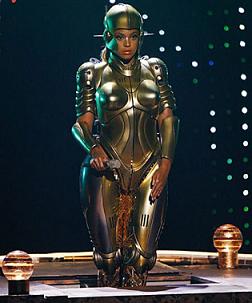
The looped rhythm is hypnotic, perfect for the dance floor and the sound of Disco, a rare movement in music for its futurism. The late Seventies saw a natural convergence of the highly-synthesised Disco sound with the ascent of popular Sci-Fi on the big and small screen, and so the likes of Moroder, Meco (who memorably Disco-fied the themes to the first two Star Wars movies), and the incorporated SF elements in the look and music of artists like Eruption, La Belle, Boney M and Earth Wind and Fire are for me intrinsically linked to the experience of watching Star Wars, Battlestar Galactica (whose chrome Cylons are the epitome of Disco-tech) and Logan's Run at the movies. Given the association it's little surprise that Beyonce would later reference the style for her own stage attire. And with her, of course, the likes of Kylie Minogue and Lady Gaga. Disco for me is the soundtrack of Seventies Sci Fi, and I haven't even mentioned the likes of Geoff Love and Jeff Wayne. Need I?

So farewell, Ms Summer. A voice destined to be with us for ages to come.