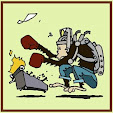
Today marks the 30th anniversary of the release of the Sinclair ZX Spectrum, a fact that quite frankly blows my mind just a little.
We had a Spectrum, my brother and I, after months of attending the local Computer Club and watching the slow transition of those in the group from the modest but limited ZX81 through to models that were a little more ambitious in memory and performance - including the Speccy. Money was saved, cases were argued (including the old chestnut that it would improve our education) and, eventually, as a family we made the trip down to Dunedin to pick up the new addition, all 16 kilobytes, peripherals, manuals and polystyrene packaging of it. It was a big moment in my adolescent life. I was thirteen and this looked for all the world like the future in our spare room. We loved our ZX Spectrum, lavishing it with hours of our developing lives and crafting it a fuzzy blue workstation of its very own, with holes for its coaxial cables and a shelf for its cassette player. Within a year or so we made a further plunge and with the help of a school friend, upgraded our little beauty to a more impressive 48k.
Let other blogs and sites tell of games and cheats and fledgling forays into BASIC and COBOL; my Spectrum experience was forged in site of these. I was no programmer, although my early attempts at computer graphics started with our home machine; nor was I a gamer, my lot in digital life seemingly ever to be terminated (with extreme prejudice) around the end of level three of every game I've ever played. My Spectrum experience was however an immersive one: lured by glossy ads and the promise that my comic heroes (Dredd, Nemesis the Warlock, Strontium Dog, Rogue Trooper, Dan Dare) would be realised in interactive, noisy 8 bit form. I became savvy to the Spectrum phenomena of marketing and fan culture - the slick advertising that promised so much (even if it delivered slightly less), the cheat-sheets and playground negotiations of these and bootleg game cassettes, the specialist magazines with their infinite lives pokes and codes. Every day trip to Dunedin had to involve two shop visits: to London Bookshops for White Dwarf magazine, and to David Reid Electronics, who'd sold us the computer and had many more cheap games and cassettes to copy others on to.
Somewhere amidst travelling with Bilbo Baggins, collecting Chuckie's Eggs and Jet-Setting with Willy I grew up. I learned the shrewdness of brand recognition (Melbourne House games were often literary based - The Hobbit, Sherlock Holmes, earnest but very well put together, Ultimate games - Sabre Wulf, Atic Atac, were punchy, dynamic, imaginative and innovative) and brand loyalty (I spit on you, Amstrad! et cetera). I learned my limitations as a programmer and gamer. But I communicated wit other kids about our shared interest in the computer, I made friends, and by god I actually got more out of it than I put into it. That's a rare thing in life right there. In time the world moved on: my friends upgraded to C64s or Amigas, and our school BBC Micros became robust, cuboid early Apple Macs. Ten years on from our ZX Spectrum I was eventually writing university essays on a word processor, then using email, Telnet, and eventually the World Wide Web. Technology, as George Lucas would modestly put it, had caught up with me. But my first love, for ever and always, will be a slim, black box with rubber keys and a non-threatening 80s-sharp rainbow flash on the corner.
Manic Street Preachers 'Gold Against the Soul' (1993)
Almost a year on from listening to Gold Against the Soul for the first time, I’m still unsure what to make of it. On the face of it, Gold is a logical progression from Generation Terrorists – lyrically it’s not greatly different in style or content, and thematically and sound-wise it seems as though the Manics have simply taken up where they left off, in the direction they probably intended to go. It’s not a memorable album, though, and while it was no failure, so far as I can ascertain it’s not regarded as one of their important ones either. It simply hasn’t warmed on me the way other Manics albums have.
Put broadly, Gold is Manic Street Preachers sticking to their plan of pop chart domination, and perhaps this intention is flagged a little more deliberately than on the previous album – the compositions are more straightforward, with more variety in pace and melody. Rather than barking polemic the lyrics flow like confessionals – indeed, the album seems more of an intimate work, with greater use of the first person and less of an objective second-person. What’s more the influences are, for want of a better word, more traditional and softer – there are bluesy moments, and a synthesised Hammond organ fills in gaps where previously guitar feedback would have performed the task. James Dean Bradfield’s voice is in places hushed, conveying more emotion and less hysteria – if this is a formula for greater chart penetration then it’s a simple and reliable one. It all adds up to the impression that as threatened the Manics are making their pitch at the hit parade, but not necessarily on their terms only, it’s a calculated form of compromise, and one that stops short of crying ‘sell out’. One resists the term ‘radio friendly’, although it’s an apt one, but under this new façade the band is changing still; in fact it’s deteriorating. Indeed, you don’t have to look far to see that below this glossier veneer, the Manics are still writing and singing about some troubling subjects. Insomnia, the anonymity of age, addiction, self-loathing – this is perhaps the first clear example of the band’s lyricists expressing their lives explicitly through their songs, but for a tilt at stadium success these make for difficult subjects to sing along to. Life Becoming a Landslide’s “My idea of love comes from / a childhood glimpse of pornography” is hardly Living on a Prayer. Within the band had something of a crisis the coming year, with Richie James admitted to a clinic for alcoholism and depression, singer Bradfield summing up the year in four words “Bag of utter shite.”
And yet, Manic Street Preachers supported Bon Jovi on a national tour to some success in that year, and Landslide remains one of the standouts from the album, achieving a melodic accessibility though a ballad format, one which wasn’t previously explored on an album outside of Pretty Baby Nothing. You might well think this evidence of a growing maturity in their songwriting, and perhaps it is. For me though the album’s highlight is its other big single, La Tristesse Durera (Scream to a Sigh), seeming to lead in on a single sustained note from the fading close of From Despair to Where: “I sold my medal, it bought a meal / It trades in market stalls, parades Milan catwalks” strikes me as one of their simplest, most elegantly rueful lines of the band’s early output, and its meditation on the lot of an elderly ex-serviceman will revisited three albums later of course in If You Tolerate This Your Children Will Be Next. On the whole, Gold has some good material, and a well-constructed first side indeed, with Sleepflower/Despair/La Tristessa and the egocidal Yourself playing a clever game of changing subjects and pace while leaving off and picking up in the same key. It flows rather well and deliberately, and it’s really only the latter songs of the album’s second side that either show their melodic limitations (Symphony of Tourette) or dated treatment (the title track, which I’d really like to hear stripped of its popping, blistering dancefloor synthesisers and mashed production.) Perhaps the final judgement I could lay on Gold is not that the Manics overreach themselves with this album, but that compared with what output follows this release doesn’t show the same verve or invention as its predecessor, even if the technique and awareness is evident.
The temptation I suppose in dealing with an album like Gold Against the Soul is to treat it as part of the journey, consigning it the status of a stepping stone along the way to a bigger, more influential or important work. Superficially this is of course what it is – there are two of these immediately to come, but Gold isn’t a road marker - it’s not even the fork in the road. What follows for the Manics is the choice between staying the path and sticking to their plan of chart success and that Wembley Stadium gig, or taking the path less followed, eschewing all to pursue something more personal and less radio friendly. Such decisions are the things that kill bands. In the end, with internal trials making themselves evident in song and the band’s appearances, I’m not so sure the choice was clear cut for the band, and what resulted is sort of both, for better or worse, and the seeds of the next two albums are equally shared in Gold Against the Soul.
Cover Story: Artistic, and decidedly less provocative than the previous effort. There's nudity inside the album jacket, but by far the most offensive object on display is Sean Moore's scary red ruffled pirate shirt, in which he's decided to take a swim:
If the master plan had come to fruition, there'd be a picture of a much-used, well-loved Marshall Amp here, which, given my rather timid approach to rock and/or roll at the time, would never have been turned past ten. So a sad farewell to a man whose product I always coveted, but haven't yet owned. I figure if I can make it to 88 myself, then I have a few more years yet to achieve the dream.
May the wonders of the next life go all the way to Eleven for you, sir...
As a postscript to Talkin' Eds, I always meant to put this up, coming as it did around the time of the series' end, and as it is of local interest (i.e., seen while driving home from work one day):
It's St Patrick's Day today. I have no great attachment to the day to be honest. To be brutally, unpretentiously honest - no Irish blood, no connection; I'm no hypocrite. More spleen-venting here, of course, but if you're eager to see me in a more charitable mood, here's an Irish judge from the Judge Dredd universe, hailing from the small Brit-Cit controlled territory of Emerald Isle. And it's a lady - trust me.
With a theme park mentality and a capital christened Murphyville you'd be a fool to expect anything less than a stereotype here, but, as seems the frequent case in the Dredd stories, the truth is stranger. Emerald Isle first appeared in the story of the same name during the run of Dredd largely overseen by the then up-and-coming writer Garth Ennis, and the look of the Irish judges - all harps, tricolours, shamrocks and pints, by fellow Irishman Steve Dillon - an artist whose style was for some time something of an early model for mine. The story's played for laughs, with spud guns on three settings (mash, chips and full-on taters), and yer man Dredd a grumpy fish out of water among a small band of the Garda who are largely in it for 'the craic' and aren't used to his big-city ultraviolent ways. Carnage ensues.
Murphyville's Judge-Sergeant Joyce returned for two further stories and then, with his creator, slipped the magazine with a fellow Judge - er, 'Wilde', I think (gosh, Mr scriptwriter Mark Millar, that's punching above your weight in the names department) filling in.
Enough grumbling. I actually like the Murphyville Judges, particularly for their levity in the face of an absurdly unfair world. That's probably another stereotype there, sorry, but that's the Dreddworld for you. And now for a confessions: so parochial were the early 2000ad stories of Mr Ennis that I genuinely and erroneously suspected his name was actually a pen-name, as no writer of Irish origin would seriously have a real name that so resembled the name of his homeland's national beverage.
Oh, look - more space! Okay then. A video - and here it is in honour of the day itself, the first wholly-Irish music track (and video) to totally blow me away, back in 1988. With, as any fule kno, additional crucial content by William Butler Yeats:
Manic Street Preachers: 'Generation Terrorists' (1992) At seventeen you want to change the world, and you think that you can.
I am, roughly, the same age as the surviving members of Manic Street Preachers and, along with Blur, consider them a band of interest because of this. As I age, so do they, and as groups and fan we live and stand side by side, albeit at very different ends of the chorus line. It’s around the age of seventeen that the individual members of Manic Street Preachers came to be a group, still at school, not yet a four-piece, but equipped with the beginnings of an education and attitude which would inform their later career. There’s little to show of this early incarnation, lacking the essential ingredient of songwriter Richey James, and before this album there’s only the New Art Riot EP with its essential single Motown Junk(“I laughed when Lennon got shot” etc) vying for attention. In the years between 1986 and 1991 it’s ground-work for the band. Touring playing, creating a buzzword and building a fan base. Generation Terrorists, the first album proper is the result of this work, and the Manics’ first full-length outing on a major label.
When I first encountered the MSP it was in the pages – or rather, on the cover, of the Melody Maker, and we were all about twenty-one years old . Sprawled languidly across each other, all glam makeup and cynical mouthiness, I instantly despised them, and what the interview inside revealed about this band of try-hard Bolans and Lydons were vying for. It seemed so ludicrous, their arrogance, their ambition and belief in their self-worth. Built up as much as they were by the music press at the time, I thought if anything that they were destined for a fall. But instead they clung in there, becoming a fixture of the NME and Maker. Instead of being an irritant they were a curiosity; but not enough of one for me to follow yet, or inspect further. The cover pose, media assault and the sound of their debut album were an adroit combination of intended outrage and provocation, a very rock and roll charm offensive.
The major label launch exemplifies the slightly schizophrenic nature of Manic Street Preachers’ media strategy. As informed as they were in their early days by left-wing punk and post-punk band such as the Clash and Red Wedge acts like Billy Bragg, their loftier ambitions are much more mainstream and acquired an instant and assured infamy: they wanted to make an album like Guns N Roses’ Appetite for Destruction; they wanted to sell out Wembley Stadium, and then they wanted to split up. They achieved none of those aims, and their failure (such as it might be measured) is the story of the band, marked by a calculated but portentous opening salvo through establishment in the UK indie and later mainstream music scene, and a steady, stable line-up interrupted only once -albeit crucially - with the disappearance of a creative lynchpin. I was saddened in downloading YouTube videos of this album to be forced to sit through an interstitial ad for, of all things, McDonalds. Is this what these young men wanted? The band who later courted controversy and eschewed the crass commercial buy-in, touring Cuba and playing for Castro? “Madonna drinks Coke and so you can too.”
Yet Generation Terrorists works surprisingly well on a single issue per song, contained and disciplined as they were at this stage. NatwestBarclaysMidlandsLloyds for example, and the single Little Baby Nothing, a feminist ballad in which singer James Dean Bradfield duets with Tracie Lords. Originally the duet was to have been shared with Kylie Minogue, but Minogue’s management vetoed the deal; the duet eventually occurred and can be heard here, although for my money there’s no comparison - Lords’ provenance and heavier delivery sell the song, while Minogue comes across as gimmicky. Wrought large, the album is single statements and phrases mashed together, invoking a deliberate clash and juxtaposition of lyrical images, fitting for the band’s own mix-and-match approach to style, image and reference. LBN is probably the most straightforward song of the whole album, addressing one person directly, while more celebrated and successful songs like Motorcycle Emptiness and Stay Beautiful represent a different marriage of slogan and descriptor, the latter almost a manifesto for the band itself.
What works:Slash 'n' Burn is a good opener, and a distinct nod to the band’s US influences in title as well as music (look out for a Robert Plant/Axl Rose yelp before the last chorus) plus NatWest, Motorcycle Emptiness (with nice Stuart Adamson guitar runs), You Love Us / Stay Beautiful. Half of the album is punchy and great, the other half sags in dated structure (Another Invented Disease with its GnR intro is clunky), and the full album is probably one side too long. The repetition of Repeat is somewhat ironic. The opposite effect is in James’ car crash lyrics of the above sloganeering and literary reference. Their density obfuscates delivery, and the message become lost amid a barrage of words which at this stage a game Bradfield manages well enough – two albums on and he’s gamely continuing and largely winning, but it’s a wall of words, and it begins here.
Which is not to paper over the contributions of the other, surviving members. James Bradfield's guitar work is already very accomplished, if a little studied and styled in the wake of others; Nicky Wire's bass is perfunctory, and we're yet to hear Sean Moore's drumming, alas, as it's all programmed for this album (and on some tracks, it shows). Perhaps at this stage the important thing is the look. The Sex Pistols just got away with an attitude and a minimum of open chords on stage; fifteen years on and this won't do - Bradfield has 'the chops' as they say, but it's a little startling also to see in live videos a young, 'ripped' shirtless torso behind the guitar as well. Nicky Wire's bizarre dressing - face paint, gender-bending frocks and scarves, is another thing entirely, and among them a genuinely wiry frame of Richey James. Yet it's James' lyrics that is one of the big things the Manics are known for and which drew the critical ear, and it’s still being developed on this album. The result here is early James, rather than the gatling-gun approach two albums on, and there’s still space, thankfully, for the quieter Spectators of Suicide, a late highlight.
Videos: As noted above, at this stage the videos are slick and straightforward; and extension of the band image and lyrics. Rather than narrative or cinematic they are studio-bound, sometimes cheap but always immediate. By the video of Little Baby Nothing the visual interplay of slogans and one-liners actually works against the intended message. The video’s direction makes them look more like that bane of Eighties music, the earnest ‘social issue’ band. Compared with the supercharged black-top muscle of, say, Slash ‘n’ Burn and the brattish You Love Us it really jars and must have given the casual viewer pause.
Album Cover: politely provocative. There’s a post-Like a Prayer church-bothering crucifix and bare ensemble, with tattoo (is it Richey’s arm?) all rendered in a daring pink on front, while on the reverse a European Union flag burns. It cries out for attention, but as suggested, falls somewhat short of outrage, while managing to merge provocation with an androgynous aesthetic (c.f Love’s Sweet Exile video)At this stage the borrowed iconography is a performance issue rather than a packaging one, so as sleeve design goes, the debut album is more of its time than the way forward.
If we did this right, then by now both Jamas over at The Truth Behind and I will be blogging on the same topic, the 1982 made-for-TV movie Mazes and Monsters. The movie has gained infamy for two things: firstly as an early entry in the oeuvre of two-time Oscar winner Tom Hanks, and secondly, as a memorable adjoinder to the great Satanic panic episode that accompanied the mainstream entry of Dungeons and Dragons into popular culture. Adapted from the book of the same name by Rona Jaffe, it takes its inspiration from the real-life story of James Dallas Egbert III, a Michigan State student whose disappearance into the university's steam tunnels and later suicide were investigated and later documented by private detective William Dear in his book The Dungeon Master.
I discovered the whole shebang wildly out of order, having played the game at fourteen through sixteen, discovered Dear’s book in, of all places, a roadside diner near Lake Ohau in ’86 (I didn’t buy it, though the dust jacket blurb was intriguing, if a little sensationalist), and then the movie itself, played on local TV around 1993. I also saw, before all of these, the Wizards and warlocks episode of Greatest American Hero; which was surely inspired by the Edgar incident but remains, I’m afraid, complete bobbins, even if it did get me into the game in some form. Most recently, I discovered my father-in-law has the movie, as a double pack with a portmanteau National Lampoon-style series of shorts called Loose Shoes and billed as a Bill Murray movie. At $4 from the Ashburton warehouse it’s a steal, but the transfer is the worst I’ve ever seen, with a poor picture quality and often indecipherable audio. It all adds to the mystique, I guess.
Mystique of course is something the early game had in spades, especially down here in NZ, where its press was almost non-existent, relegating one’s discovery of it to browsing in bookshops, or the subject of school gossip. Oh, there was gossip. And regional TV provided an interesting primer when it ran a news article on the phenomenon in 1982 or so. As much as we protested, the rulebooks of course did cover demons and devils – the AD&D ones at least, and the concept of assuming the personality of a fictional character and playing with lots of strange dice but no board? With no clear winner? It genuinely baffled my parents and older relatives, and I loved it for that. It made the game my own, a private world I could share only with my friends.
M&M’s conceit, borrowed from the case of Egbert is that a player of in-movie-analogue Mazes and Monsters, already traumatised by the childhood disappearance of his brother, “flips out and freaks out” during a Live Action Role Playing version of the hitherto table-bound game. Hank’s level-headed character Robbie (something of a dark horse as you’d be expect his erstwhile Egbert-like and serial hat-wearing fellow player JJ), has a nervous breakdown culminating in hallucinatory episodes, and him assuming the personality of his Mazes and Monsters character. Absconding to Manhattan to look for the ‘Great Hall’ (his absent brother Hall), endures some harrowing scrapes before making his way to the top of one of the World Trade Centre towers and… and… well, I’m not going to tell. Suffice it to say, it’s an area of the movie that happily doesn’t replicate the real life story of Egbert, and happily doesn’t speak for the experiences of most players of Roleplaying games I grew up with. For what it’s worth, our little band of teenaged adventurers did go through adolescence and roleplaying at the same time – real life is nightmarish enough at that age. And a couple of us struggled with the reaction the game had provoked in the more fervent (US) Christian literature, as we were churchgoers (the same can be said for our choice of music, of course). But our encounters with the game were much more mundane to be any sort of movie, even a made for TV one.
But having said that, the movie is at least neutrally inclined toward RPGs in that it doesn’t present the game maze and monsters as the cause of Robbie’s breakdown, although arguably the high stress environment of its play-acting episode could be construed as some form of catalyst. By comparison, Egbert’s steam-tunnel escapade has been attributed to external influences outside of his roleplaying – for Rona Jaffe it’s easy to see how the two elements (dungeons and dragons and real-life tunnels and mystery!) could make for a compelling combination. In her world, Mazes and Monsters is a pretty far out game:
And Mazes and Monsters is a pretty far out kind of movie. Silly in a lot of places, with amateur acting I many scenes (hanks shows early form though), and far too many hats. One to watch with a liquid friend or two, perhaps. I don’t think it deserves the scorn and ridicule heaped on it by the RPG community over the years, poor things. We can’t blame the writer for such a hackneyed analogue of D&D in her movie; Spielberg was no better, and it might help to view ‘movie’ RPGs as needing the same necessary ‘oomph’ as Hollywood OS; when the reality is mundane, who wouldn’t film a more exciting version? Incredibly, for a fictional game with very little on-screen detail, someone’s actually made a playable clone, complete with Mazemaster screen and playing board. Cool!


 Synchronise blogs!