Saturday, November 13, 2021

Making Room for the Gnome

 Believe it or do not, but the road to the Redcastle Gnome took a great many twists and turns before I found the ingredient I was looking for in the books of B.B.

I honestly don't even remember first setting out on it - though it would have been at least fifteen years ago. I rolled a Gnome character (Wrangfauld Orpin, a Thief/Illusionist, if memory serves) who never got used in my heady AD&D days, and even started on a large-scale adventure storyline that would eventually be resurrected around 2005 to become the Dwarven minecrawl Barbigazl.

The Gnomes that featured in Barbigazl were where I thought I would take the class if a regular gaming group had spun off: a largely subterranean culture with woodland roots who were devoted to exploration. Their paragons were the Delvers, who dared to go farther and deeper than those before them in search of the secrets of the earth. They would be spellcasters, after a fashion, with their requisite staff/rod analogue being a highly practical and desirable crozier or 'crook'. I allowed them options for invention and professions as 'tinkerers', themselves drawn to creating the most miraculous and fanciful of machines to serve Gnomekind. They would trade with Dwarves, war with kobolds, and build great and unfathomable subterranean cities incorporating fungi, giant arthropods and diminutive architecture.

It doesn't look too bad on paper, but it was probably too complicated, relied on too much buy-in to meet the rather necessary worldbuilding... and unless there were whole campaigns built around this sort of thing, who could be bothered? So it was abandoned.

Nearly ten years later I read the little grey men books, and my mind was re-sparked, and everything seemed to fall into place - a new race-as-class option for Basic D&D games (the Gnome as Druid) emerged, and there was enough cultural integrity to ensure that this player character option was recognisable, believable, and relatable. And if in the Barbigazl days I was at risk of reinventing the Deep Gnome or Tinker Gnome, I was later at risk of just reinventing the Forest Gnome, then whatever. The Druid spells papered over the gaps the ratification exposed.

Could I have made a similar problem for the Gnome in declaring them a woodland creature as the original game had in having them encroach across the Dwarf template? Maybe. But in my Redcastle world, that's a largely empty ecological niche, Elves being more widespread than just the green bits on the map, and most definitely not flower-wearing earth warriors. Instead, I move the Elves out of the forest; up mountains, in elaborately-excavated hill fortresses and under the sea. The woods no longer ring with their noble song, and have become more wild, dangerous and full of ancient mystery. 

And there, in the tangled roots and fallen trunks of ancient trees, under the bends of whispering brooks and between to fissures of weathered cliffs, the Gnomes live, and watch the outside world. 


Friday, November 12, 2021

The Spiritual Gnome

 It may seem counterintuitive to think of a Gnome worshipping a deity - at least as much as those other early demi-humans. Back in D&D's early days it was assumed clerics - that practical way to restore hit points and get rid of undead, were particular to all races, but only the human (or half-orc in AD&D) peoples would allow their clergy to also kit up and go a-dungeon-crawling.

In the case of Gnomes in early D&D the lines were drawn even thicker. Gnomes, it could be inferred, were not spiritual, they were magical; creatures adept in illusion and sleight of hand, it jibed with the theory, aligning with other diminutive tricksters of the fairy world. Who cares if the ability to cast great illusions seemed strange in a dark old mine? Their sworn enemies, the kobolds, were also underground dwellers and tricksy. Otherwise, it went some way to justifying the Illusionist class spell list if it could be used in more than one player character type. Woodland Gnomes weren't much different, and unless you are prepared to go back to the Brothers Grimm (it's complicated) , they're not especially magical.

Unless...

Unless the woodland Gnome were taken to specialise in woodland magic, and employ natural components in their spells, supplicating to gods personifying wild nature. This is what B.B offers in The Little Grey Men, with the older Dodder praying and ultimately summoning Pan, whose presence is felt throughout the rest of their story. I like the aspect of Pan: in line with the gods, actually a god, but not entirely godly, being very earthly, somewhat feral and (maybe) a bit horny as well. Of the Roman gods he's the most animalistic, and that works, too. I'm not saying Gnomes should worship Pan, but other gods are available: Silvanus, Gaia, Abnoba, Cernunnos, Phaunus, Leshy - and so on. 

Woodland magic, the worship of nature deities satisfies the Druid role in AD&D, and so my ideal race-as-class Gnome PC is just that: a Druid.

Thursday, November 11, 2021

Gnomes and Beasts

 Having covered Gnomes from a floral aspect for a couple of episodes now, it's time to turn to fauna - the beasts of the Gnomes' world.

I'm going to assume an archetypal D&D fantasy woodland and its animals - that is to say, Northern Hemisphere, European, and temperate, with defined seasons. The variety of animals (excluding invertebrates) run the range of fish, reptiles and amphibians, birds (waterfowl, passerine and non-passerine, raptors) and mammals. In the works of B.B and Wil Huygen the largest animals are generally badgers, foxes, domesticated dogs and polecats, but a fantasy woodland might also incorporate bears, boars, wildcats and wolves. Below that size are the other common woodland creatures: otters, squirrels, moles, bats, mice, rats, voles, rabbits, hedgehogs, weasels and stoats. The Cook Expert D&D Set of course includes giant ferrets as guard animals for a sample Gnome lair - but the aforementioned works, strictly sticking to their favoured Gnome dimensions (roughly a handspan), has no need of them. 

Size notwithstanding, it's the relationship which counts. Gnomes are the guardians of the woodland, friend to most animals, and sometimes fellow residents (B.B's little grey men share a tree with a couple of owls, Hugyen's foster infant mammals). Reptiles are at best tolerated - in Down the Bright Stream an adder is as capricious and sinister as the serpent of Eden, and fish are equally food and predator, depending on their size (minnow and a pike, respectively.) The underlying philosophy is that the Gnomes share their woodland home with animals. They rarely eat flesh, save for fish (it's okay, they don't have any feelings), and steal bird eggs, but don't seem to hunt fowl or rabbits. This extends to their craft - of which more in another post.


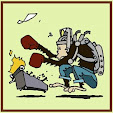
Above: Gnome with Squirrel, after B.B

Gnomes share a language with the animals, being able to converse with (seemingly) all mammals, most birds, and the aforementioned adder, and they rely on the strength, skills (burrowing by moles, hunting by otters, flight by the owls) and knowledge of these creatures. In exchange they ply their crafts, invention and dexterity to help their animal friends. In short, Gnomes are a woodland creature among others - notably in the Tales from the Wood RPG inspired by Watership Down and the books of BB, Gnomes are simply another player type alongside the rabbits, badgers, squirrels and other creatures.

To the adventuring Gnome such relationships and skills are significant. The ability to naturally Speak With Animals (certain kinds) and rely on them for intelligence and local lore could be very handy. the ability to summon those creatures at a time of peril could be a life saver.

Best left there for now. Suffice it to say the animal/Gnome relationship is essential to the character class and not to be sniffed at. There's more to add, but there we drift into the mystical. And that's best for another post... 

Wednesday, November 10, 2021

Names and Gnomenclature.

 There is a lot of codification in the names of fantasy characters. George  Martin employed consonant shifts and an almost phonetic approach in adapting common names for his characters in his Song of Ice and Fire novels ('Eddard', 'Podrick', 'Sersei'). Tolkien took hi from Old Norse and Anglo Saxon histories, depending on the culture of his people - and when it came to Hobbits, he mixed the old with the contemporary, adding evocative descriptors and alliteration to give them their own distinctive sounds: Bilbo, Frodo, Samwise, Odo, Bungo, Meriadoc, Gerontius, Belladonna.

The last name - that of Bilbo's ill-fated mother, is of course a botanical name, and it's the names of wild flowers that B.B. uses for his little grey men: Dodder is a vine-like weed, Baldmoney an aromatic mountain plant, Cloudberry a raspberry-like fruit, and Sneezewort a hardy wildflower. Some of these are edible, some have medicinal properties, others known for their toughness or resilience, and yet others for their beauty.


I like the convention of botanical names for Gnomes. They divorce themselves from the human and cleave instead to the natural world. There are dozens of names for some plants, and hundreds of varieties; some names are almost lost , or so regional as to be obscure, and if Gnomes are not numerous, in a fantasy setting they needn't have linear surnames to distinguish themselves - in fact, I'd recommend against the convention. But to make it slightly codified, I've taken to using tree or weed names for males, and floral or herbal names for females. It'll do for now.

Above: Houndstongue and Primula.  

Recommended sourcebook: Culpeper's Complete Herbal (1653), via Project Gutenberg
 

Tuesday, November 9, 2021

The Adventuring Gnome

 “It's a dangerous business, Frodo, going out your door. You step onto the road, and if you don't keep your feet, there's no knowing where you might be swept off to.” - Bilbo Baggins


So far I've described a Gnome at home in the woods; tied to nature, attuned to the rhythm of the living world, breathing to the wind in the treetops. A Gnome in his or her element is exactly where they should be - but it's no epic story in the making. If a Gnome is so ideally posited as a loner, or part of a small community of fosters, what on earth would inspire one to go adventuring?


Fortunately we have a literary precedent, in the form of Cloudberry, a Gnome at the heart of B.B's The Little Grey Men. Unlike his brothers Dodder, Sneezewort and Baldmoney, Cloudberry is, as his name suggests, something of a spiritual wanderer and is gripped with wanderlust. Of his own volition, and against the counsel of his brothers, he leaves Folly Brook and goes off 'up river', adventuring with a flock of high flying geese ('heaven Hounds') to distant lands. Like Bilbo and Frodo in the quote above, he returns to his brothers, never the same again.

Despite this cautionary example (Cloudberry is at the last a dangerous dreamer, and at worst... much worse), we can at least say we have one - and it's useful in noting the 'change' that occurs in Cloudberry afterwards. he is ever restless, unable to think or talk of anything else but his travels, and schemes to find a way to rejoin them. A player character Gnome needn't be so pathologically obsessed, but the curiosity is a handy hook. Everything else is detail, although my preference, if it hasn't been obvious already, is to start out keeping things simple. A beginner Gnome adventurer ought to have their own hand-crafted tools and weapons, and little armour, perhaps collecting the more usual trappings along the way. The life of a wandering Gnome among fellow drifters of other races need have little more, but change is inevitable. If you seek to play a Gnome adventurer, expect change.

Monday, November 8, 2021

Arms and the Gnome

 Last post left off on a question: are Gnomes warriors? I think yes, and no. 

No, in that they don't - or hardly ever go to war. They are not a martial people, and we could turn to  J.R.R.Tolkien's Hobbits as a comparison; also peaceful peoples, albeit with a ready to assemble militia and sheriff as needed (and even during the events of the destruction of the Ring this is rarely employed - and even then by third parties)

So perhaps yes in the sense that they will fight if they have something to defend. The D&D Gnome in the wild has a lair, and the various Monster Manuals give them colonies of many individuals, defences and guardian animals. The Monster manuals also express a preference for crossbows (since Greyhawk, as far as I can see), which lends more towards the mechanical side of Gnomes - or perhaps is a 'different flavour' necessary to distinguish them from their cousins.

Myself, I would strip this back. 


If pragmatism is a characteristic of the woodland Gnome, then it makes sense that he or she would be prepared to defend their home, their friends, or their livelihood with whatever may be at hand. I would surmise then that like peasant warriors they would adapt their common tools into ready arms - or be skillful enough to wield them so. For a woodland Gnome this could be a staff, a hatchet-style axe, a sturdy knife, or a club (frankly, a much overlooked weapon). A ranged weapon might be more along the lines of hunting equipment: shortbow, sling or blowdart. Spears? Maybe. Swords, pole arms, maces - and yes, crossbows - are out.Shields and armour? None to speak of.

Metals being rare in woodlands, and war even rarer, such resources would be reserved for more practical things. Take a Gnome out of the woods, however, and the story may well change...

Sunday, November 7, 2021

The Warrior Gnome

 The default 'Monster' setting for any character race in D&D is the Fighter. It's reductionist, and we know that there's so much more to many of these peoples, but there it is. Look in the Monster Manual, or the Monsters pages of the Basic set (Moldvay or Mentzer) and they're there among the similarly fighter-ised Halflings and Elves (who do at least get a spell in). In part this is simple game mechanics - a template to base your encounter off. But unlike the pop culture histories of Dwarves and Elves, Halflings and Gnomes don't carry the same martial weight.

And so, setting Halflings aside, we must ask: what is a Gnome Fighter? Are Gnomes warriors - i.e., do they go to war?