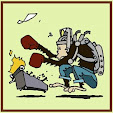
Appropriately for a winter release, GBQ (as I shall abbreviate it henceforth) doesn’t get a lot of playtime in sunnier months, but yesterday was a very soggy day for summer, and it seemed to fit. In fact, my earliest memory after buying this was listening to it on the car stereo during a drive home, stuck in traffic with what looked like half of Wellington’s annual rainfall hammering down around me. GBQ is a rain-lashed album, with imagery of dark, thunderous clouds and an impending deluge – a post-millennial throwback to the rising oceans of Simonon’s famous former act’s London Calling. There’s London on the album, too, of course – throughout the album, in fact. This is Damon Albarn in his late solo phase cast as a fretful sleeper anchored in England’s sinking and drinking capital, singing songs about global warming, the Iraq invasion and the spiritual gloom of his homeland. It’s not all storm clouds, but the Apocalypse can’t be far away: bunting hangs awaiting the return of soldiers posted abroad, ambulance sirens chorus in the distance, a whale is stranded up the Thames, and the ravens of the Tower take flight. GBQ shares its producer Danger Mouse with Gorillaz’ equally doomsday Demon Days, but the result here is less global, more local. This is an album which flirts as much with other works as it does with English ritual and lore – there are echoes of Dirty Old Town in the lyrics, late in the play Simonsn’s bass threatens to deliver an updated version of Guns of Brixton (something the bassist reportedly did accidentally during a live performance), and comparisons and contrasts are inevitable with the Village Green Preservation Society sound of peak era Blur. Yet the arch, playful Parklife this is not, but it’s as perfect a counterpart to Blur’s London album as its follow-up, the fraught and boorish The Great Escape wasn’t.
Wednesday, January 22, 2014
On a Stroppy Little Island of Mixed-up People
Appropriately for a winter release, GBQ (as I shall abbreviate it henceforth) doesn’t get a lot of playtime in sunnier months, but yesterday was a very soggy day for summer, and it seemed to fit. In fact, my earliest memory after buying this was listening to it on the car stereo during a drive home, stuck in traffic with what looked like half of Wellington’s annual rainfall hammering down around me. GBQ is a rain-lashed album, with imagery of dark, thunderous clouds and an impending deluge – a post-millennial throwback to the rising oceans of Simonon’s famous former act’s London Calling. There’s London on the album, too, of course – throughout the album, in fact. This is Damon Albarn in his late solo phase cast as a fretful sleeper anchored in England’s sinking and drinking capital, singing songs about global warming, the Iraq invasion and the spiritual gloom of his homeland. It’s not all storm clouds, but the Apocalypse can’t be far away: bunting hangs awaiting the return of soldiers posted abroad, ambulance sirens chorus in the distance, a whale is stranded up the Thames, and the ravens of the Tower take flight. GBQ shares its producer Danger Mouse with Gorillaz’ equally doomsday Demon Days, but the result here is less global, more local. This is an album which flirts as much with other works as it does with English ritual and lore – there are echoes of Dirty Old Town in the lyrics, late in the play Simonsn’s bass threatens to deliver an updated version of Guns of Brixton (something the bassist reportedly did accidentally during a live performance), and comparisons and contrasts are inevitable with the Village Green Preservation Society sound of peak era Blur. Yet the arch, playful Parklife this is not, but it’s as perfect a counterpart to Blur’s London album as its follow-up, the fraught and boorish The Great Escape wasn’t.
Tuesday, January 21, 2014
Lead Time Lords: The Fifth Doctor
Here he is, the Fifth Doctor, my beige nightmare as played by Peter Davison
This is the last of the Doctors produced in miniature by Citadel, and here’s the soft-toy cuddly version, below:
Harlequin’s update is posed suspiciously similarly – an update in a way that three of their other twentieth-century Doctors were.
That said, Harlequin’s Davison is a little better in proportion – although look out for the bendy legs once more, and perhaps on the whole the figure lacks some further realisation. The face for one is disappointing – there’s no discreet likeness to speak of with regard to the actor, and the eyes are something of a challenge, looking more like buttons than anything else. By far the most annoying aspect of this figure is an affliction that strikes a lot of the Harlequin Doctors – a serious case of paddle-foot. Shoes should not be hard to sculpt, and here it just looks as though someone stopped trying once they finished off the trousers. I’ve attempted to sculpt some laces in green stuff, just to give the feet a bit more definition.
In all, perhaps Harley’s Davison (ho ho) is a victim of the company’s similar approach to the Eighth Doctor – a little rushed, culminating in something that lacks dynamism or real character. He doesn’t even have a hat, although an alternative sculpt (pictured here) at least gives him a cricket bat, which might do if you ever needed a Doctor to co-opt into a Shaun of the Dead-themed miniatures game.
Finally, hat tips are due to three miniature painters whose work I studied at length to get this puppy finished – once again, An Evil Giraffe’s eyes and palette are wonderful, and faced with any number of options for rendering the Fifth Doctor’s problematic striped flannels, I took much inspiration from Mark Evans’ job (sadly no longer online, it seems). Finally, the curiously-named No Such Agency of the Lead Adventure Forum produced a rather lovely model from this mini, complete with a cricket ball for added colour, so there’s definitely hope . I must, however, confess to getting a little tetchy with Harlequin’s range, and I think my impatience shows here. To be honest, I’m very much looking forward to working on some more recent sculpts from other manufacturers.
This is the last of the Doctors produced in miniature by Citadel, and here’s the soft-toy cuddly version, below:
![]() |
| Painted by Menace Miniatures |
That said, Harlequin’s Davison is a little better in proportion – although look out for the bendy legs once more, and perhaps on the whole the figure lacks some further realisation. The face for one is disappointing – there’s no discreet likeness to speak of with regard to the actor, and the eyes are something of a challenge, looking more like buttons than anything else. By far the most annoying aspect of this figure is an affliction that strikes a lot of the Harlequin Doctors – a serious case of paddle-foot. Shoes should not be hard to sculpt, and here it just looks as though someone stopped trying once they finished off the trousers. I’ve attempted to sculpt some laces in green stuff, just to give the feet a bit more definition.
In all, perhaps Harley’s Davison (ho ho) is a victim of the company’s similar approach to the Eighth Doctor – a little rushed, culminating in something that lacks dynamism or real character. He doesn’t even have a hat, although an alternative sculpt (pictured here) at least gives him a cricket bat, which might do if you ever needed a Doctor to co-opt into a Shaun of the Dead-themed miniatures game.
Finally, hat tips are due to three miniature painters whose work I studied at length to get this puppy finished – once again, An Evil Giraffe’s eyes and palette are wonderful, and faced with any number of options for rendering the Fifth Doctor’s problematic striped flannels, I took much inspiration from Mark Evans’ job (sadly no longer online, it seems). Finally, the curiously-named No Such Agency of the Lead Adventure Forum produced a rather lovely model from this mini, complete with a cricket ball for added colour, so there’s definitely hope . I must, however, confess to getting a little tetchy with Harlequin’s range, and I think my impatience shows here. To be honest, I’m very much looking forward to working on some more recent sculpts from other manufacturers.
Monday, January 20, 2014
"Vanity Waltz"...?
Five things I can remember about the ZX Spectrum game Planet of Death:
1 Adventure A: Planet of Death is a text-only adventure based around the scenario of the player character (YOU!) marooned on an unfamiliar world.
2 It came free with the machine we bought, and as this was a common practice at the time, I believe this adventure has a certain association with a generation of computer fans.
3 It has this awesome cover which I thought was one of the most awesome things ever and, I regret to add, has absolutely no bearing on the events of the game. A world of disappointment at owning a ZX Spectrum may well have begun with this stark, simple fact.
4 Artic Computing strikes me as a most unusual name for a business, and perhaps as far from the world of high adventure computer games as you could get. But their logo totally does what it says on the box - it's in the shape of an articulated lorry, wheels and all!
5 I never completed the game despite many tries, and found its infamous clue "VANITY WALTZ!" utterly impenetrable for a thirteen year old. The answer lay in a means to pass a force field separating you from your captured ship, the only thing that will take you off the titular benighted, but lamentably storm-lashed, skull-rocked world.
1 Adventure A: Planet of Death is a text-only adventure based around the scenario of the player character (YOU!) marooned on an unfamiliar world.
2 It came free with the machine we bought, and as this was a common practice at the time, I believe this adventure has a certain association with a generation of computer fans.
3 It has this awesome cover which I thought was one of the most awesome things ever and, I regret to add, has absolutely no bearing on the events of the game. A world of disappointment at owning a ZX Spectrum may well have begun with this stark, simple fact.4 Artic Computing strikes me as a most unusual name for a business, and perhaps as far from the world of high adventure computer games as you could get. But their logo totally does what it says on the box - it's in the shape of an articulated lorry, wheels and all!
5 I never completed the game despite many tries, and found its infamous clue "VANITY WALTZ!" utterly impenetrable for a thirteen year old. The answer lay in a means to pass a force field separating you from your captured ship, the only thing that will take you off the titular benighted, but lamentably storm-lashed, skull-rocked world.
Sunday, January 19, 2014
Lead Time Lords: The Fourth Doctor (1)
"You might be a doctor, but I am THE Doctor. 'The Definite Article', you might say!"I
Still working my way through Harlequin's Doctors Who, and so I'm up to Tom Baker's Fourth Doctor, or at least one of Harlequin's three versions:
This is, as far as I've seen, not that common a choice of figures among painted collections I've seen. But thanks to a UK-based friend from the over ten or so years ago this was purchased, this was the one I got sent (cheers Dave!) when Harlequin went out of business and places like Forbidden Planet had them going for a song. Je ne regrette rien as they say in Rome, and so this version is the one I have. I'll paint one of the other versions recently sourced (cheers Jamas!) in due course.
Actually, I rather like this version, as it strikes most of the notes you want to with the Fourth Doctor - jelly babies, long scarf, long coat, teeth and curls, wild eyes (though that might be my painting again.) My quibbles are small - for instance, the scarf should be looped around the Doctor's neck; it doesn't look quite long enough this way, but some things I just don't want to attempt with green stuff, because that would mean sculpting around the back of his neck as well, and I can't see how I could better things, really. It's a trade-off anyway - you get the scarf, but not the buccaneer boots (thus firmly positing the Doctor somewhere in his Seasons Fourteen to Fifteen phase), you get the hair, but not the hat - that sort of thing.
Still, face aside, the ensemble was pretty straightforward to paint once I'd found a story to base everything on (either Hand of Fear or Robots of Death - I forget which.) The coat is a chocolatey velvet, so a semi-gloss seemed the order of the day, and the scarf is in reasonably muted colours - that Begonia Pope, she knew what she was doing.
And that's one of the Fourth Doctors!
Still working my way through Harlequin's Doctors Who, and so I'm up to Tom Baker's Fourth Doctor, or at least one of Harlequin's three versions:
This is, as far as I've seen, not that common a choice of figures among painted collections I've seen. But thanks to a UK-based friend from the over ten or so years ago this was purchased, this was the one I got sent (cheers Dave!) when Harlequin went out of business and places like Forbidden Planet had them going for a song. Je ne regrette rien as they say in Rome, and so this version is the one I have. I'll paint one of the other versions recently sourced (cheers Jamas!) in due course.
Actually, I rather like this version, as it strikes most of the notes you want to with the Fourth Doctor - jelly babies, long scarf, long coat, teeth and curls, wild eyes (though that might be my painting again.) My quibbles are small - for instance, the scarf should be looped around the Doctor's neck; it doesn't look quite long enough this way, but some things I just don't want to attempt with green stuff, because that would mean sculpting around the back of his neck as well, and I can't see how I could better things, really. It's a trade-off anyway - you get the scarf, but not the buccaneer boots (thus firmly positing the Doctor somewhere in his Seasons Fourteen to Fifteen phase), you get the hair, but not the hat - that sort of thing.
Still, face aside, the ensemble was pretty straightforward to paint once I'd found a story to base everything on (either Hand of Fear or Robots of Death - I forget which.) The coat is a chocolatey velvet, so a semi-gloss seemed the order of the day, and the scarf is in reasonably muted colours - that Begonia Pope, she knew what she was doing.
And that's one of the Fourth Doctors!
Saturday, January 18, 2014
A Box of Progs
My trip down south coincides with the clearing of my Dad's place, and with it (somewhat inevitably), some rediscoveries of old, long-thought disappeared treasures. I've found quite a few now, but chief among them has to be my collection of early 2000ADs. Hooray!!! Every home visit for maybe the last ten years has been frustrated by me not being able to find two large cardboard boxes of issues (or 'progs' to use the magazine's own futuristic vernacular), but this month with what seemed the last ever attempt to find them by hand, they let their hidden presence be known.
As expected, and then some more, these boxes have turned out to be as much a time capsule as my own juvenilia. A friend once went into a virtual state of mourning after our flat was burgled and he lost his entire music cassette collection; his reasoning being that among those often redundant and patchy collections of albums and dubs he could name the times he first heard certain songs, the places he'd visited or the mood he was in. The act of consuming media is a weird two-way street sometimes; it seems to me that the more vivid or visceral the experience of reading or listening, watching... is, the more that experience takes in and 'records' other experience around it as an unconscious contextual backdrop. And so in that regard I've memories of when I first read in the pages of my progs the series Helltrekkers, discovered the histories of the various 80s ABC Warriors, got into Slaine (on a train, as it turned out), followed Dredd and Anderson through the City of the Damned, had my mind blown by the likes of Pat Mills and Kev O'Neill in Nemesis the Warlock and Metalzoic. It's all there, and flowers like fireworks in my brain when I open those pages again after twenty-five to thirty years of simply getting on with life. It's remarkable.
My boxed progs are only part of my collection - it's not complete, but may now number over a thousand, and the process of integrating these old issues (I've only brought up around thirty so far) with my collection here will be a slow but interesting one. I've been selective with the ones I've brought up - two boxes, one of my earliest progs (I think Prog 180 might be the oldest of them?), and another of a selected run comprising the aforementioned Helltrekkers, some of Bryan Talbot's stint on Nemesis, and all of Metalzoic (on which I'll post soon). Of course, the issues I left behind will eventually make their way here (fingers crossed). In them is the end of my 80s infatuation with 2000AD, petering out somewhere past Prog 500 and, as it seemed to me, the end of the magazine's early golden age and its short transformation from adventure comic for boys into ephemeral accessory of the Acid House set. I did reacquaint myself with 2000AD during my Uni years, and those progs are also at home, but the prospect of having all of these issues together at last (still incomplete, I must stress) is an exciting one. Happy times and places in every issue, and, of course, the stuff of Jetsam.
As expected, and then some more, these boxes have turned out to be as much a time capsule as my own juvenilia. A friend once went into a virtual state of mourning after our flat was burgled and he lost his entire music cassette collection; his reasoning being that among those often redundant and patchy collections of albums and dubs he could name the times he first heard certain songs, the places he'd visited or the mood he was in. The act of consuming media is a weird two-way street sometimes; it seems to me that the more vivid or visceral the experience of reading or listening, watching... is, the more that experience takes in and 'records' other experience around it as an unconscious contextual backdrop. And so in that regard I've memories of when I first read in the pages of my progs the series Helltrekkers, discovered the histories of the various 80s ABC Warriors, got into Slaine (on a train, as it turned out), followed Dredd and Anderson through the City of the Damned, had my mind blown by the likes of Pat Mills and Kev O'Neill in Nemesis the Warlock and Metalzoic. It's all there, and flowers like fireworks in my brain when I open those pages again after twenty-five to thirty years of simply getting on with life. It's remarkable.
My boxed progs are only part of my collection - it's not complete, but may now number over a thousand, and the process of integrating these old issues (I've only brought up around thirty so far) with my collection here will be a slow but interesting one. I've been selective with the ones I've brought up - two boxes, one of my earliest progs (I think Prog 180 might be the oldest of them?), and another of a selected run comprising the aforementioned Helltrekkers, some of Bryan Talbot's stint on Nemesis, and all of Metalzoic (on which I'll post soon). Of course, the issues I left behind will eventually make their way here (fingers crossed). In them is the end of my 80s infatuation with 2000AD, petering out somewhere past Prog 500 and, as it seemed to me, the end of the magazine's early golden age and its short transformation from adventure comic for boys into ephemeral accessory of the Acid House set. I did reacquaint myself with 2000AD during my Uni years, and those progs are also at home, but the prospect of having all of these issues together at last (still incomplete, I must stress) is an exciting one. Happy times and places in every issue, and, of course, the stuff of Jetsam.
Friday, January 17, 2014
Lead Time Lords: The Second Doctor (1)
Over the break I didn’t just holiday – I also painted.
First off the rank is a completion of my Second Doctor figure. As with the other four ‘classic’ Doctors of their range, the Patrick Troughton iteration was first rendered lead-wise by Citadel Miniatures as a gargoyle 28mm piece in the mid-80s. Check out Modeller Chris Clayton's excellent paint job.
Harlequin’s 90s effort adopts a similar pose – though there is a rarer, alternative version, based on a still from the as-yet missing debut Power of the Daleks, featuring the Doctor with 500 Year Diary and birdcatcher’s hat:
But back to the one I have, the more regularly seen Oscar™-style pose with recorder. Unlike the ‘Power’ version this is a tad more generic, which is useful, but wiser heads than I – notably An Evil Giraffe, have seen the error in Harlequin’s design – inadequate pockets and a too-short jacket, making the Troughton Doctor a little less tramp-like in appearance. AEG rectified this masterfully with green stuff, and I’ve followed suit as best I could. In addition, and because I also think the recorder a little lazy in rendering, I’ve added some green stuff tassels. There’s not a lot of colour variance between the First and Second Doctors’ outfits, so I’ve strived for as much as I reasonably can; the tassels help to break up a mid-section that is equal parts unimaginative (come one, guys – it’s the Second Doctor!) and sausage-fingered. The result is that my Second Doctor with his grey trousers, red hanky, salt-and-pepper hair and George Hamilton tan is more your actual Eighties incarnation of the Second Doctor – fresh from a trip to Seville, if you will (and not to suggest, I trust, that he is an orange.)
I’ll make no apologies – it’s not a great paint job, and is a little wobbly in places, but it’s time to press on. I do have another of these figures sitting around, however, and might well revisit the Cosmic Hobo in time – again, with some green stuff to hand, and maybe with an eye to a different kind of coat altogether, and from a less-Mediterranean clime…
Harlequin’s 90s effort adopts a similar pose – though there is a rarer, alternative version, based on a still from the as-yet missing debut Power of the Daleks, featuring the Doctor with 500 Year Diary and birdcatcher’s hat:
But back to the one I have, the more regularly seen Oscar™-style pose with recorder. Unlike the ‘Power’ version this is a tad more generic, which is useful, but wiser heads than I – notably An Evil Giraffe, have seen the error in Harlequin’s design – inadequate pockets and a too-short jacket, making the Troughton Doctor a little less tramp-like in appearance. AEG rectified this masterfully with green stuff, and I’ve followed suit as best I could. In addition, and because I also think the recorder a little lazy in rendering, I’ve added some green stuff tassels. There’s not a lot of colour variance between the First and Second Doctors’ outfits, so I’ve strived for as much as I reasonably can; the tassels help to break up a mid-section that is equal parts unimaginative (come one, guys – it’s the Second Doctor!) and sausage-fingered. The result is that my Second Doctor with his grey trousers, red hanky, salt-and-pepper hair and George Hamilton tan is more your actual Eighties incarnation of the Second Doctor – fresh from a trip to Seville, if you will (and not to suggest, I trust, that he is an orange.)
I’ll make no apologies – it’s not a great paint job, and is a little wobbly in places, but it’s time to press on. I do have another of these figures sitting around, however, and might well revisit the Cosmic Hobo in time – again, with some green stuff to hand, and maybe with an eye to a different kind of coat altogether, and from a less-Mediterranean clime…
'A Distillation of Smug' or, The Hobbit reviewed part two
Yes, I went to the second Hobbit movie. I think it’s a better movie than the first, but overall I don’t think this will stick in my memory for long.
I’ve struggled with the Hobbit movies so far as an adaptation. I’m usually tolerant of adaptations, and I definitely subscribe to the argument that you can’t film a book – but it’s not for want of trying to read a movie like a book if you’re a fan of the original text. After twenty minutes I finally told myself to stop looking for where I’d put my theoretical cuts on a book-fan edit and just went with the movie; which is just as well by this installment’s end, which very definitely goes its own way as well, but not altogether successfully.
I do have an issue with the additions Jackson, Walsh and Boyens have set upon the original story line. Which isn’t to say I dislike them all – the character of Tauriel is welcome in my book, and even her love triangle between Legolas and Kili is ‘okay’; no, the problem is that with this amour comes that beloved trope of modern scriptwriters, the ‘character arc’. When every major character has to grow within a story, even with a three-movie arrangement as here, the seams will be tested as more characters are included. And it’s not just characters – some key installments form the novel are given short shrift here, too – Beorn’s back story is now reliant on the stitched-on dreaded Azog subplot, which itself is now tied to the greatly expanded and mostly made-up Necromancer B-plot. From where I sit now it seems likely to me that Beorn will be little more than a ‘surprise’ cameo in the third movie’s Battle, while Laketown’s inhabitants deserved more than to be mute observers in a battle of wills between Luke Pace’s not-Aragorn Bard (the likenesses aren’t as close as some feared, but I do suspect the writers were at pains to make a distinction anyway) and Stephen Fry’s set-gnawing Master – a role which is written OTT anyway, but still – who are these people and why should we worry that they are in peril at the end of the movie? Or is that what stranding Kili, Fili, Oin and Bofur (each given welcome character expansion, I do admit) there is for? For a community who have as much of a claim to the Lonely Mountain and a prophecy surrounding it, I think we could have been better served than the shenanigans inside Erebor and its giant golden dwarf statue.
Everything is so tied together in The Desolation of Smaug that the narrative has a lot of boxes to tick. Whereas Tolkein simply had to get Bilbo and the Dwarves through Mirkwood and Laketown without Gandalf and while building the Company’s trust in their Thief as Thorin’s treasure-sickness grows, in the movie we’ve the Necromancer story, tragic pasts for Bard and Beorn, a character arc for Tauriel and Legolas (and likely Thranduil, who while distant and veal in the book gets lumbered with facial scarring and class issues as well on the screen). In all, this part of the story should be building up the plot, not creating a more complicated story with more mouths to feed – I was relieved when I heard the Hobbit was to be a trilogy, thinking it would enable the story to breathe, particularly with the added B-story; unfortunately I still think it’s choking, and unlike The Lord of the Rings I’m not feeling as disposed to redressing the balance with extended editions.
The rest, I’m happy to say, is an improvement. The casting is still great; with Pace, Evans and Lilly all offering nuanced performances to new or almost-new characters – even Mikael Persbrand’s Beorn is an interesting interpretation, although he is somewhat one-note with the scene he’s given. The CGI is largely good where it counts – Smaug is indeed magnificent, although there are some ropey composite shots here and there; overall the design work is superb, although as before I could have happily sacrificed time in Laketown for actual detail on its significance. I decided to see DOS in 2D this time, and don’t regret it – I think nothing’s been lost, and while the high frame rate still makes sets look more like sets and action look more like video than film, watching the film without the added gimmickry was a more pleasing experience. It’s not an uncommon criticism or snark online that the Hobbit trilogy has done for Tolkien movies what George Lucas’ prequel trilogies did for Star Wars, offering an overly-fussy, somewhat gaudy and not-entirely satisfactory return to a much-loved original. Two movies through the trilogy now I’m actually feeling the same way as I did after Attack of the Clones, a little underwhelmed, hopeful for the last installment, but half-expecting it to fail to deliver. It’s a shame, but I’m not sorry I’ve seen this after all.
Plus, it's given me a few ideas about what I want to do next model-wise...
I’ve struggled with the Hobbit movies so far as an adaptation. I’m usually tolerant of adaptations, and I definitely subscribe to the argument that you can’t film a book – but it’s not for want of trying to read a movie like a book if you’re a fan of the original text. After twenty minutes I finally told myself to stop looking for where I’d put my theoretical cuts on a book-fan edit and just went with the movie; which is just as well by this installment’s end, which very definitely goes its own way as well, but not altogether successfully.
I do have an issue with the additions Jackson, Walsh and Boyens have set upon the original story line. Which isn’t to say I dislike them all – the character of Tauriel is welcome in my book, and even her love triangle between Legolas and Kili is ‘okay’; no, the problem is that with this amour comes that beloved trope of modern scriptwriters, the ‘character arc’. When every major character has to grow within a story, even with a three-movie arrangement as here, the seams will be tested as more characters are included. And it’s not just characters – some key installments form the novel are given short shrift here, too – Beorn’s back story is now reliant on the stitched-on dreaded Azog subplot, which itself is now tied to the greatly expanded and mostly made-up Necromancer B-plot. From where I sit now it seems likely to me that Beorn will be little more than a ‘surprise’ cameo in the third movie’s Battle, while Laketown’s inhabitants deserved more than to be mute observers in a battle of wills between Luke Pace’s not-Aragorn Bard (the likenesses aren’t as close as some feared, but I do suspect the writers were at pains to make a distinction anyway) and Stephen Fry’s set-gnawing Master – a role which is written OTT anyway, but still – who are these people and why should we worry that they are in peril at the end of the movie? Or is that what stranding Kili, Fili, Oin and Bofur (each given welcome character expansion, I do admit) there is for? For a community who have as much of a claim to the Lonely Mountain and a prophecy surrounding it, I think we could have been better served than the shenanigans inside Erebor and its giant golden dwarf statue.
Everything is so tied together in The Desolation of Smaug that the narrative has a lot of boxes to tick. Whereas Tolkein simply had to get Bilbo and the Dwarves through Mirkwood and Laketown without Gandalf and while building the Company’s trust in their Thief as Thorin’s treasure-sickness grows, in the movie we’ve the Necromancer story, tragic pasts for Bard and Beorn, a character arc for Tauriel and Legolas (and likely Thranduil, who while distant and veal in the book gets lumbered with facial scarring and class issues as well on the screen). In all, this part of the story should be building up the plot, not creating a more complicated story with more mouths to feed – I was relieved when I heard the Hobbit was to be a trilogy, thinking it would enable the story to breathe, particularly with the added B-story; unfortunately I still think it’s choking, and unlike The Lord of the Rings I’m not feeling as disposed to redressing the balance with extended editions.
The rest, I’m happy to say, is an improvement. The casting is still great; with Pace, Evans and Lilly all offering nuanced performances to new or almost-new characters – even Mikael Persbrand’s Beorn is an interesting interpretation, although he is somewhat one-note with the scene he’s given. The CGI is largely good where it counts – Smaug is indeed magnificent, although there are some ropey composite shots here and there; overall the design work is superb, although as before I could have happily sacrificed time in Laketown for actual detail on its significance. I decided to see DOS in 2D this time, and don’t regret it – I think nothing’s been lost, and while the high frame rate still makes sets look more like sets and action look more like video than film, watching the film without the added gimmickry was a more pleasing experience. It’s not an uncommon criticism or snark online that the Hobbit trilogy has done for Tolkien movies what George Lucas’ prequel trilogies did for Star Wars, offering an overly-fussy, somewhat gaudy and not-entirely satisfactory return to a much-loved original. Two movies through the trilogy now I’m actually feeling the same way as I did after Attack of the Clones, a little underwhelmed, hopeful for the last installment, but half-expecting it to fail to deliver. It’s a shame, but I’m not sorry I’ve seen this after all.
Plus, it's given me a few ideas about what I want to do next model-wise...
Subscribe to:
Posts (Atom)