Thursday, November 1, 2012

Everybody Says 'Hallow'

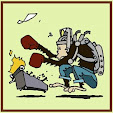
Jack-o-Lantern, Opoho 1997
This morning out of my bus window I watched a young chap walking briskly to work pursued by, I assume, his lady friend teetering along with her arms outstretched, mouth all blood-spattered. Zombie love – ain’t it grand?

I quite like Halloween. Its gradual creep into the local festival calendar has been assured and bolstered by foreign pop culture (TV specials, mainly, it seems), and as a pop culture observance you could find worse things to obsess over. Far from the folklore trappings of All Souls Eve, or the superstition and belief of the dead walking for one evening, Halloween is incongruous fun. Certainly, that’s the spirit in which I attempted to take it in when I was a stripling young Simian, dressing up with the kids next door and visiting a grand total of two houses (each other’s, naturally) for enthusiastic – if not a little self-conscious, games like apple bobbing and pumpkin carving. So nerdy. I might have been one of the few kids in my class at primary school to go the whole hog, but yes, I carved the odd green crown pumpkin and even provided my bewildered classmates with a demonstration at school one year. Off and on over the years I’d have another crack at it, hardly refining my method, but enjoying it all the same, even after university days.

I have no great issue with Halloween in New Zealand, either. Speaking personally, it’s one of the few Celtic traditions which have survived in some form in the modern world, and even though it’s become commercialised and Americanised along the way, I don’t think either of those elements have damaged it the same way that, say, the commercialisation of Easter and Christmas have. Admittedly, seeing displays for Halloween booty jostling shoulders with Guy Fawkes Night gear and Christmas decorations at this time of the year is patently ridiculous, but it’s a small thing to live with, and it seems to me that the easier thing to do would be to elbow Guy Fawkes out of the picture entirely, or move the fireworks to Matariki when it really is cold, dark, bereft of holidays and we’d all appreciate a noisy night out. As a side note I like the slow import of Day of the Dead as well – a local Mexican bar is going all-out on it this Friday and in an impressive charm offensive Hell Pizza are embracing the day as well. It seems to me that Día de los Muertos allows us the opportunity to observe both the pagan and Christian aspects of this season. It’s a win-win.

Halloween in the Southern Hemisphere however makes me feel as though we actually got the better deal season-wise. Yes, the Samhain connection with the harvest cycle is lost, but in a modern sense warmer, lighter nights for kids to go trick or treating makes perfect sense. If someone could explain to our neighbourhood teens that trick or treating isn’t some form of intimidatory entitlement ritual then all the better. Jet Junior’s birthday is about a week out from Halloween, so I expect that as the years go by pirates and Wiggles may make way for Halloween-inspired birthday parties, and if they do I’ll be there armed and ready with a pumpkin and a knife, ready for the fun.

Tuesday, October 23, 2012

Oaken's Twelve: Jackson's Thirteen

When I set myself the challenge of bringing Thorin Oakenshield's Company to plastic life in 28 millimetres, the original plan was to be well underway before casting was announced or, at the latest, before the forthcoming Hobbit character shots were available. Didn't work out that way. On the other hand, I knew I'd be assessing and reviewing the eventual reveals at some stage, so here I go with a rather belated and facetious review before I've even stumped up my attempts.

Penultimately it comes to the following image: In just over a month Peter Jackson’s version of The Hobbit will be released onto the world, promising visual interpretations of Thorin Oakenshield’s company which will, if the Lord of the Rings’ success has anything to say, become pretty much indelible in the public consciousness. Can anyone now picture, for example, Boromir without seeing him as Sean Bean? Or more potently, Gandalf as anyone but Sir Ian McKellan? In my lifetime I’ve had a version of Aragorn change from a rather faceless (not literally) hooded ranger, to an animation voiced by John Hurt and (unkindly) compared to Tonto, the finally and more recently and, yes, indelibly – Viggo Mortenson. Next stop: the classic greying, ageing, blue-hooded Thorin as played for ever more by Richard Armitage. Granted, a lot of how these figures will rise, fall or remain in the minds of your casual Tolkien watcher depends on the skills of the assembled actors; but then I could tell you about what seventeen years of Judge Dredd as played by Sylvester Stallone can do to the public imagination as well. I digress.


The point I should come to is that as previous posts have attempted to point out, Jackson’s designers haven’t had the luxury or challenge of carte blanch when it came to designing the movie’s Dwarves. Of the thirteen some are pretty well visually described – the main ones being Thorin, Balin, Dori, Bombur, Fili and Kili, pretty much. The others – perhaps Dwalin excluded (we know he’s strong enough to carry Bilbo), not so much, and presented with the real challenge of twelve distinct personalities to convey behind heavy latex and judiciously apportioned dialogue, it’s not surprising that some of the dwarves as depicted here are verging on the very limits of dwarf-ness. Kili is almost beardless (heresy!), Nori has hair that defies gravity as well as belief, and Bifur appears to be part badger, part axe-head, and, reputedly, everything but talk. Ori we could perhaps have had a guess at: in the story hints of his bookishness are all but there, fleshed out post mortem in The Fellowship of the Ring, so a clerical look he has, as much as an innocent again (I presume) informed by his eventual doom in the mines of Moria. Bofur was always going to be free license to any imaginative designer, perhaps his own face furniture tells a story as much as Kili’s, although you’d want to think that with it Jackson’s visual engineers could have foreseen the unfortunate moniker James Nesbitt’s character has since gathered among the online community – 'pedo dwarf'.

There’s a lighter, more comic touch to these dwarves, though – perhaps it’s even cartoonish. The proof will of course be on the big screen. In the mean-time, and not shown in this large image is the gathered storytelling implicit in the Hobbit dwarf designs – chiefly, we’ve become accustomed now to seeing the dwarves not as Tolkien wrote them – unarmed, hooded, carrying little but their wits, musical instruments and a heavy grudge, but as the post-LotR movie environment wishes us to view them. The Jackson dwarves are variously armed and armoured, mostly in a light way (I suspect once the army of Dain Ironfoot is seen we’ll be able to make a clearer distinction), but much more than indicated in the original novel – particularly at the start, the movie dwarves are to varying degrees ready for war. Some (Dwalin, Bifur) already look like veterans, and it’s this form of visual shorthand which intrigues me most. Some of these dwarves will have very few lines – Bifur may not have any, so anything that tells a story, fills in a background or otherwise provides detail is really useful not only in selling a movie in advance (and this should not be underestimated given The Hobbit is over fifty years old and available to be read anywhere in mostly any language already), but in telling its story onscreen. It’s considerations such as this which I’ll be taking into account when I resume my own race against time to complete the Fellowship of Oakenshield before The Hobbit opens properly.

Saturday, October 20, 2012

"I Was Born to Underachieve"

Manic Street Preachers: 'Send Away the Tigers' (2007)

 “I realised that The Manics had lost that element of fabulous disaster... And on this album, we've gone back to source” - Nicky wire on Send Away The Tigers 

And now for the triumphant return, the second second coming? Lifeblood’s fortunes had been mixed indeed – eschewed critically and by the fans for its different sound and introspective mood. By 2007 Manic Street Preachers were an old band, shedding ill-fated solo projects and looking with steely eyes to a twentieth anniversary in a handful of years. Surely after the lacklustre response to their last group effort, the next album would open quietly and fade away slowly? Well, not in this instance. It’s a strange element in the music and life of the Manic street Preachers that confounded expectation runs through their career. Generation Terrorists was not the incendiary monolithic debut the band had hoped to arrive and shorty retire on; The Holy Bible did not achieve its Important Album status by chart success, and the fortune of Everything Must Go is a matter of historical record by now. By 2007 though, you’d be forgiven for thinking the well was running dry after two albums whose reception had been, to put it kindly, ‘mixed.’

Send Away the Tigers was instead a great success, and widely regarded as that elusive thing for an ageing band, the ‘return to form’. Pipped to the number one album spot by fewer than 700 units, its first chart-eligible track, the grand and sparring Your Love Alone Is Not Enough with The Cardigans’ Nina Persson (the band’s first duet since Pretty Baby Nothing) took them back to the number two spot in the UK, and re-launched the group as a credible radio-friendly band once more. Certainly, speaking for myself the results were there. I bought Tigers aware that friends and family who had ‘til then had no opinion (or even awareness) of the band were expressing genuine interest in the single, and this far from Wales that had to mean something (Your Love eventually reached number 20 in the NZ charts), so all was well there. What of the rest of the album though?

Comeback albums are funny things; not as common an industry cliché as “the difficult second album”, but common enough that there’s a commercial imperative built in for any aspiring manager of a downwardly-motivated act to dream of. Send Away the Tigers as a whole for me recalls Green Day's American Idiot (2004), an altogether huger work with longer-lasting impact, but as an example of a return effort with little change to sound other than a renewed vigour, the albums are close. Tigers ups the ante a little, offering more politically-motivated tracks (Rendition, the Clash-like Imperial Bodybags) peppered among the ‘mature’ audience-friendly ones, and overall the efforts speak of Wire’s aforementioned intent to ‘return to the source’. There’s a lot that’s familiar and comforting to the established fan: Lifeblood’s keyboards open the album but are pointedly drowned out by another Adamson-styled guitar intro, and the band’s past works are referenced too – from You Stole the Sun From My Heart finding its way into the lyrics of Your Love Alone to the swinging 6/8-timed Indian Summer, which so resembles A Design for Life that Bradfield and Wire were at loggerheads over its inclusion, and soon after its release a YouTube wag demonstrated just how close the similarity was. Critically and emotionally as well as commercially Send Away the Tigers is a great success, probably well worth the return of the reversed-R cover lettering, I’d say. But for me it’s not a long player, being maybe too familiar, too rehearsed. It’s the sound of a band who knew they always had it in them, but because their past two albums had fared poorly, this return to form strikes me also as something of a shrug of acknowledgement. The hidden track, an unnecessary cover of Working Class Hero (also covered by Green Day for an Amnesty International album) tend towards lip-service. The Tiger burns bright, and where and when it needed to, but the follow up album for me is the big one; another resurrection of the past, but crucially less well-rehearsed, and the better for it.

Cover Story: Finally, a cover with legs. An astute choice, using a professional photographer’s work. This was borne out with the video for Autumnsong which came in two varieties – a label-sanctioned version, and a second pass instigated by the band themselves using the same models miming to the song and directed by the photographer. It’s an attractive sleeve. There, I said it.

Thursday, October 18, 2012

I'll be the Judge of that

This blog is synchronised with that of my good friend Jamas. His review is here!
I've been surprised to discover that the success of the new Dredd 3D movie has meant an awful lot to me. Of course in 1995 I was disappointed, and I didn't even see the Stallone vehicle on the widescreen, but I was determined to see it properly in 2012 - widescreen, 3D, and with company who would 'get' the character and his world. I'm very happy to say that I succeeded there (especially enjoying the company and generosity of the above mentioned Mr Enright). I'm not happy, however, to observe that Dredd 3D was not so lucky, and hasn't succeeded.

The term 'flop' is pejorative, and I don't think it helps movies like Dredd, particularly when critical opinion has been largely very enthusiastic. It's fairer to say that it, like a few other technically high quality, faithful movies, failed to find its audience in sufficient number, which is another way to say it is by no means a bad movie, and definitely didn't deserve its fate of near cinematic obscurity with no hope for world-building sequels. Despite its niche market, B-list star and R18 rating, it deserved better, and hopefully on the home market will get it. Please don't download this movie, folks.

As I indicated earlier, Judge Joe Dredd is a tough hero to film. Aloof, implacable, and visually inhuman, there’s no clinch to his character. He’s less Robocop (whose narrative depends on the once-human Murphy rediscovering his humanity and reinventing himself) and more akin to the original Terminator – ready-made, singularly-driven and determined. An idea driven to an extreme, although not necessarily the extreme. I take some issue with the thesis that Dredd is ultimately a fascist character. An absolute, certainly, but his crusade isn't one of power or control for the sake of personal power; it’s control for the sake of control, or at the expense of the alternative, which is a certain chaos depicted by the nature of Mega City One (and especially as depicted in this movie). You can’t sympathise or identify with such a character, although you can still cheer him on, appealing as Dredd does to a certain repressed, visceral desire for absolute order. In that regard Dredd 3D and Karl Urban is pitch perfect – he’s far from robotic, but he never once cracks a smile, never stops working because the nature of the movie’s metropolis doesn't allow for that; as he says in the movie’s first reel, “it’s all deep end.” So I applaud Urban’s understanding of the role and his take on such a complicated character, as much as Alex Garland’s taking Judge Cadet Cass Anderson as the story’s ‘heart’. Easily and still the human face of the Justice Department, in the movie Anderson’s emotional journey contextualises the character of Dredd as much as her understanding of her place in the ugly reality of MC-1. That she ultimately rejects Dredd’s answer and likely assessment yet completes her training to literally walk away from the ordeal of Peach Trees Block completes her journey, while it’s Dredd’s awarded ‘pass’, granted when she’s well out of earshot, which furthers his. That kind of dynamic, not present in the comics, just further shames the 1995 pairing of Dredd and his female counterpart Hershey (whose equivalent status is more pronounced in the comic as well), and makes me sadder that we’ll not likely see Olivia Thirlby reprise the role or, indeed, see how the Dredd and Anderson relationship develops.

Finally, the villain of the piece, Lena Headey’s Ma-Ma. When I first heard there would be a female antagonist I immediately worried that the script would call for something campy and over the top – Uma Thurman’s Poison Ivy, for example. This wouldn't have been absolutely out of the question for the comic, but wasn't something I wanted to see in a make-or-break movie. The character as written, and Headey’s reading of it, however, is something else. When you see more humanity in her turn as Cersei Lannister in Game of Thrones then the dead-eyed cold killer of the big screen outdoes all of that. Ma-Ma is just evil, a version of Dredd's inhumanity with a veneer of humanity.

In all, I like this movie more with every passing day, though the two of us had a lot to say on leaving the theatre. With the passing of time things have sunk in a little more. The violence is still an issue; I'm still of the opinion that launching an unfamiliar franchise on such an enormous and significant market as the US behind such a strong rating was hazardous. And I'm not entirely convinced that this level of violence is really true to the strip, which is smarter and as shocking, but in the glory days of the Seventies and Eighties knew when to turn the camera away from the head shots. That said, the gore I feared I'd see was largely implied rather than depicted, and the greatest feeling of unease for me was an eerie and utterly discomforting vertigo-inducing 3D glimpse down the atrium of Peach Trees and into hell itself. The 3D and Slo-Mo effects weren't for my fellow film-goer, but like a lot of other reviewers I was impressed, and didn't see it as being too gimmicky.

If you're at all curious, see this movie. You won't get another chance. And now I worry, as I did in 1995, that for Judge Dredd to have any film future in another re-imagining it may be via a real case of diminishing returns. As far as Dredd 3D goes, however, this was far from the case.

Monday, October 8, 2012

Watch it before Darth Flannel finds out!

A brief update and yes it's come to this, a Star Wars one. Who'd have thought?

Now, as I've been at tedious pains to point out, I've been not a Star Wars fan since 1984, but I need to say that when its makers decide to clamp down on the spirit of sharing and cultural blending that has actually sustained the franchise and enabled it to turn a profit in leans years and flabby, I can sympathise with the fans who might see it as a rebuke against THEIR love of the series and how it can span the borders. So as I say, enjoy this, the third installment of Withnail and I/Star Wars before the dread cohorts of The Bearded One have it blocked, as they did to the wonderful first installment with Uncle Monty*.


(*that is, of course until they can find a way cough!*Robot Chicken* cough! to make it hack!*Family Guy* huck! profitable for them, naturally)

Sunday, September 16, 2012

Video Affects - The Smiths, Girlfriend in a Coma

Morrissey is coming to NZ this December. It's kind of a big deal, I guess, with people of my age, added to that the fact Moz hasn't visited these shores in twenty-one years. There's the sense that this time, a bit like The Pixies maybe and Bowie (though we didn't necessarily see that one coming) is a 'last chance to see' sort of gig. Nevertheless, I'm already double-booked, so there we are, and there I won't be, Boo.

I discovered The Smiths late, like most of New Zealand, the late Eighties being (as I see it) the last gasp of our Antipodean six months/two years-behind-the-rest-of-the-world-in-pop-culture factor that led to most of our punk bands arising in the early Eighties and Acid House not really a going concern until 1989 at best. By the Nineties and the arrival of the Worldwide Web, our embarrassing South Seas Bubble would burst, but 1987-1988, The Smiths were a vaguely-known thing to me; the source of obsession by a schoolmate Mark, and of bewilderment by yours truly.


Enter the video for Girlfriend in a Coma, one of their last singles. This is a video that's a signature of the band, is in a big way irrelevant to the song with its scenes from The Leather Boys (as much as their album and single covers steadfastly eschewed images of the band themselves, opting istead for silver screen idols), yet rewards the viewer curious enough to follow up the images (I haven't) - to get to know the band without actually seeing the band. Front and slightly left or right of centre is enigmatic frontman Steven Morrisey in action, and this as far as I can recall, ismy entry point proper to the world of The Smiths. By my second year of university a couple of years later I'd heard pretty much all I could get my hands on, bought their albums and resold them again for ridiculously small fare (but then I had to eat), and having learned a few songs along the way and taken all I could at the time from them, moved on.

But the video was a serviceable entry point for the band, as late as it was to their story. Here's Morrissey at the corners of the frame, singing devotedly to the black and white image of Rita Tushingham, the singer's colour and the footage's monochrome separating the two subjects until the 1:40 mark where Morrissey's face becomes merged with that of co-star Colin Campbell. The rest of the band are absent, as is the case for the other videos from parent album Strangeways Here We Come, and the vdeo says nothing of The Smiths' internal ructions and impending split - in fact, it's business as usual.But it was enough for me. I'd not seen a video like it, in a decade known more for putting musical artists in increasingly narrative or cinematic contexts, here's a video apparently about adulation and worship. Curiously introverted, studied and coy. It started me on a short road of Smiths fandom.

Saturday, September 15, 2012

"We Used to Have Answers"

Manic Street Preachers: 'Lifeblood' (2004) And now the mid-Nineties synth job. Produced by industry veteran Tony Visconti, there’s little redolent of his long-time collaboration with David Bowie here, unless you count the late-era slapped bassline in Always/Never. Instead, the overall sound reminds me more of early Steve Lillywhite, producer of Big Country, a later incarnation of Manic influence The Skids, and certainly album opener 1985 contains a decent likeness of a typical Stuart Adamson guitar fill, but elsewhere is reminiscent also of late career U2 and mid-career Coldplay. Which goes some way to saying that while James Dean Bradfield’s guitar is present, it once again shares the roster with other instruments, namely keyboard washes and piano lines (more Lillywhite), muting the tone and softening the edges.

 Lyrically Lifeblood improves on Know Your Enemy, although there seems a less obvious polemic at work. Nicky Wire described the album as ‘elegeic’, and maybe that’s more apt than first appears, because I sense more resignation than protest in its songs, of offences being commented on after the fact; Emily, Wire’s comment on the usurping of heroine status of Emmeline Panckhurst by the likes of Princess Diana (“So pity poor Emily / You have been replaced by charity”.) We’re leagues away from the inflective of The Holy Bible, and even now listening to the album certain phrases come to mind: ‘domesticated’, ‘middle-aged’, almost ‘dinner party’. Nobody’s nose is going to be put out of joint by this offering – even in 2004 a reference in Empty Souls to “collapsing like the twin towers / falling down like April showers” was overdubbed for the single release.

 If anything, Lifeblood is perhaps a little too homogenous, succeeding in recovering the sense of continuity that its more celebrated predecessors (Bible, Everything, Truth), but the risk run here is that the songs, particularly after the first half of the album, tend to merge rather too well, and as a result the album drifts off to sleep shortly before closer Cardiff Afterlife and its Smiths-styled harmonica wraps things up. The eighties are all over this album for me, from the aforementioned Lillywhite sound (To Repel Ghosts could have come off U2’s October), to the lyrical opening of 1985 (“In 1985, Orwell was proved right / Torville and Dean’s Bolero, redundant as a sad Welsh chapel”) and its nod to the bands who would inspire the Manics’ creation (“Friends were made for life / Morrissey and Marr gave me choice”)

Cover Story: Slick and somehow anonymous. Text is along the lines of Everything and This Is My Truth (which seems apt and sensible after the less than spectacular efforts on Know Your Enemy). Computer-enhanced blood splashed over a nude figure against a white background. The motif’s presented further inside the liner notes, but the shots of the band members posed ‘reacting’ to splashes of red don’t work so well – it looks like it may well be – Ribena spilled on some black and white photos.