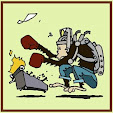
It's St Patrick's Day today. I have no great attachment to the day to be honest. To be brutally, unpretentiously honest - no Irish blood, no connection; I'm no hypocrite. More spleen-venting here, of course, but if you're eager to see me in a more charitable mood, here's an Irish judge from the Judge Dredd universe, hailing from the small Brit-Cit controlled territory of Emerald Isle. And it's a lady - trust me.
With a theme park mentality and a capital christened Murphyville you'd be a fool to expect anything less than a stereotype here, but, as seems the frequent case in the Dredd stories, the truth is stranger. Emerald Isle first appeared in the story of the same name during the run of Dredd largely overseen by the then up-and-coming writer Garth Ennis, and the look of the Irish judges - all harps, tricolours, shamrocks and pints, by fellow Irishman Steve Dillon - an artist whose style was for some time something of an early model for mine. The story's played for laughs, with spud guns on three settings (mash, chips and full-on taters), and yer man Dredd a grumpy fish out of water among a small band of the Garda who are largely in it for 'the craic' and aren't used to his big-city ultraviolent ways. Carnage ensues.
Murphyville's Judge-Sergeant Joyce returned for two further stories and then, with his creator, slipped the magazine with a fellow Judge - er, 'Wilde', I think (gosh, Mr scriptwriter Mark Millar, that's punching above your weight in the names department) filling in.
Enough grumbling. I actually like the Murphyville Judges, particularly for their levity in the face of an absurdly unfair world. That's probably another stereotype there, sorry, but that's the Dreddworld for you. And now for a confessions: so parochial were the early 2000ad stories of Mr Ennis that I genuinely and erroneously suspected his name was actually a pen-name, as no writer of Irish origin would seriously have a real name that so resembled the name of his homeland's national beverage.
Oh, look - more space! Okay then. A video - and here it is in honour of the day itself, the first wholly-Irish music track (and video) to totally blow me away, back in 1988. With, as any fule kno, additional crucial content by William Butler Yeats:
Manic Street Preachers: 'Generation Terrorists' (1992) At seventeen you want to change the world, and you think that you can.
I am, roughly, the same age as the surviving members of Manic Street Preachers and, along with Blur, consider them a band of interest because of this. As I age, so do they, and as groups and fan we live and stand side by side, albeit at very different ends of the chorus line. It’s around the age of seventeen that the individual members of Manic Street Preachers came to be a group, still at school, not yet a four-piece, but equipped with the beginnings of an education and attitude which would inform their later career. There’s little to show of this early incarnation, lacking the essential ingredient of songwriter Richey James, and before this album there’s only the New Art Riot EP with its essential single Motown Junk(“I laughed when Lennon got shot” etc) vying for attention. In the years between 1986 and 1991 it’s ground-work for the band. Touring playing, creating a buzzword and building a fan base. Generation Terrorists, the first album proper is the result of this work, and the Manics’ first full-length outing on a major label.
When I first encountered the MSP it was in the pages – or rather, on the cover, of the Melody Maker, and we were all about twenty-one years old . Sprawled languidly across each other, all glam makeup and cynical mouthiness, I instantly despised them, and what the interview inside revealed about this band of try-hard Bolans and Lydons were vying for. It seemed so ludicrous, their arrogance, their ambition and belief in their self-worth. Built up as much as they were by the music press at the time, I thought if anything that they were destined for a fall. But instead they clung in there, becoming a fixture of the NME and Maker. Instead of being an irritant they were a curiosity; but not enough of one for me to follow yet, or inspect further. The cover pose, media assault and the sound of their debut album were an adroit combination of intended outrage and provocation, a very rock and roll charm offensive.
The major label launch exemplifies the slightly schizophrenic nature of Manic Street Preachers’ media strategy. As informed as they were in their early days by left-wing punk and post-punk band such as the Clash and Red Wedge acts like Billy Bragg, their loftier ambitions are much more mainstream and acquired an instant and assured infamy: they wanted to make an album like Guns N Roses’ Appetite for Destruction; they wanted to sell out Wembley Stadium, and then they wanted to split up. They achieved none of those aims, and their failure (such as it might be measured) is the story of the band, marked by a calculated but portentous opening salvo through establishment in the UK indie and later mainstream music scene, and a steady, stable line-up interrupted only once -albeit crucially - with the disappearance of a creative lynchpin. I was saddened in downloading YouTube videos of this album to be forced to sit through an interstitial ad for, of all things, McDonalds. Is this what these young men wanted? The band who later courted controversy and eschewed the crass commercial buy-in, touring Cuba and playing for Castro? “Madonna drinks Coke and so you can too.”
Yet Generation Terrorists works surprisingly well on a single issue per song, contained and disciplined as they were at this stage. NatwestBarclaysMidlandsLloyds for example, and the single Little Baby Nothing, a feminist ballad in which singer James Dean Bradfield duets with Tracie Lords. Originally the duet was to have been shared with Kylie Minogue, but Minogue’s management vetoed the deal; the duet eventually occurred and can be heard here, although for my money there’s no comparison - Lords’ provenance and heavier delivery sell the song, while Minogue comes across as gimmicky. Wrought large, the album is single statements and phrases mashed together, invoking a deliberate clash and juxtaposition of lyrical images, fitting for the band’s own mix-and-match approach to style, image and reference. LBN is probably the most straightforward song of the whole album, addressing one person directly, while more celebrated and successful songs like Motorcycle Emptiness and Stay Beautiful represent a different marriage of slogan and descriptor, the latter almost a manifesto for the band itself.
What works:Slash 'n' Burn is a good opener, and a distinct nod to the band’s US influences in title as well as music (look out for a Robert Plant/Axl Rose yelp before the last chorus) plus NatWest, Motorcycle Emptiness (with nice Stuart Adamson guitar runs), You Love Us / Stay Beautiful. Half of the album is punchy and great, the other half sags in dated structure (Another Invented Disease with its GnR intro is clunky), and the full album is probably one side too long. The repetition of Repeat is somewhat ironic. The opposite effect is in James’ car crash lyrics of the above sloganeering and literary reference. Their density obfuscates delivery, and the message become lost amid a barrage of words which at this stage a game Bradfield manages well enough – two albums on and he’s gamely continuing and largely winning, but it’s a wall of words, and it begins here.
Which is not to paper over the contributions of the other, surviving members. James Bradfield's guitar work is already very accomplished, if a little studied and styled in the wake of others; Nicky Wire's bass is perfunctory, and we're yet to hear Sean Moore's drumming, alas, as it's all programmed for this album (and on some tracks, it shows). Perhaps at this stage the important thing is the look. The Sex Pistols just got away with an attitude and a minimum of open chords on stage; fifteen years on and this won't do - Bradfield has 'the chops' as they say, but it's a little startling also to see in live videos a young, 'ripped' shirtless torso behind the guitar as well. Nicky Wire's bizarre dressing - face paint, gender-bending frocks and scarves, is another thing entirely, and among them a genuinely wiry frame of Richey James. Yet it's James' lyrics that is one of the big things the Manics are known for and which drew the critical ear, and it’s still being developed on this album. The result here is early James, rather than the gatling-gun approach two albums on, and there’s still space, thankfully, for the quieter Spectators of Suicide, a late highlight.
Videos: As noted above, at this stage the videos are slick and straightforward; and extension of the band image and lyrics. Rather than narrative or cinematic they are studio-bound, sometimes cheap but always immediate. By the video of Little Baby Nothing the visual interplay of slogans and one-liners actually works against the intended message. The video’s direction makes them look more like that bane of Eighties music, the earnest ‘social issue’ band. Compared with the supercharged black-top muscle of, say, Slash ‘n’ Burn and the brattish You Love Us it really jars and must have given the casual viewer pause.
Album Cover: politely provocative. There’s a post-Like a Prayer church-bothering crucifix and bare ensemble, with tattoo (is it Richey’s arm?) all rendered in a daring pink on front, while on the reverse a European Union flag burns. It cries out for attention, but as suggested, falls somewhat short of outrage, while managing to merge provocation with an androgynous aesthetic (c.f Love’s Sweet Exile video)At this stage the borrowed iconography is a performance issue rather than a packaging one, so as sleeve design goes, the debut album is more of its time than the way forward.
If we did this right, then by now both Jamas over at The Truth Behind and I will be blogging on the same topic, the 1982 made-for-TV movie Mazes and Monsters. The movie has gained infamy for two things: firstly as an early entry in the oeuvre of two-time Oscar winner Tom Hanks, and secondly, as a memorable adjoinder to the great Satanic panic episode that accompanied the mainstream entry of Dungeons and Dragons into popular culture. Adapted from the book of the same name by Rona Jaffe, it takes its inspiration from the real-life story of James Dallas Egbert III, a Michigan State student whose disappearance into the university's steam tunnels and later suicide were investigated and later documented by private detective William Dear in his book The Dungeon Master.
I discovered the whole shebang wildly out of order, having played the game at fourteen through sixteen, discovered Dear’s book in, of all places, a roadside diner near Lake Ohau in ’86 (I didn’t buy it, though the dust jacket blurb was intriguing, if a little sensationalist), and then the movie itself, played on local TV around 1993. I also saw, before all of these, the Wizards and warlocks episode of Greatest American Hero; which was surely inspired by the Edgar incident but remains, I’m afraid, complete bobbins, even if it did get me into the game in some form. Most recently, I discovered my father-in-law has the movie, as a double pack with a portmanteau National Lampoon-style series of shorts called Loose Shoes and billed as a Bill Murray movie. At $4 from the Ashburton warehouse it’s a steal, but the transfer is the worst I’ve ever seen, with a poor picture quality and often indecipherable audio. It all adds to the mystique, I guess.
Mystique of course is something the early game had in spades, especially down here in NZ, where its press was almost non-existent, relegating one’s discovery of it to browsing in bookshops, or the subject of school gossip. Oh, there was gossip. And regional TV provided an interesting primer when it ran a news article on the phenomenon in 1982 or so. As much as we protested, the rulebooks of course did cover demons and devils – the AD&D ones at least, and the concept of assuming the personality of a fictional character and playing with lots of strange dice but no board? With no clear winner? It genuinely baffled my parents and older relatives, and I loved it for that. It made the game my own, a private world I could share only with my friends.
M&M’s conceit, borrowed from the case of Egbert is that a player of in-movie-analogue Mazes and Monsters, already traumatised by the childhood disappearance of his brother, “flips out and freaks out” during a Live Action Role Playing version of the hitherto table-bound game. Hank’s level-headed character Robbie (something of a dark horse as you’d be expect his erstwhile Egbert-like and serial hat-wearing fellow player JJ), has a nervous breakdown culminating in hallucinatory episodes, and him assuming the personality of his Mazes and Monsters character. Absconding to Manhattan to look for the ‘Great Hall’ (his absent brother Hall), endures some harrowing scrapes before making his way to the top of one of the World Trade Centre towers and… and… well, I’m not going to tell. Suffice it to say, it’s an area of the movie that happily doesn’t replicate the real life story of Egbert, and happily doesn’t speak for the experiences of most players of Roleplaying games I grew up with. For what it’s worth, our little band of teenaged adventurers did go through adolescence and roleplaying at the same time – real life is nightmarish enough at that age. And a couple of us struggled with the reaction the game had provoked in the more fervent (US) Christian literature, as we were churchgoers (the same can be said for our choice of music, of course). But our encounters with the game were much more mundane to be any sort of movie, even a made for TV one.
But having said that, the movie is at least neutrally inclined toward RPGs in that it doesn’t present the game maze and monsters as the cause of Robbie’s breakdown, although arguably the high stress environment of its play-acting episode could be construed as some form of catalyst. By comparison, Egbert’s steam-tunnel escapade has been attributed to external influences outside of his roleplaying – for Rona Jaffe it’s easy to see how the two elements (dungeons and dragons and real-life tunnels and mystery!) could make for a compelling combination. In her world, Mazes and Monsters is a pretty far out game:
And Mazes and Monsters is a pretty far out kind of movie. Silly in a lot of places, with amateur acting I many scenes (hanks shows early form though), and far too many hats. One to watch with a liquid friend or two, perhaps. I don’t think it deserves the scorn and ridicule heaped on it by the RPG community over the years, poor things. We can’t blame the writer for such a hackneyed analogue of D&D in her movie; Spielberg was no better, and it might help to view ‘movie’ RPGs as needing the same necessary ‘oomph’ as Hollywood OS; when the reality is mundane, who wouldn’t film a more exciting version? Incredibly, for a fictional game with very little on-screen detail, someone’s actually made a playable clone, complete with Mazemaster screen and playing board. Cool!
Just in time for Waitangi Day, something not really that necessary, but old.
This version drawn ooh... 1993 I'd say. A bona fide New Zealand judge never made it into the Judge Dredd strip of course; the best we've had so far has been the odd mention in Oz-themed stories (notably the Chopper epic Oz), and an addition in a rather outdated Dreddworld map from around the same time as the above illustration.
So, what we have here is young Simian's approximation of it, based on an Oz Judge (there'll be one along soon, it was Australia Day last week after all), and a less garish, more localised colour palette. Yes, his legs are too short, although so are mine. One of us has the convenient excuse that the creator ran out of page space while composing the drawing and already liked the top half too much to move it!
Just in case anyone (you know who you are) was wondering, my attempts to realise the Dwarves of The Hobbit in 25mm plastic haven't been entirely abandoned! In fact, likely candidates were identified and plans made. They just need to be executed...
But in the interests of science, here's the earlier mugshot of Games Workshops' "Dwarf Rangers" and how they panned out as the future Company of Thorin Oakenshield:
And just to explain things further, the notes I made for each character are below. I made these whilst re-reading the book for key character points and identifiers, the Lord of the Rings appendices, and consulting a few reference guide along the way, observing the work of others (the "Lee" mentioned is Alan Lee, Hobbit illustrator and movie designer)
Right. That's done, now to find the time to put it all into action!
Time for a brief stop on our trip south. Elephant Rocks, about five kilometres west of Duntroon is one of North Otago’s best kept secrets. It is, however, also a recognisable location for The Lion the Witch and the Wardrobe. Next door is a still standing, but surely crumbling, set for the seemingly-doomed Kingdome Come. It’s an incongruity, sitting as it is among sheep-tracked hillocks, and with a sealed road metres from its boundaries; but utterly vacant and telling a sad tale of bankruptcy, is threatening no-one and impressing few. Much more interesting are the rocks themselves. Limestone shapes erupting from the ground, formed by the movement of earth and water and shaped over thousands of years by wind into grey and cream clouds of calcium carbonate. This far from the Highway 56 they’re wonderfully silent sentinels in some still green pastureland, and an instant reminds of climbing games with friends from years back.
Jet Junior took great delight clambering over the smaller ones, and it was encouraging to see on a late afternoon that the tourists passing through on the Vanishing World fossil trail were content to leave things as they were, to take photos and sit happily atop the giants, becoming part of the landscape for a spell. There’s something restful about being enclosed by so many soft, organic curves of hill and stone face, with only the open air above and quietly grazing sheep nearby. I’ll return here again as soon as I can, I reckon.
When I was seventeen I knew everything. I was confident in the beliefs I’d held for the majority of my teenage years, my world view was broadening and my knowledge increasing. I took to school debating with aplomb; and I knew what I liked when it came to music. I liked Alternative Music, whatever that was. The irony wasn’t lost on me at the time, but the sheer exclusivity of my musical tastes were. I’d scoffed at a school mate who once answered my question of what music he liked with “everything”. No, Malcolm, I insisted. What genre of music do you like? His answer was the same. Years later I finally caught up. My tastes have also broadened. I may not like “everything”, but I’m sure I can find something in most modern forms, a few old forms, and, well, so long as there’s a good beat to tap my foot to, I can probably accommodate the rest. Music is supposed to be universal, isn’t it? It’s supposed to find a common ear?
It’s also supposed to entertain. No, really. It was another couple of years and well into my University age that I discovered for myself what really bugged me about the NMEs, Melody Makers and Rip It Ups I’d fussily collected and studiously pored over. Even the Rolling Stones, which, after a brief period of adoration were swiftly consigned to that great Malcolm-styled pile of ‘pointless’ in my still-developing adult brain. What I realised was that every one of these titles were to a man JOYLESS. Indexed and categorised with fickle detail like the Top Gear Wall of Cool, and just as useless. The UK music press was the worst, trapped in a routine of hype-and-destroy with a new indie band the front cover darlings for up to five months before they were met with the indignity of relegation to the sarcastic humour page, buried under the gormless faces of the next indie front page darlings. It was, I found, a depressing cycle to which I had no desire to subscribe or contribute. And I returned to buying comics.
The best thing about all of this, and liking bands like Iron Maiden and The Darkness is that I no longer feel I have to justify my liking them. There’s no cool-sheet to follow when you reach middle age (God help you if you actually find one. Run away!), and the older I get, the more that derisive label Dad Rock(tm) allows me the freedom to exercise that right. It's a win-win for me, and it appeals strongly because the alternative is the inevitable: free jazz. Shoot me if I ever go there, somebody.
I love The Darkness because they eschew those rules, that music can only be of value if it's earnest, boundary-pushing or somehow 'worthy'. Music shouldn't always challenge, and along with moving the heart, the feet and the mind, dammit, it should also move the corners of your mouth from time to time. Their self-funded debut is an absolute cracker. Their follow-up is disappointing, suggesting they'd instead bought into the arguments of their critics and actually produced a novelty album of silly juvenile songs. Their break-up produced two different but also alike bands, Hot Leg and Stone Gods. And - if this is important to some - they've walked a difficult road of overnight success without major label backing, critical scorn (accused a novelty act) sibling fallout, break-up, drug rehab and osteonecrosis (yikes). And now they've re-formed with their original lineup and are touring and recording. It makes me happy.
All music fans owe it to themselves to follow at least one act or artist who isn't there to validate some self (or worse) appointed notion of 'cool'; and remind them why they got into music in the first place. The Darkness are mine. Who's yours?
 With a theme park mentality and a capital christened Murphyville you'd be a fool to expect anything less than a stereotype here, but, as seems the frequent case in the Dredd stories, the truth is stranger. Emerald Isle first appeared in the story of the same name during the run of Dredd largely overseen by the then up-and-coming writer Garth Ennis, and the look of the Irish judges - all harps, tricolours, shamrocks and pints, by fellow Irishman Steve Dillon - an artist whose style was for some time something of an early model for mine. The story's played for laughs, with spud guns on three settings (mash, chips and full-on taters), and yer man Dredd a grumpy fish out of water among a small band of the Garda who are largely in it for 'the craic' and aren't used to his big-city ultraviolent ways. Carnage ensues.
 Enough grumbling. I actually like the Murphyville Judges, particularly for their levity in the face of an absurdly unfair world. That's probably another stereotype there, sorry, but that's the Dreddworld for you. And now for a confessions: so parochial were the early 2000ad stories of Mr Ennis that I genuinely and erroneously suspected his name was actually a pen-name, as no writer of Irish origin would seriously have a real name that so resembled the name of his homeland's national beverage.

 Synchronise blogs!