Saturday, December 11, 2010
Back on a Roll
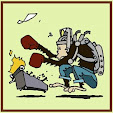
The further back I look, the harder it gets to find my first encounter with the phenomenon of Dungeons and Dragons. Likely I saw pictures of the game and read about it in books just as I was exiting childhood and entering adolescence, but it might be earlier than that. I had an issue of the Star Wars comic (actually I had two and that’s the sum of my collection!) which had an enticing cartoon advertising the game, and it’s possible that that same issue was also advertising the Ralph Bakshi Lord of the Rings movie, such was its infiltration into popular media of the time. In 1982 the movie ET attempted to show a game in progress (further discussion on that here.)
The Greatest American Hero even pitched in on the trend working in a (very silly) story connected to early misbegotten LARPing games in real life, and later still TSR in relaunching the set for an 80s audience ran a serial advertisement in UK comics (2000AD in my case) to continue the marketing push. All of this served less to explain the game to me than promote more confusion, but with that, it did increase its mystique. It was simply a game I HAD to find out more about! So the advertising worked, due in no small part to my overactive imagination. By my 14th birthday my brother and I had a set – the red ‘Basic’ box rather than the older Advanced D&D rules (they really didn’t name things these well, did they?) and we set to, armed with a couple of handy independent guidebooks to help us on our way. This was the best of the bunch – British in origin and approach, and full of really useful insight into a game our parents were absolutely dumbfounded by and just didn’t understand. Which, in its own way, was rather cool; it made the game all the more ‘ours’, though it didn’t help me accrue many more associated books, modules and game aids because of the fact.
From that age I played the game with school friends, as did my brother with his, and for two or three years it featured quite heavily in my extracurricular life, fitting somewhere between youth group, scouts and venturers, and (thankfully) girlfriends. My characters came and went, as did my playmates, and eventually so did the game – revived over a couple of university summers mainly to recapture some of the old magic when Paul M, one of the old group, returned home from the Navy for the holidays. Things eventually went really quiet; Paul and I moved away for good, we found spouses and he even moved overseas. Before making that move though we had one ‘last’ game, with a few local friends and his brother – Jamas has it blogged here. It went okay – being as we are all grown up with less free time the games were rushed and business-like. For the most part they were okay – some of the old magic was there, albeit framed by adult duties responsibilities – that’s life.
This weekend Paul’s back for a limited time. We have one day set aside to return to the mines of Barbigazl and undo the wrongs committed in the first place. Will righteousness prevail? Can the heroes see it through and triumph? More to the point, can we fit this in over one Sunday before the inevitable call to come home for dinner? We wait to see!

Wednesday, December 1, 2010
Talkin' Eds - Dance of Death (2004)
Rock and roll – heavy metal, is a young man’s game. True, there are old men involved, and young women too, but by and large it is a genre consisting of young men strutting their musicianship, singing to other young men visceral songs about the sorts of concerns (or lack thereof) that a male in the prime of life might have. “Getting drunk... having sex… getting drunk and then having sex” in the words of Blaze Bayley. And well it might be – “rejoice, young man, in thy youth’ says Ecclesiastes. Very few uses of this phrase venture any further into the verse, because the cold reality of age and creeping decrepitude become the theme; it’s a bit of a downer, and that’s life. Rock and roll is also a form of escapism from the inevitable, a railing against light’s dying, but when the glory days are in the past and a young man’s pursuits become regarded as trivial, temporary and less than profound, what then for the aging rocker? Fifty years on we still haven’t found the answer to that question.
Iron Maiden have been looking though, and having found each other and themselves again with Brave New World, their follow-up Dance of Death is an attempt to continue the search for deeper meaning and something else to sing about besides the devil and history’s bad men. That’s not the theme of this album though – despite the title, DoD has no theme, and that’s an initial failing. The previous effort won through on the large spectacle of the band’s reinvigorated return, and its longevity when all of its comrades from 1980 had dwindled or stumbled off into solo projects (or actually DIED!) Their rejoinder is a hodgepodge of tracks, each technically tight and well-executed, but also a song apart from the rest. The pieces are there, but the places are wrong. Furthermore, this is the workings of older men. While the instrumentation goes undiminished, Bruce Dickinson’s voice shows the first signs of its aging here (although he’s still a formidable talent), and Steve Harris and Adrian Smith are tackling their issues with questionable direction. “I’ve got to organise some changes in my life!” is the opening line to track one Wildest Dreams, a baby-booming paean to hitting the open road on one’s new wheels. Whee! But really, these are hardly the same league as NotB’s longboats, X-Factor’s eleven saintly shrouded men, or BNW’s hand of fate? It’s a self-help manifesto for change – a mid-life crisis in the form of a song that could double as a car ad. Things improve with Rainmaker, another fast-paced high-end foot stomper, and No More Lies, a sort of Masque of Red Death with a chorus that does what it says on the tin and allows some Gatling gun drumming from Nicko McBrain to back the shouted title. All three songs are individually different, yet typical of Dance of Death, being the summation of over twenty years of Maiden doing their thing, but not pushing the boat out too far, and perhaps that’s the album in microcosm. Of all of Maiden’s fifteen studio outings, this is the one I feel the least goodwill towards – even Virtual XI has its moments as much as the two ex-Smith, pre-Bayley records. Dance sounds great, but it’s the sound of not a lot.
There are no classic tracks here – Smith’s Paschendale is the closest to meeting the criterion, but with two albums to come it’s not difficult to see its ideas being better exercised later on – ditto album closer and acoustic number Journeyman. Between these is material which is far from being dross (there’s no repeat of Quest for Fire, for example), but frustratingly misses the mark, even with every band member contributing to the lyrics and composition. Janick Gers provides much of the title track, and it stands out for being a little too much like Number of the Beast in narrative and therefore out of time. Montsegur is the least appealing – a shouty, clanging noise of a song with Dickinson racing to keep up with the meter. Age of Innocence has a reliably excellent solo by Dave Murray, but is spoiled lyrically – Harris railing against the injustices of the world around him with all the insight of a taxi driver. “A life of petty crime gets punished with a holiday/ the victims’ minds are scarred for live most every day” – what, scarred by petty crime? You really think that, Steve? For me it’s uncomfortably close to the over-earnest sound of the late 80s ‘social comment’ song, so many dealing with the plight of the world’s poor, performed by residents of the world’s tax havens. It’s disingenuous, and even if that isn’t the intent, the association sticks, and I’ll never pretend to imagine that the prison system is for anyone a ‘holiday’. I shouted back at the song when I first heard it and still grumble over skipping it now.
But re-listening to the album in full as this blog has required of me has borne some fruit. The lesser-played tracks Gates of Tomorrow, New Frontier and Face in the Sand have each earned a new ear and probably by virtue of not being the title track, the big message, the opener or closer, have been more enjoyable for it. The doom saying Face in the Sand in particular is the album’s highlight for me, and in a pared-down listing should definitely have opened Dance of Death, beginning with Dickinson’s upper register and detailing some form of game plan for a collection of songs from a band held together as friends and equals while the world seemingly falls apart around them.
 Cover Art:
Well, here it is. Despite recent stiff competition, we've come to the worst ever Iron Maiden album cover. It's a tragedy and a travesty - obviously at some point there was a design specification here, a plan of some kind, and then everything went haywire and before everyone knew it the thing was finished before all of the fancy digital artwork could actually be rendered, polished and tested before a live studio audience. At least Eddie's centred - even if everyone else is in cluttered non-solid dimensions land. Fans didn't take kindly to this, some een thinking it an actual joke on the band's part, but it seems the truth is theat someone deicided it was finished before the artist (not Riggsy, not Melvyn Grant) decided it was. The rest is now consigned to Maiden history, save for the artist's name, which he asked to have removed (and fair enough too).
On the other hand, inside the booklet are some of the band's best posed pictures of the guys, surrounded by blurry artistically nude ladies in masquerade masks. Top stuff, made all the more arrestiog for their contrast to the throw-up on the front.
Album Tracks(taken from the Death on the Road tour where possible)
Wildest Dreams
Rainmaker
No More Lies
Dance of Death
Montsegur
Gates of Tomorrow
New Frontier
Paschendale
Face in the Sand
Age of Innocence (save yourselves! Try Nicko's version instead)
Journeyman
Iron Maiden have been looking though, and having found each other and themselves again with Brave New World, their follow-up Dance of Death is an attempt to continue the search for deeper meaning and something else to sing about besides the devil and history’s bad men. That’s not the theme of this album though – despite the title, DoD has no theme, and that’s an initial failing. The previous effort won through on the large spectacle of the band’s reinvigorated return, and its longevity when all of its comrades from 1980 had dwindled or stumbled off into solo projects (or actually DIED!) Their rejoinder is a hodgepodge of tracks, each technically tight and well-executed, but also a song apart from the rest. The pieces are there, but the places are wrong. Furthermore, this is the workings of older men. While the instrumentation goes undiminished, Bruce Dickinson’s voice shows the first signs of its aging here (although he’s still a formidable talent), and Steve Harris and Adrian Smith are tackling their issues with questionable direction. “I’ve got to organise some changes in my life!” is the opening line to track one Wildest Dreams, a baby-booming paean to hitting the open road on one’s new wheels. Whee! But really, these are hardly the same league as NotB’s longboats, X-Factor’s eleven saintly shrouded men, or BNW’s hand of fate? It’s a self-help manifesto for change – a mid-life crisis in the form of a song that could double as a car ad. Things improve with Rainmaker, another fast-paced high-end foot stomper, and No More Lies, a sort of Masque of Red Death with a chorus that does what it says on the tin and allows some Gatling gun drumming from Nicko McBrain to back the shouted title. All three songs are individually different, yet typical of Dance of Death, being the summation of over twenty years of Maiden doing their thing, but not pushing the boat out too far, and perhaps that’s the album in microcosm. Of all of Maiden’s fifteen studio outings, this is the one I feel the least goodwill towards – even Virtual XI has its moments as much as the two ex-Smith, pre-Bayley records. Dance sounds great, but it’s the sound of not a lot.
There are no classic tracks here – Smith’s Paschendale is the closest to meeting the criterion, but with two albums to come it’s not difficult to see its ideas being better exercised later on – ditto album closer and acoustic number Journeyman. Between these is material which is far from being dross (there’s no repeat of Quest for Fire, for example), but frustratingly misses the mark, even with every band member contributing to the lyrics and composition. Janick Gers provides much of the title track, and it stands out for being a little too much like Number of the Beast in narrative and therefore out of time. Montsegur is the least appealing – a shouty, clanging noise of a song with Dickinson racing to keep up with the meter. Age of Innocence has a reliably excellent solo by Dave Murray, but is spoiled lyrically – Harris railing against the injustices of the world around him with all the insight of a taxi driver. “A life of petty crime gets punished with a holiday/ the victims’ minds are scarred for live most every day” – what, scarred by petty crime? You really think that, Steve? For me it’s uncomfortably close to the over-earnest sound of the late 80s ‘social comment’ song, so many dealing with the plight of the world’s poor, performed by residents of the world’s tax havens. It’s disingenuous, and even if that isn’t the intent, the association sticks, and I’ll never pretend to imagine that the prison system is for anyone a ‘holiday’. I shouted back at the song when I first heard it and still grumble over skipping it now.
But re-listening to the album in full as this blog has required of me has borne some fruit. The lesser-played tracks Gates of Tomorrow, New Frontier and Face in the Sand have each earned a new ear and probably by virtue of not being the title track, the big message, the opener or closer, have been more enjoyable for it. The doom saying Face in the Sand in particular is the album’s highlight for me, and in a pared-down listing should definitely have opened Dance of Death, beginning with Dickinson’s upper register and detailing some form of game plan for a collection of songs from a band held together as friends and equals while the world seemingly falls apart around them.
Cover Art:Well, here it is. Despite recent stiff competition, we've come to the worst ever Iron Maiden album cover. It's a tragedy and a travesty - obviously at some point there was a design specification here, a plan of some kind, and then everything went haywire and before everyone knew it the thing was finished before all of the fancy digital artwork could actually be rendered, polished and tested before a live studio audience. At least Eddie's centred - even if everyone else is in cluttered non-solid dimensions land. Fans didn't take kindly to this, some een thinking it an actual joke on the band's part, but it seems the truth is theat someone deicided it was finished before the artist (not Riggsy, not Melvyn Grant) decided it was. The rest is now consigned to Maiden history, save for the artist's name, which he asked to have removed (and fair enough too).
On the other hand, inside the booklet are some of the band's best posed pictures of the guys, surrounded by blurry artistically nude ladies in masquerade masks. Top stuff, made all the more arrestiog for their contrast to the throw-up on the front.
Album Tracks(taken from the Death on the Road tour where possible)
Wildest Dreams
Rainmaker
No More Lies
Dance of Death
Montsegur
Gates of Tomorrow
New Frontier
Paschendale
Face in the Sand
Age of Innocence (save yourselves! Try Nicko's version instead)
Journeyman
Wednesday, November 24, 2010
This, That and the Otter
 Last posting on Albert for a while, promise.
Anyway, the book is out and sales are pretty good. At the moment supply is chasing demand, so that's promising too. Oh, and the coverage!
David's blog Southerly kicked things off on Public Address and conversation was plentiful and really positive, even if it eventually turned into a linguistic discussion free of otters. This sort of stuff happens on PA, and that's cool.
A week or so later there was a nice piece in The Press, largely about the author but with some good reproductions of the book's artwork. I'm sure I must have been reading Phillip Matthews' stuff for nearly twenty years now and have dug it for just as long. He can carry on saying nice things about us, frankly!
Then Morgue sent me this hat-tip courtesy of the VUW Psyc department newsletter. Whoah. Didn't see that coming. Nice to see we're in good company.
And finally and most recently, we made Steve Braunias' 'Best Of 2010' column over the weekend in the Sunday Star Times supplement. Unexpected, unsolicited, and very cool, from another writer I could just read and read again.
Result. For any readers out there who've contacted me about copies, hang tight, they're on their way. In the mean-time, I'm crossing my fingers and sharpening my pencil for the next project.
Otter and out!

Tuesday, November 9, 2010
Talkin’ Eds – Best of the ‘B’ Sides (2002)
You can tell a lot about a band, judge their character possibly, by the quality of their B sides. Perhaps that’s going a little far – I have a limited experience when it comes to b-side collections and only own a few, being mainly a completist for the bands whose flippers I have collected. Blur’s b-sides I’ve found virtually impregnable, despite being a big fan of their singles. But I do believe that the status of these often lesser-known songs deserve as much attention as album tracks for a given band, if not as much attention as the singles themselves. For the most part from their heyday through to their demise sometime in the last ten years they have been released alongside a band’s crop of their best or most accessible work. Perhaps the marriage isn’t always a happy one, and perhaps management or record company machinations make some pairings of single and b-side something of a shotgun affair, but for as long as the two have been paired we’ve been stuck with them. Artists, choose your b-sides as wisely as your singles, I say.
A prolific band needn’t fear the prospect of a b-side. If lesser songs can’t be added, out-takes included or demos trialled on the spare vinyl of a 45 single, then other options offer themselves: a live track, perhaps, an interview for the fans, maybe? How about a cover of another band’s song? Iron Maiden did all of these from 1980 through to 2000 and the resulting double CD release collects the majority of this output. For the most part there are covers, which shouldn’t diminish the appeal of the title, as they are pretty well chosen and not immediately familiar – in fact, I would venture to say that it’s the more familiar tracks (Who and Zeppelin I’m looking at you) which suffer the most from sloppy execution or poor comparison. For myself I wasn’t aware of a lot of the bands from whose crops Maiden have harvested these songs: Tull I do know of course, plus UFO and Free, but the rest are a new discovery and so the collection offers something of an introduction to those bands who have inspired maiden along the way. I think that’s what the intention was, and it’s a cool gesture. There are some notables here: Reach Out has Adrian Smith singing – a slightly throaty vocal reminiscent of Joe Elliot (in a good way) with Bruce Dickinson providing backing. It’ a good match, and a shame Smith didn’t get any other opportunity to flex his vocal chords. Doctor Doctor is the last cover and the last Blaze Bayley song featured here, but distinguishes itself for being a popular song for the band to play before live shows. It’s actually one of Bayley’s best vocal performances with maiden, and is a standout for that. The other standout I’d nominate is actually absent, and one of my favourite Maiden covers – Thin Lizzy’s Massacre from Seventh Son, in which Maiden speed things up to a tempo that suits them, and Dickinson demonstrates just how much of an influence the voice of Phil Lynott was on his style. Fortunately this is available as a track on the iTunes version of Seventh Son, so it was an easy purchase for me.
I have less to say about the live versions – Maiden is in its element lie and so the quality here is reliable, despite a cheat here and there. Remember Tomorrow is a Di’Anno era recording with Dickinson’s voice overdubbed and it feels less honest for that, but the rest of the selection is very sound – it’s good to hear DiAnno letting loose on Drifter early on and Blaze sounding in good form also. Like the covers the selection ere is not exhaustive, but it’s enough, and Dickinson’s version of Futureal from Rock in Rio (I think) rounds things off well.
Which brings me to the originals. An even more mixed bag, particularly for being something of a pick and mix. Invasion is called a proto-version of NotB’s Invaders, and brings out the early punky side attributed to the band in its infancy, while Burning Ambition wears a few influences – Boston, Cheap Trick, on its sleeve. At the other end of the collection are two of the three X-Factor cast-offs covered earlier. Good for those interested in Blaze’s potential, but almost all of them not absolutely cheated as potential album fillers. Between these poles are the four novelty originals – Black Bart and Nodding Donkey Blues, The Sheriff of Huddersfield and Roll Over Vic Vella. Half of them dedicated to the subject of bedding groupies, the other half about support crew or management. Sheriff (directed at band manager Rod Smallwood) is the funniest and least offensive, and Vic Vella (which as you’d expect takes its musical cue from Chuck Berry) the least intelligible. The other two are indicative of the changing nature of the band and its output – very self-indulgent, throwaway, and not as cap-doffing to musical roots. I’d be as happy to not have these, and perhaps Dickinson’s fourth-form interjections over the closing lines of Juanita and Space Station No. 5 as I would have the omissions listed below, but you can’t have them all, literally.
 Cover Art
We’re beyond serious Eddie here, and the technique is rougher for it, as well. Ladies and gentlemen of the jury – in deference to the compilation title Edward the Head presents his very own and decidedly ‘b’ side out of a (tour bus?) windscreen. The CD-label design sketches for Somewhere in Time and Stranger in a Strange Land inside the package may be more to your taste.
Track Listing:
These are out of order in the following list
Originals:
Burning Ambition
Invasion
The Sheriff of Huddersfield
Black Bart Blues
Nodding Donkey Blues
Roll Over Vic Vella
Justice of the Peace
Judgement Day
Not featured: I Live My Way
Live versions:
Drifter
Remember Tomorrow
Prowler ‘88
Charlotte the Harlot ‘88
Blood on the World’s Hands
The Aftermath
Futureal
Wasted Years
Covers:
I’ve Got the Fire (Montrose)
Cross-Eyed Mary (Jethro Tull)
Rainbow’s Gold (Beckett)
King of Twilight (Nektar)
Reach Out (ASAP/The Entire Population of Hackney)
That Girl (As above)
Juanita (Marshall Fury)
All in Your Mind (Stray)
Kill Me Ce Soir (Golden Earring)
I’m a Mover (Free)
Communication Breakdown (Led Zeppelin)
Space Station No. 5 (Montrose)
I Can’t See My Feelings (Budgie)
My Generation (The Who)
Doctor Doctor (UFO)
Not featured: The Massacre (Thin Lizzy)
A prolific band needn’t fear the prospect of a b-side. If lesser songs can’t be added, out-takes included or demos trialled on the spare vinyl of a 45 single, then other options offer themselves: a live track, perhaps, an interview for the fans, maybe? How about a cover of another band’s song? Iron Maiden did all of these from 1980 through to 2000 and the resulting double CD release collects the majority of this output. For the most part there are covers, which shouldn’t diminish the appeal of the title, as they are pretty well chosen and not immediately familiar – in fact, I would venture to say that it’s the more familiar tracks (Who and Zeppelin I’m looking at you) which suffer the most from sloppy execution or poor comparison. For myself I wasn’t aware of a lot of the bands from whose crops Maiden have harvested these songs: Tull I do know of course, plus UFO and Free, but the rest are a new discovery and so the collection offers something of an introduction to those bands who have inspired maiden along the way. I think that’s what the intention was, and it’s a cool gesture. There are some notables here: Reach Out has Adrian Smith singing – a slightly throaty vocal reminiscent of Joe Elliot (in a good way) with Bruce Dickinson providing backing. It’ a good match, and a shame Smith didn’t get any other opportunity to flex his vocal chords. Doctor Doctor is the last cover and the last Blaze Bayley song featured here, but distinguishes itself for being a popular song for the band to play before live shows. It’s actually one of Bayley’s best vocal performances with maiden, and is a standout for that. The other standout I’d nominate is actually absent, and one of my favourite Maiden covers – Thin Lizzy’s Massacre from Seventh Son, in which Maiden speed things up to a tempo that suits them, and Dickinson demonstrates just how much of an influence the voice of Phil Lynott was on his style. Fortunately this is available as a track on the iTunes version of Seventh Son, so it was an easy purchase for me.
I have less to say about the live versions – Maiden is in its element lie and so the quality here is reliable, despite a cheat here and there. Remember Tomorrow is a Di’Anno era recording with Dickinson’s voice overdubbed and it feels less honest for that, but the rest of the selection is very sound – it’s good to hear DiAnno letting loose on Drifter early on and Blaze sounding in good form also. Like the covers the selection ere is not exhaustive, but it’s enough, and Dickinson’s version of Futureal from Rock in Rio (I think) rounds things off well.
Which brings me to the originals. An even more mixed bag, particularly for being something of a pick and mix. Invasion is called a proto-version of NotB’s Invaders, and brings out the early punky side attributed to the band in its infancy, while Burning Ambition wears a few influences – Boston, Cheap Trick, on its sleeve. At the other end of the collection are two of the three X-Factor cast-offs covered earlier. Good for those interested in Blaze’s potential, but almost all of them not absolutely cheated as potential album fillers. Between these poles are the four novelty originals – Black Bart and Nodding Donkey Blues, The Sheriff of Huddersfield and Roll Over Vic Vella. Half of them dedicated to the subject of bedding groupies, the other half about support crew or management. Sheriff (directed at band manager Rod Smallwood) is the funniest and least offensive, and Vic Vella (which as you’d expect takes its musical cue from Chuck Berry) the least intelligible. The other two are indicative of the changing nature of the band and its output – very self-indulgent, throwaway, and not as cap-doffing to musical roots. I’d be as happy to not have these, and perhaps Dickinson’s fourth-form interjections over the closing lines of Juanita and Space Station No. 5 as I would have the omissions listed below, but you can’t have them all, literally.
 Cover Art
We’re beyond serious Eddie here, and the technique is rougher for it, as well. Ladies and gentlemen of the jury – in deference to the compilation title Edward the Head presents his very own and decidedly ‘b’ side out of a (tour bus?) windscreen. The CD-label design sketches for Somewhere in Time and Stranger in a Strange Land inside the package may be more to your taste.
Track Listing:
These are out of order in the following list
Originals:
Burning Ambition
Invasion
The Sheriff of Huddersfield
Black Bart Blues
Nodding Donkey Blues
Roll Over Vic Vella
Justice of the Peace
Judgement Day
Not featured: I Live My Way
Live versions:
Drifter
Remember Tomorrow
Prowler ‘88
Charlotte the Harlot ‘88
Blood on the World’s Hands
The Aftermath
Futureal
Wasted Years
Covers:
I’ve Got the Fire (Montrose)
Cross-Eyed Mary (Jethro Tull)
Rainbow’s Gold (Beckett)
King of Twilight (Nektar)
Reach Out (ASAP/The Entire Population of Hackney)
That Girl (As above)
Juanita (Marshall Fury)
All in Your Mind (Stray)
Kill Me Ce Soir (Golden Earring)
I’m a Mover (Free)
Communication Breakdown (Led Zeppelin)
Space Station No. 5 (Montrose)
I Can’t See My Feelings (Budgie)
My Generation (The Who)
Doctor Doctor (UFO)
Not featured: The Massacre (Thin Lizzy)
Monday, November 1, 2010
Whole Otter Love
Hooray! The Hidden Talent of Albert Otter has now sold out of its limited first edition! This is good news, but there's more to come as a couple of other translations are now completed and a launch of the second print run is imminent.

Albert as a line-art profile for the front endpapers.

A smaller illustration not intended for publication.
Copies are still available for pre-order through Public Address Books
To mark the occasion, a couple of out-takes (ott-takes?):

Albert as a line-art profile for the front endpapers.

A smaller illustration not intended for publication.
Copies are still available for pre-order through Public Address Books
Thursday, October 28, 2010
Otter in a Can

Some of my more regular readers may know that for the past year or thereabouts my attention has been taken up by many things domestic and creative, and deputy chief among these is this chap here, Albert Otter. I’m delighted to announce that after eight months of evenings and occasional weekends wrestling with a pretty new medium, my illustrations for David Haywood’s wonderful story The Hidden Talents of Albert Otter are now on the eve of publication. The book is rit, the pics are drwnd. I have enjoyed a sleep like no other for a good week or so now.
The project was long in execution and had some build-up. I initially contacted David through his blog after his call for an artist for a previous project, on which we made some headway before the very early arrival of Jet Junior meant my complete attention and energy were needed elsewhere for the foreseeable future. That illustration project went no further, and in the interim David completed his second book, the scurrilous and outrageous NZ Reserve Bank Annual 2010. I missed the Parliamentary launch but gate-crashed his setting up for the signing at Arty Bees to say Hi and (hopefully) reconnect as things domestic had settled down considerably. Gracious and welcoming as ever, David offered me a copy of the book and said he had a new project in mind and would I be interested? A few days later he revealed it was to be Albert (of course it would be Albert!), and we set to work, gradually planning the look and feel of the book.
David was initially interested in an Oliver Jeffers approach (though not a slavish copy of course), while I’d imagined something Beatrix Potter-ish. I think we struck a happy medium, and in the event David’s feedback throughout has been positive, helpful and insightful. Readers of David’s blog will of course know that his home is among those in one of the worst-hit areas of the Christchurch quake zone, so his patience and encouragement are, in my opinion, absolutely heroic. And now, scarping on the good side of a deadline the book is done – hooray!
For a better look inside I urge you to visit the preview pages at Public Address Books.
More details on availability are there.
Thanks to David and his family and of course my family for their patience and stoicism over the last eight months, and to those generous friends who’ve already put orders in!
The project was long in execution and had some build-up. I initially contacted David through his blog after his call for an artist for a previous project, on which we made some headway before the very early arrival of Jet Junior meant my complete attention and energy were needed elsewhere for the foreseeable future. That illustration project went no further, and in the interim David completed his second book, the scurrilous and outrageous NZ Reserve Bank Annual 2010. I missed the Parliamentary launch but gate-crashed his setting up for the signing at Arty Bees to say Hi and (hopefully) reconnect as things domestic had settled down considerably. Gracious and welcoming as ever, David offered me a copy of the book and said he had a new project in mind and would I be interested? A few days later he revealed it was to be Albert (of course it would be Albert!), and we set to work, gradually planning the look and feel of the book.
David was initially interested in an Oliver Jeffers approach (though not a slavish copy of course), while I’d imagined something Beatrix Potter-ish. I think we struck a happy medium, and in the event David’s feedback throughout has been positive, helpful and insightful. Readers of David’s blog will of course know that his home is among those in one of the worst-hit areas of the Christchurch quake zone, so his patience and encouragement are, in my opinion, absolutely heroic. And now, scarping on the good side of a deadline the book is done – hooray!
For a better look inside I urge you to visit the preview pages at Public Address Books.
More details on availability are there.
Thanks to David and his family and of course my family for their patience and stoicism over the last eight months, and to those generous friends who’ve already put orders in!
Thursday, October 21, 2010
Talkin' Eds - Brave New World (2000)
 Iron Maiden have reformed, and it’s an interesting thing. Most band reunions take place over a short space of time and are generated around a particular event – a tour, a Best Of album or perhaps an appearance borne from other media – say, a movie appearance. Maiden’s is different, as much as the band itself are different to many about at the time or since. Bruce Dickinson has had a pretty good solo career, and Adrian Smith too has enjoyed collaboration with other musicians and the chance to flex his considerable talent; but over the time of their respective absence from the main band things have changed. The band has got older, the brand itself has aged and music – heavy metal in particular, has evolved. Blaze has come and gone. All of this is evident and has been covered in previous posts, but what bears repeating from those for me is that the writing of Steve Harris, to date still the core and main writer for Iron Maiden, has also changed. His compositions – never simple in the first place, have by and large lengthened, involving fewer tricky time changes and more slow-build; his lyrics have moved on from the Hammer Horror stock of the past and embraced the subjects of a maturing man. There’s much more of this to come over Maiden’s most recent (last?) three full studio albums, but for the moment the band’s ‘comeback’ album has the unenviable challenge of acknowledging the past, and marking time as it looks to a future with the biggest line-up it’s ever had.
I love the fact that despite Smith’s return Maiden have retained Janick Gers. It seems only fair – in 2000 he’d already served more time than Smith had in years and only two albums shy to equalise him. Like Smith he’s had a hand in writing and composing too, significantly changing the sound of the band. Brave New World is as much a product of Gers’ time in Maiden as any of his previous records, although it seems the dynamics of three guitarists on stage at once are themselves a developing thing for live Maiden. Early shows for the reunited band carried reviews that reduced Gers to backing guitar, or class-clown with his now trademark antics of throwing his instrument and dancing with it to fill in the gaps as it were. On the album however the roles change.
Brave New World does open on a tease, mind. The Wicker Man is one of a small number of traditional Maiden songs, and you’d be forgiven for thinking its position in the track listing is as Trojan Horse – all the old Maiden hallmarks are there: fast pace, sing-along chorus, horror movie trappings. It’s a cheat though – Harris’ “Your time has come!” catch cry isn’t directed at the song/movie’s unwilling sacrifice, but the band’s new audience of young listeners accrued in the previous decade and seemingly entering this new millennium at the height of their potential – “hand of fate is moving and the finger points to you/ He knocks you to your feet and so what are you gonna do?” After ten years of railing against a changing world around him Harris is passing the baton to the next generation.
From there on Brave New World settles in, an exploration of the musical developments of the past three albums, with the essential reinjection of two of its greatest assets. This is a good album, and one from a band who know what they are, confident in a very strong fanbase (particularly in Europe and South America, who would be repaid the debt in the monumental CD and DVD Rock in Rio the following year). The songs have greater space and less gallop than Classic Maiden, but are the stronger for this, I think. Oddly, it’s the fillers – The Mercenary, The Fallen Angel and possibly The Wicker Man, which evoke the band of old and stand out as being a little less than the maturer efforts of, say, Blood Brothers and the album’s title track. At risk of repeating myself, the album does slow somewhat towards the end – Iron maiden seem to have an issue with album length and often err on the side of too long. Perhaps it’s the newer slow-build approach that affects the last three tracks, but each of them The Nomad (clunky beginning and dodgy lyrics but a beautiful instrumental section), Out of the Silent Planet and The Thin Line Between Love and Hate show that there’s still time for the band to look again at track arrangement. For the most part the albums are better paced from here, though this is by no means a poor effort. It’s a great return to form, and in that, not an entire return at all, which is all the better.
I bought the previous compilation CD Best of the Beast after chancing across the band performing The Wicker Man on Top of the Pops , of all places. It’s a mimed playback, alas – a far cry from the ragged and punchy live band debut of years ago, but it did the job. The band were older, Bruce had cut his hair and divested himself of the studded gauntlets of his heyday, but my partner and I were suitably impressed.
Cover Art
 If you look carefully there’s the ghost of Derek Riggs in here somewhere – or rather, the ghost of his Eddie, the remaining (and apparently unauthorised) use of an earlier mock-up cover he’d done for the Wicker Man single. I’m not enthralled by this album cover, mainly because it’s just not an Iron Maiden cover – it’s static, scenic, and Eddie’s once again pushed to the background. The days of the band mascot being the star feature are now gone. On the back the boys stand in a field of weather balloons (used in the official video for The Wicker Man here). Ooh, haven’t they aged well?
Album tracks
The Wicker Man (Rock in Rio version - non-album intro!)
Ghost of the Navigator (Rock in Rio version)
Brave New World (Rock in Rio version)
Blood Brothers (Rock in Rio version)
The Mercenary (Rock in Rio version)
The Dream of Mirrors (Rock in Rio version)
The Fallen Angel (live in Argentina)
The Nomad (fan video using Hildago footage)
Out of the Silent Planet (album version, official video cuts off the intro)
The Thin Line Between Love and Hate
Subscribe to:
Posts (Atom)