Thursday, October 28, 2010

Otter in a Can


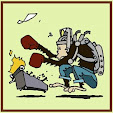
Some of my more regular readers may know that for the past year or thereabouts my attention has been taken up by many things domestic and creative, and deputy chief among these is this chap here, Albert Otter. I’m delighted to announce that after eight months of evenings and occasional weekends wrestling with a pretty new medium, my illustrations for David Haywood’s wonderful story The Hidden Talents of Albert Otter are now on the eve of publication. The book is rit, the pics are drwnd. I have enjoyed a sleep like no other for a good week or so now.

The project was long in execution and had some build-up. I initially contacted David through his blog after his call for an artist for a previous project, on which we made some headway before the very early arrival of Jet Junior meant my complete attention and energy were needed elsewhere for the foreseeable future. That illustration project went no further, and in the interim David completed his second book, the scurrilous and outrageous NZ Reserve Bank Annual 2010. I missed the Parliamentary launch but gate-crashed his setting up for the signing at Arty Bees to say Hi and (hopefully) reconnect as things domestic had settled down considerably. Gracious and welcoming as ever, David offered me a copy of the book and said he had a new project in mind and would I be interested? A few days later he revealed it was to be Albert (of course it would be Albert!), and we set to work, gradually planning the look and feel of the book.

David was initially interested in an Oliver Jeffers approach (though not a slavish copy of course), while I’d imagined something Beatrix Potter-ish. I think we struck a happy medium, and in the event David’s feedback throughout has been positive, helpful and insightful. Readers of David’s blog will of course know that his home is among those in one of the worst-hit areas of the Christchurch quake zone, so his patience and encouragement are, in my opinion, absolutely heroic. And now, scarping on the good side of a deadline the book is done – hooray!

For a better look inside I urge you to visit the preview pages at Public Address Books.
More details on availability are there.

Thanks to David and his family and of course my family for their patience and stoicism over the last eight months, and to those generous friends who’ve already put orders in!

Thursday, October 21, 2010

Talkin' Eds - Brave New World (2000)

Iron Maiden have reformed, and it’s an interesting thing. Most band reunions take place over a short space of time and are generated around a particular event – a tour, a Best Of album or perhaps an appearance borne from other media – say, a movie appearance. Maiden’s is different, as much as the band itself are different to many about at the time or since. Bruce Dickinson has had a pretty good solo career, and Adrian Smith too has enjoyed collaboration with other musicians and the chance to flex his considerable talent; but over the time of their respective absence from the main band things have changed. The band has got older, the brand itself has aged and music – heavy metal in particular, has evolved. Blaze has come and gone. All of this is evident and has been covered in previous posts, but what bears repeating from those for me is that the writing of Steve Harris, to date still the core and main writer for Iron Maiden, has also changed. His compositions – never simple in the first place, have by and large lengthened, involving fewer tricky time changes and more slow-build; his lyrics have moved on from the Hammer Horror stock of the past and embraced the subjects of a maturing man. There’s much more of this to come over Maiden’s most recent (last?) three full studio albums, but for the moment the band’s ‘comeback’ album has the unenviable challenge of acknowledging the past, and marking time as it looks to a future with the biggest line-up it’s ever had.

I love the fact that despite Smith’s return Maiden have retained Janick Gers. It seems only fair – in 2000 he’d already served more time than Smith had in years and only two albums shy to equalise him. Like Smith he’s had a hand in writing and composing too, significantly changing the sound of the band. Brave New World is as much a product of Gers’ time in Maiden as any of his previous records, although it seems the dynamics of three guitarists on stage at once are themselves a developing thing for live Maiden. Early shows for the reunited band carried reviews that reduced Gers to backing guitar, or class-clown with his now trademark antics of throwing his instrument and dancing with it to fill in the gaps as it were. On the album however the roles change.

Brave New World does open on a tease, mind. The Wicker Man is one of a small number of traditional Maiden songs, and you’d be forgiven for thinking its position in the track listing is as Trojan Horse – all the old Maiden hallmarks are there: fast pace, sing-along chorus, horror movie trappings. It’s a cheat though – Harris’ “Your time has come!” catch cry isn’t directed at the song/movie’s unwilling sacrifice, but the band’s new audience of young listeners accrued in the previous decade and seemingly entering this new millennium at the height of their potential – “hand of fate is moving and the finger points to you/ He knocks you to your feet and so what are you gonna do?” After ten years of railing against a changing world around him Harris is passing the baton to the next generation.

From there on Brave New World settles in, an exploration of the musical developments of the past three albums, with the essential reinjection of two of its greatest assets. This is a good album, and one from a band who know what they are, confident in a very strong fanbase (particularly in Europe and South America, who would be repaid the debt in the monumental CD and DVD Rock in Rio the following year). The songs have greater space and less gallop than Classic Maiden, but are the stronger for this, I think. Oddly, it’s the fillers – The Mercenary, The Fallen Angel and possibly The Wicker Man, which evoke the band of old and stand out as being a little less than the maturer efforts of, say, Blood Brothers and the album’s title track. At risk of repeating myself, the album does slow somewhat towards the end – Iron maiden seem to have an issue with album length and often err on the side of too long. Perhaps it’s the newer slow-build approach that affects the last three tracks, but each of them The Nomad (clunky beginning and dodgy lyrics but a beautiful instrumental section), Out of the Silent Planet and The Thin Line Between Love and Hate show that there’s still time for the band to look again at track arrangement. For the most part the albums are better paced from here, though this is by no means a poor effort. It’s a great return to form, and in that, not an entire return at all, which is all the better.

I bought the previous compilation CD Best of the Beast after chancing across the band performing The Wicker Man on Top of the Pops , of all places. It’s a mimed playback, alas – a far cry from the ragged and punchy live band debut of years ago, but it did the job. The band were older, Bruce had cut his hair and divested himself of the studded gauntlets of his heyday, but my partner and I were suitably impressed.

Cover Art
If you look carefully there’s the ghost of Derek Riggs in here somewhere – or rather, the ghost of his Eddie, the remaining (and apparently unauthorised) use of an earlier mock-up cover he’d done for the Wicker Man single. I’m not enthralled by this album cover, mainly because it’s just not an Iron Maiden cover – it’s static, scenic, and Eddie’s once again pushed to the background. The days of the band mascot being the star feature are now gone. On the back the boys stand in a field of weather balloons (used in the official video for The Wicker Man here). Ooh, haven’t they aged well?

Album tracks
The Wicker Man (Rock in Rio version - non-album intro!)
Ghost of the Navigator (Rock in Rio version)
Brave New World (Rock in Rio version)
Blood Brothers (Rock in Rio version)
The Mercenary (Rock in Rio version)
The Dream of Mirrors (Rock in Rio version)
The Fallen Angel (live in Argentina)
The Nomad (fan video using Hildago footage)
Out of the Silent Planet (album version, official video cuts off the intro)
The Thin Line Between Love and Hate

Friday, October 15, 2010

Brother

My discovery of Tolkien was chiefly through my brother. Like a lot of younger siblings I suppose, I idolised my elder ones – him in particular, and spent many of my earlier years hanging on his every word. Things changed, as they inevitably do when we both became older and in turn desired more personal space, literally and figuratively. But for five or six years we shared a room and lived in each other’s heads, after a fashion. Second-hand I learned about machines, history (wars, mainly), school ground politics and the exploits of his friends (who all seemed so much more daring and clever and funny than mine). I learned about which music was best and what happened in movies I wasn’t allowed to stay up and watch, and in the dim orange bedside lamplight of our room I learned scarier things too. The "Bomb" that mankind had made which could destroy anything, but couldn’t be disposed of itself (“you couldn’t even shoot it into space”), and of course I was told the story of The Lord of the Rings.

This is the edition we had at home – bought, I think, by him as a school prize in third form. The cover drew me in, seemingly infinite in perspective and possibility – a window into a mountainous and green world framed by arching trees, with strange creatures (Gollum?) playing among their roots. The potted version of the story I was told had Gandalf the Wizard, a Hobbit called Frodo and a creature called Gollum who plotted secretly to himself to steal back the Ring, and a cool Elf called Legolas. And it had Orcs “evil things like goblins, but with faces like a mix of men and animals”, and their shadowy overlord “Soaron”, the real Lord of the Rings who watched over everything in a tower on the other side of Middle Earth. Expressive gesticulating hands casting shadows over the bedroom walls, and increasingly hushed tones after the lights went out; somehow it’s this version which has stayed with me – gripping, imaginative, as full of possibility as that book jacket, far more than the book I eventually read and read again, or the film adaptations I watched. None of them conveyed the same mystery or creepiness or heroism that my brother was able to over those summer nights, not long before we’d move into our own rooms and everything would change again.

In times to come I’d be relayed more stories – synopses of whatever he’d been watching – Monty Python, Rocky Horror, The Who’s Tommy, and after that his D&D games with some of those self-same schoolmates (God how I envied him!) All of them eventually discovered by me in time, but somehow diminished with it. First time is always the best, and so many of them never lived up to those early lights-out re-tellings. I still think he's one of the best storytellers I know, and so this post is for him.

Happy birthday, big brother.

Wednesday, October 6, 2010

(Another Very Special) Talkin' Eds - Viral XI!

As mentioned earlier, Virtual XI was a real disappointment to me, featuring some poor song choices, particularly in light of some stronger songs preceding the album in the single Virus and a couple of original B-Sides from The X Factor. Angel and the Gambler kills the album early from its length, and the whole virtual reality inspired name dates it even for 1998. So with no more ado, I present: Viral XI!

No more football theme - this album really has eleven tracks!

And a Derek Riggs cover (taken from the poster for Futureal)!

Angel and the Gambler is still here, but shorter!

Album Tracks

Virus
Futureal
Judgement Day
Lightning Strikes Twice
The Angel and the Gambler (single edit)
The Clansman
When Two Worlds Collide
The Educated Fool
Justice of the Peace
Don't Look to the Eyes of a Stranger
Como Estes Amigo

Thursday, September 30, 2010

Talkin' Eds - Virtual XI (1998)

Okay, I'm going to keep this brief. In my opinion Virtual XI is the worst Iron Maiden album so far. Unlike The X Factor I don't think its reputation can be saved by calling it a side-project for Steve Harris and his friends - this one is just not a great collection of material. Collectively it's the sound of five pairs of eyes being taken off the ball, to borrow a football metaphor - and why not, as of course Harris himself decided to here

But first, a matter of catching up. Iron Maiden haven't been idle since album number ten, having put out The Best of the Beast - my re-entry into their canon, as it were, and with it the non-album single Virus. Virus is Harris’ answer to critics of the band’s recent direction and despite a rather rough video is a pretty decent song for this era, recalling bits of Edge of Darkness and Metallica’s One in the intro. The main guitar again has the weird, thin overdub sound referred to in The X Factor, and it returns on Virtual XI, a number of songs from which sadly don’t meet the standard set by Virus or the album before it. Did Harry burn himself out with that one song, I wonder?

XI certainly starts reliably enough, with the pre X Factor quickfire opening track reinstated. Futureal is one of two songs here which survived the Bayley era for a while and still goes down well. It’s an energetic, spiralling song which doesn’t outstay its welcome. It’s immediate successor does, however, and is probably the biggest, ugliest nail in the album’s coffin. The Angel and the Gambler is Iron Maiden doing a crowd opening stadium song, years after they perfected such tracks. The result is a plodding, hackneyed and overlong mess with a really really really repetitive filler trio of lines (‘don’t you think I’m a saviour, don’t you think I can save ya, don’t you think I can save your life” – around 21 times in succession). It’s simply too much, and its Superbowl keyboard stabs punctuating the verses kill any attempt at ‘rock’. Oh, its video references the sleeve for Stranger in a Strange Land, by the way. Dave Murray’s Lightning Strikes Twice is mostly good, with the main weaknesses being the verse to chorus leads in and a dated guitar rhythm. Plus the song is about… lightning striking. It’s not asking too much, but in the wake of outside criticism of a new lead singer I’d imagine that a reasonably decent composition like this with a gift of a song title could have had farther reaching lyrics to match – maybe, I dunno, thematically addressing the possibility that another great frontman for the band could be a possibility? Instead it, like Angel, is detached from the album at large – it’s the second filler song in a row. Things pick up with The Clansman, another ‘epic’ song based around the story of William Wallace, probably. Well, based on the recollections of someone who once saw Braveheart perhaps. There’s more lazy songwriting here with harks to ‘the land of the free’ and biscuit tin Highlands ‘they’re taking our land/that belongs to the clans’ – the sort of thing Irvine Welsh called ‘Jocksploitation’. It’s a shame, because Bayley clearly believes in the song and it served him well, as it did Janick Gers’ rather soulful into. Clansman is the second survivor of the album, and has probably aged better as a live song for it.

I’m coming down hard on the lyrics and composition of Virtual XI mainly, but I have to say I’m not impressed by the production either. The album was made using Pro Tools, and it has a shallowness to it that exacerbates the impression that for a lot of the songs there seems to be only one guitar really working. I’m not sure what’s going on, but Maiden’s signature twin guitars have fled the studio by this album, and the result means that these track in particular sound overlong and over linear. I mean absolutely no pretence or ambition in saying they sound like something I could have composed in my band days – and I was a rubbish composer. When Two Worlds Collide is a prime example – maybe the worst song on the album for boneheaded lyrics (it’s about an approaching asteroid, not a planet) and very straight structure that again does Bayley no favours. The Educated Fool is where Harris opens up a little more and has become a highlight for me. It’s still not great in all, but does have a variety in touch that makes you forget the songs before. Don’t Look To The Eyes of a Stranger is a Killers-era theme which could have been shorter and would have been better for it. At last, and the last song of Blaze’s days, is Como Etsais Amigo, co-written again with Gers and after nearly an hour’s inane plodding it serves to end the record on a dignified note. Initially about the Falklands War (though not actually about the war but the need for rebuilding friendship afterwards), I can’t hear it without imagining it as a fitting farewell to Bayley himself as frontman. Probably the best song on the album.

I don’t know much about Virtual XI’s creation, but I’m guessing it wasn’t good. The album was launched alongside a themed video game (never a good idea) Ed Hunter and images from that litter the booklet along with the aforementioned football shots and merchandise offers. We’re a long way away from the young chancers posing in the London Dungeons or in the sun-drenched Barbados. Distracted, tired, and maybe looking for an escape clause, I just don’t think Maiden were trying hard enough here, and it shows.

Cover Art

Mind you, it's not all bad. Melvyn Grant, the artist responsible for the cover art Fear of the Dark does a decent job here is bringing together the disparate elements of 'Arry's shopping list - here's Eddie in blood-red bestial glory, a virtual reality machine (maybe ten years out of fashion but hey ho), and finally some of yer actual football being played. The band feature in the liner booklet also in football strips, so this is an indulgence of the soccer-mad Harris clearly being played out. Interestingly Derek Riggs' name seems to have still been on Maiden's rolodex as he had a stab at the album cover too (look out for it next post), but Grant's does the trick well enough, and while Riggs' is reliably good, maybe it references his past work a little too much.


Album Tracks

Futureal
The Angel and the Gambler
(4-minute version)
Lightning Strikes Twice (album version)
The Clansman (album version, bad fan art?)
When Two Worlds Collide (live , and better for being faster!)
The Educated Fool (live, Canada)
Don’t Look to the Eyes of a Stranger (album version)
Como Estais Amigo (album version)

"Which will it be?"

I reckon that Generation X is to date the last generation to play Cowboys and Indians as children. Lots of elements probably fed the genre's popular demise - urbanisation and the urbanisation of its motifs and archetypes (perhaps most potently in the figure of The Man With No Name turning into Harry Callahan), the emergence of Sci-Fi as a popular cinematic genre in the Seventies, shifting cultural identity in an increasingly mutlicultural United States... and possibly bigger and more obvious reasons than those which occur to me now.

Consequently the Westerns of my childhood were largely from off the TV - shows like Gunsmoke, The Virginian, Bonanza, The Lone Ranger and their ilk. There were very few Western movies I recall watching with interest, and few which stuck with me. I properly discovered Westerns in my university Film Studies course, and only then realised what I'd dismissed or simply not seen.

Having said that, I still haven't seen a lot of Westerns, but I do count some of them among my all-time favourite movies. So I was really excited to hear that one of those, which I fondly recall watching around the age of nine or ten, has been remade by the Coen Brothers:


If you've not seen the original, hell, why not just watch its trailer below and have the whole thing pretty much told to you in hilarious style. I'm guessing the 2010 revision will be less on the lightness and a more ponderous piece, which isn't to discount the original at all. True Grit's a great story, and the Duke deserved the Oscar he got for bringing Rooster Cogburn to life on the big screen. Roll on, December...


And seriously, how cool is Wayne in that last confrontation?

Monday, September 20, 2010

Talkin' Eds - The X Factor (1995)

1995 In Heavy Metal

Heavy Metal is dead. Its Glam and Speed successors have similarly come and gone – Metallica and Anthrax have gone grunge and the future, it appears, is in Death, Goth, Industrial and Nu-Metal. In the same year of The X Factor Slipknot and Korn form, and Nine Inch Nails and Killing Joke are also on the scene, also informing some of the mood for Nineties heavy music.

The X Factor, Maiden’s tenth studio album is a reaction to the changing scene, and arguably the last time the band audibly change with the times. On a personal level it’s fed by events in Steve Harris’ own personal life (a divorce and the death of his father) and the world around him. With Bruce Dickinson having left the band, Harris seems to have drawn a line under the band of the past and sought a new sound with the enthusiastic and agreeable (and less fractious) Blaze Bayley as his helmsman. The resulting album is dark, less self-knowing than previous efforts, and inescapably introspective. The ‘X’ moniker is a useful peg on which to hand the whole project, offering as it does many interpretations – X being the Roman numeral ten of course, X the unknown, X the cross of suffering, faith and perhaps salvation. More so than previous albums I get the sense that The X Factor is actually trying to be something other than another set of songs for the band’s fans, and to a degree it works as that, however those same fans received it at the time. I quite like this album, but it’s not a party album, or maybe even one for company. Is it an Iron Maiden album? I still don’t know. It may be that it would have gone down better as a side project under a different name – in some corners it wasn’t received well at all, Kerrang! Magazine going as far as inviting a very real thrashing by Harris for blithely dubbing it ‘a novelty record’. Nevertheless, The X Factor is important Maiden history, and a significant album in the band's canon.

The Album

The album opens strongly, as most Maiden efforts do, but eschew the standard fast-paced potboiler for a long narrative, The Sign of the Cross, wrought around a condemned man during the inquisition and musically recalling the slow build-up of Somewhere in Time's Alexander the Great. As I indicated in that review, this is the version I prefer, with some new and uncharacteristic sounds adding great atmospehere - Gregorian-styled chant for one, with bayley's opening vocals not appearing until well into the second minute. It's an impressive start and an immediate highlight with some of Dave Murray's best lead guitar in the hird acts and, rouding things off, bayley closing the song and the instruments fade around him. It's a fantastic gesture of faith by harris in his new vocalist to allow him to carry the most important track of a new album alone, and it pays off. The following two songs are more traditional in style and tempo - Lord of the Flies once again takes its cue from literature, in this case William Golding's novel, while Man on the Edge is lifted directly from Joel Shumacker's cinematic tour de force Falling Down. And then the album begins.


As said before, if there's an overall theme to The X Factor it's an internal one, Maiden's darkest album to date being far-removed from the cartoon bogeys of Number of the Beast and its ilk, and set most often in the mindset of its songs' protagonists - prisoners, soldiers, doubters, unbelievers and loners. There's melancholy, particularly in the beautiful and simple 2am, outrage in Blood on the World's Hands (informed by the Balkans conflicts), and even horror, as effectively conveyed in the album's clear nod to Coppola's Apocalypse Now, Edge of Darkness.

Throughout Bayley's voice maintains a level growl, an early indicator of his range, certainly, but very much suited to the atmosphere of the album. Compositionally the instruments favour the bottom-end - bass and drums (nicely recorded) are at the fore. Lead guitar is mixed – Dave Murray is strong, but if the rhythm duties are Janick Gers, then the thin, overdubbed treatment given here does him no favours. There's minimal keyboard, and ample use of simple guitar picking - lead-in arpeggios, an indulgent but well-times bass intro for Blood, and the aforementioned 2am's solo by Gers, recalling his work on Wasted Love, providing an effortless and expressive break mid-song. In the first of a couple of notable collaborations Maiden's two most recent members show that they are a great team.


Lyrically the album is a step up as well, with some sensible lyrics in comparison to come of Fear of the Dark's clangers - I particularly like The Aftermath's stab at the likes of Owen or Sassoon, and while Darkness pretty much makes a case for plagiarism from Coppola's script wholesale, it is what it is and isn't pretending to be anything but. In all I find The X Factor pretty strong as an album, despite some limited vocal range and two adjacent intros (Fortunes of War/Look For the Truth) that resemble one another perhaps a little closely. As a Blaze album it's his best - sensitively recorded and playing to his strengths. Sadly, it's downhill from here.

Unusually, The X Factor over-ran in its original compositions, resulting in three extra tracks being released as B-sides, two of which also appear on the Best of the B’sides collection.

Cover Art
A radical departure of course, being a photo of Eddie in verus vita to intents and purposes. But intent aside, this is a deeply unpleasant image both for striving to be lifelike, and in the unrelenting violence depicted. That might seem a slightly overwrought criticism – it’s a model Eddie after all, and therefore a model of a fantasy character; however the attempt to make Eddie ‘real’ succeeds too well in removing the cartoon aspect of the mascot (Eddie doesn’t even have his hellfire eyes, but human ones), and the result is just not nice to look at. Furthermore, I think rather than inviting listening of the album, it puts the would-be buyer off, either because the subject matter is too sensitive, or possibly because despite the aforementioned realism of the piece, it’s still cartoon enough to look juvenile at the same time. What a pity a black album cover had already been done so recently and recognisably by a more successful metal act.

Apparently an alternative ‘wide angle’ shot was made available to satisfy more squeamish markets. It’s the less provocative of the two, and the one I’ve opted for. I like the clouds in that version as well, and the crossed girders behind Eddie’s electric chair carry the ‘X’ theme effectively. Ultimately however, this is a failed cover to my mind – too realistic to dismiss outright as fantasy, yet too tied to its ‘metal’ roots to convey the true sense of departure. In all a painted Riggs-alike cover would be preferable, but that said, The X Factor still doesn’t have the worst Iron Maiden album cover ever!

Album Tracks via YouTube
The Sign of the Cross
(bonus: fan video with Dickinson vocals based on The Name of the Rose)
Lord of the Flies
Man on the Edge

(bonus: fan video based on Falling Down)
Fortunes of War
Look for the Truth
The Aftermath (live B-side version)
Judgement of Heaven
Blood on the World’s Hands (live - Sao Paolo?)
Edge of Darkness
(bonus: fan video based on Apocalypse Now)
2am
The Unbeliever